\(\dfrac{^{x^4}+y^4}{2}\ge\dfrac{x+y}{2}\times\dfrac{x^3+y^3}{2}\)

Những câu hỏi liên quan

Chứng minh các bất đẳng thức sau với x, y, z > 0
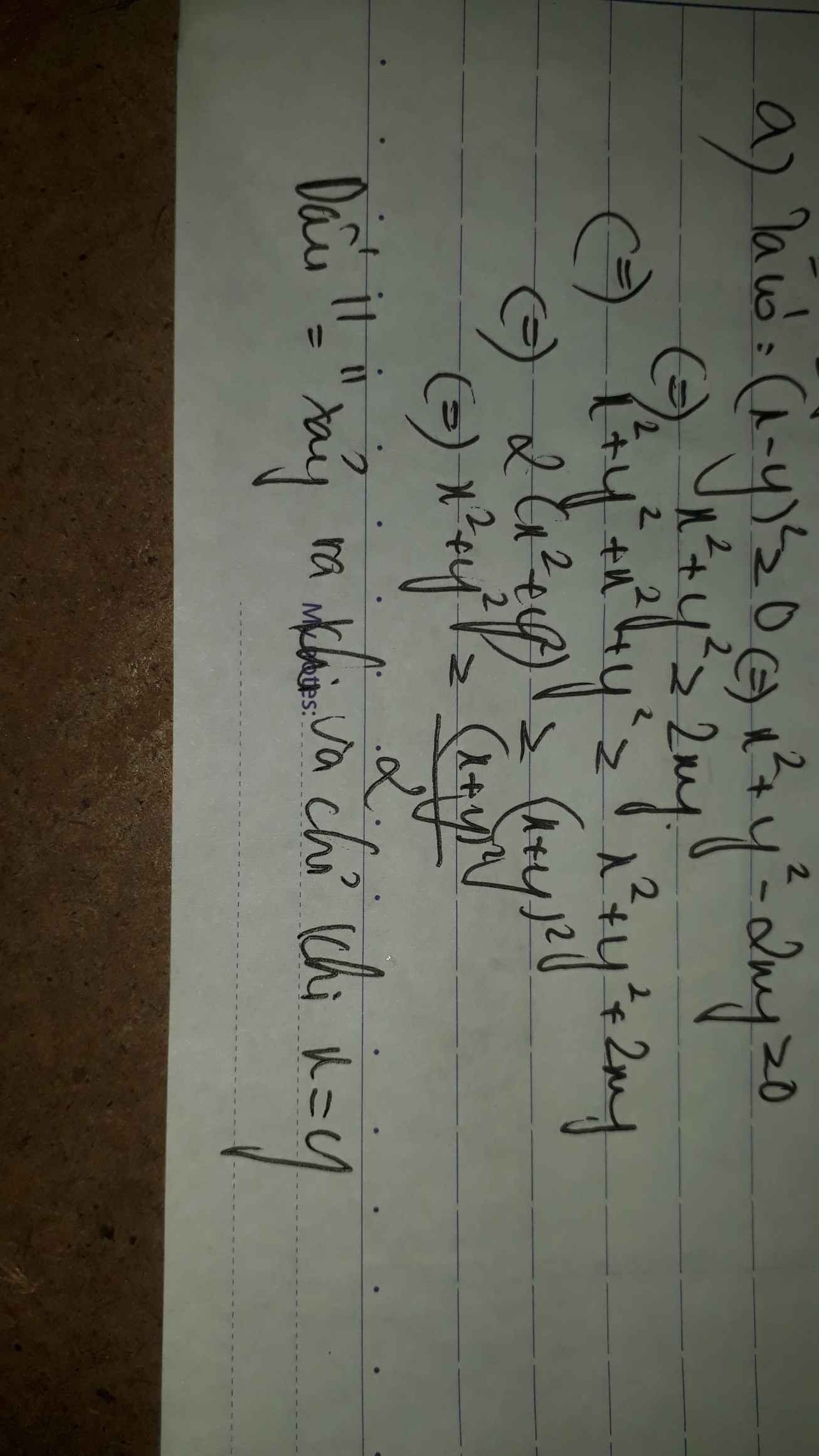
a) \(x^2+y^2\ge\dfrac{\left(x+y\right)^2}{2}\)
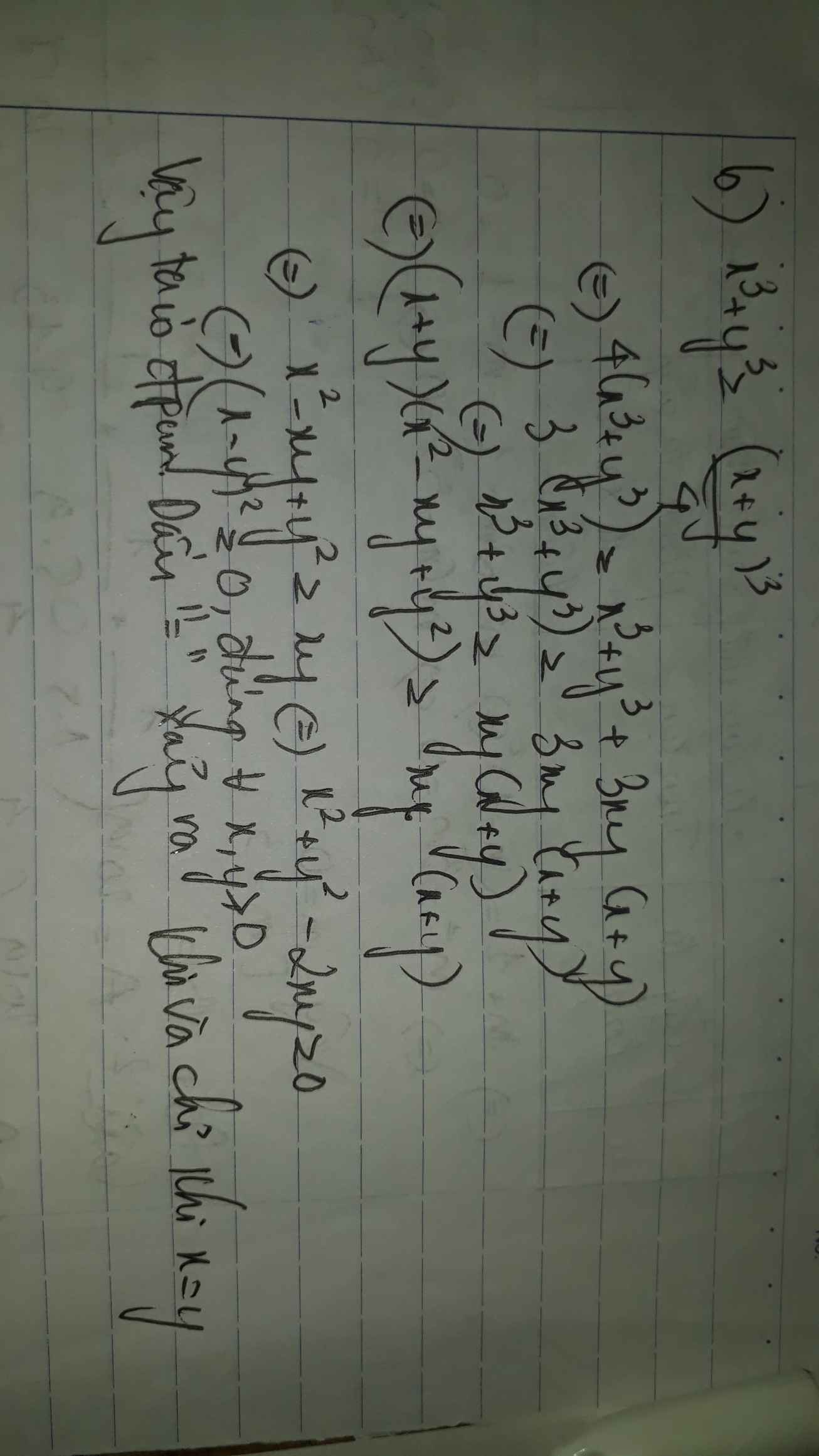
b) \(x^3+y^3\ge\dfrac{\left(x+y\right)^3}{4}\)
c) \(x^4+y^4\ge\dfrac{\left(x+y\right)^4}{8}\)
e) \(x^2+y^2+z^2\ge\dfrac{\left(x+y+z\right)^2}{3}\)
f) \(x^3+y^3+z^3\ge3xyz\)



a) \(x^2+y^2\ge\dfrac{\left(x+y\right)^2}{2}\)
\(\Leftrightarrow2x^2+2y^2\ge\left(x+y\right)^2\Leftrightarrow x^2+y^2\ge2xy\)
\(\Leftrightarrow x^2-2xy+y^2\ge0\Leftrightarrow\left(x-y\right)^2\ge0\left(đúng\right)\)
b) \(x^3+y^3\ge\dfrac{\left(x+y\right)^3}{4}\)
\(\Leftrightarrow4x^3+4y^3\ge\left(x+y\right)^3\Leftrightarrow3x^3+3y^3\ge3x^2y+3xy^2\)
\(\Leftrightarrow3x^2\left(x-y\right)-3y^2\left(x-y\right)\ge0\)
\(\Leftrightarrow3\left(x-y\right)\left(x^2-y^2\right)\ge0\Leftrightarrow3\left(x-y\right)^2\left(x+y\right)\ge0\left(đúng\right)\)
Đúng 1
Bình luận (0)


a: Ta có: \(x^2+y^2\ge\dfrac{\left(x+y\right)^2}{2}\)
\(\Leftrightarrow2x^2+2y^2-x^2-2xy-y^2\ge0\)
\(\Leftrightarrow x^2-2xy+y^2\ge0\)
\(\Leftrightarrow\left(x-y\right)^2\ge0\)(luôn đúng)
Đúng 1
Bình luận (0)


Xem thêm câu trả lời

dfrac{x^2}{y+z}+dfrac{y^2}{z+x}+dfrac{z^2}{x+y}
do x,y,z≥0 nên x2≥0 , y+z≥0
áp dụng bất đẳng thức cosi cho 2 số dương dfrac{x^2}{y+z} và y+z/4
x^2/y+z +(y+z)/4≥2sqrt{dfrac{x^2}{y+z}.dfrac{left(y+zright)}{4}} x (1)
y^2/x+z+(x+z)/4≥2sqrt{dfrac{y^2}{x+z}.dfrac{x+z}{4}} y (2)
z^2/y+x+(y+x)/4≥2sqrt{dfrac{z^2}{y+x}.dfrac{y+x}{4}} z (3)
từ (1)(2)(3)
➜dfrac{x^2}{y+z}+dfrac{y^2}{z+x}+dfrac{z^2}{x+y}+(y+z/4)+(z+x)/4+(x+y)/4 ≥ x+y+z
⇔dfrac{x^2}{y+z}+dfrac{y^2}{z+x}+dfrac{z^2}{x+y} +(a+b+c)/2 ≥x+...
Đọc tiếp
\(\dfrac{x^2}{y+z}+\dfrac{y^2}{z+x}+\dfrac{z^2}{x+y}\)
do x,y,z≥0 nên x2≥0 , y+z≥0
áp dụng bất đẳng thức cosi cho 2 số dương \(\dfrac{x^2}{y+z}\) và y+z/4
x^2/y+z +(y+z)/4≥2\(\sqrt{\dfrac{x^2}{y+z}.\dfrac{\left(y+z\right)}{4}}\) =x (1)
y^2/x+z+(x+z)/4≥2\(\sqrt{\dfrac{y^2}{x+z}.\dfrac{x+z}{4}}\) =y (2)
z^2/y+x+(y+x)/4≥2\(\sqrt{\dfrac{z^2}{y+x}.\dfrac{y+x}{4}}\) =z (3)
từ (1)(2)(3)
➜\(\dfrac{x^2}{y+z}+\dfrac{y^2}{z+x}+\dfrac{z^2}{x+y}\)+(y+z/4)+(z+x)/4+(x+y)/4 ≥ x+y+z
⇔\(\dfrac{x^2}{y+z}+\dfrac{y^2}{z+x}+\dfrac{z^2}{x+y}\) +(a+b+c)/2 ≥x+y+z
⇔\(\dfrac{x^2}{y+z}+\dfrac{y^2}{z+x}+\dfrac{z^2}{x+y}\) ≥ (x+y+z)/2
⇔\(\dfrac{x^2}{y+z}+\dfrac{y^2}{z+x}+\dfrac{z^2}{x+y}\) ≥1 (vì x+y+z=2)
vậy giá trị nhỏ nhất của \(\dfrac{x^2}{y+z}+\dfrac{y^2}{z+x}+\dfrac{z^2}{x+y}\) =1

Nham ko phai Nesbit, Cauchy-Schwarz ra luon
Đúng 0
Bình luận (1)

Bài 2: Tìm x:a)dfrac{x-1}{27}dfrac{-3}{1-x} c)3times x2times y vàx-2times y8b)dfrac{4}{5}-left|x-dfrac{1}{2}right|dfrac{3}{4} d)dfrac{x-1}{2005}dfrac{3-y}{2006} và x-4009y
Đọc tiếp
Bài 2: Tìm x:
a)\(\dfrac{x-1}{27}\)=\(\dfrac{-3}{1-x}\) c)\(3\times x=2\times y\) và\(x-2\times y=8\)
b)\(\dfrac{4}{5}\)-\(\left|x-\dfrac{1}{2}\right|\)=\(\dfrac{3}{4}\) d)\(\dfrac{x-1}{2005}\)=\(\dfrac{3-y}{2006}\) và x-4009=y
a: \(\Leftrightarrow\left(x-1\right)^2=81\)
\(\Leftrightarrow\left[{}\begin{matrix}x-1=9\\x-1=-9\end{matrix}\right.\Leftrightarrow\left[{}\begin{matrix}x=10\\x=-8\end{matrix}\right.\)
Đúng 0
Bình luận (0)
(giúp mình với bài này khó quá)
Bài 1: chứng minh rằng , với mọi x, y ta có :\(\dfrac{x^4+y^4}{2}\ge\dfrac{x+y}{2}\times\dfrac{x^3+y^3}{2}\)

Trước tiên ta cần chứng minh:
\(x^4+y^4\ge x^3y+xy^3\left(\forall x;y\right)\)(1)
Ở BĐT này có nhiều cách giải nhưng em giải cách thông thường thôi
BĐT(1) tương đương \(\left(x^4-x^3y\right)+\left(y^4-xy^3\right)\ge0\)
\(\Leftrightarrow x^3\left(x-y\right)-y^3\left(x-y\right)\)\(\Leftrightarrow\left(x-y\right)^2\left(x^2+xy+y^2\right)\)\(\ge0\left(\forall x;y\right)\)(tự cm nhé)
\(\dfrac{x^4+y^4}{2}\ge\dfrac{x+y}{2}.\dfrac{x^3+y^3}{2}\Leftrightarrow\dfrac{2\left(x^4+y^4\right)}{4}\ge\dfrac{(x^4+y^4)+(x^3y+xy^3)}{4}\)( luôn đúng như trên)
\(\Rightarrowđpcm\)
Đúng 0
Bình luận (2)

ta có Adfrac{1}{1+dfrac{bc}{a}}+dfrac{1}{1+dfrac{ca}{b}}+dfrac{1}{1+dfrac{ab}{c}}
đặt sqrt{dfrac{bc}{a}};sqrt{dfrac{ca}{b}};sqrt{dfrac{ab}{c}}left(x;y;zright) xy+yz+zx1
ta có Adfrac{1}{1+x^2}+dfrac{1}{1+y^2}+dfrac{1}{1+z^2}
ta cần chứng minh dfrac{1}{1+x^2}+dfrac{1}{1+y^2}+dfrac{1}{1+z^2}gedfrac{9}{4}Leftrightarrow1-dfrac{1}{x^2}+1-dfrac{1}{1+y^2}+1-dfrac{1}{z^2+1}ledfrac{3}{4}
Leftrightarrowdfrac{x^2}{x^2+1}+dfrac{y^2}{y^2+1}+dfrac{z^2}{z^2+1}gedfrac{3}{4}
mà dfrac{x^2}{x^2+1}+dfrac{y^2}{...
Đọc tiếp
ta có \(A=\dfrac{1}{1+\dfrac{bc}{a}}+\dfrac{1}{1+\dfrac{ca}{b}}+\dfrac{1}{1+\dfrac{ab}{c}}\)
đặt \(\sqrt{\dfrac{bc}{a}};\sqrt{\dfrac{ca}{b}};\sqrt{\dfrac{ab}{c}}=\left(x;y;z\right)\) =>xy+yz+zx=1
ta có A=\(\dfrac{1}{1+x^2}+\dfrac{1}{1+y^2}+\dfrac{1}{1+z^2}\)
ta cần chứng minh \(\dfrac{1}{1+x^2}+\dfrac{1}{1+y^2}+\dfrac{1}{1+z^2}\ge\dfrac{9}{4}\Leftrightarrow1-\dfrac{1}{x^2}+1-\dfrac{1}{1+y^2}+1-\dfrac{1}{z^2+1}\le\dfrac{3}{4}\)
\(\Leftrightarrow\dfrac{x^2}{x^2+1}+\dfrac{y^2}{y^2+1}+\dfrac{z^2}{z^2+1}\ge\dfrac{3}{4}\)
mà \(\dfrac{x^2}{x^2+1}+\dfrac{y^2}{y^2+1}+\dfrac{z^2}{z^2+1}\ge\dfrac{\left(x+y+z\right)^2}{x^2+y^2+z^2+3}=\dfrac{x^2+y^2+z^2+2}{x^2+y^2+z^2+3}=1-\dfrac{1}{x^2+y^2+z^2+3}\ge\dfrac{3}{4}\)
=> BĐT cầnd chứng minh luôn đúng

cho x,y >0 .CMR: \(\dfrac{x^2}{y^2}+\dfrac{y^2}{x^2}+4\) ≥ 3(\(\dfrac{x}{y}+\dfrac{y}{x}\))


Vì \(x,y>0\) nên theo bất đẳng thức Cô-si ta có: \(\dfrac{x}{y}+\dfrac{y}{x}\ge2\sqrt{\dfrac{x}{y}.\dfrac{y}{x}}=2\). Dấu "=" xảy ra <=> x = y
Đặt \(\dfrac{x}{y}+\dfrac{y}{x}=a\left(a\ge2\right)\Rightarrow a^2=\dfrac{x^2}{y^2}+\dfrac{y^2}{x^2}+2\)
Bpt \(\Leftrightarrow a^2-2+4\ge3a\Leftrightarrow a^2-3a+2\ge0\Leftrightarrow\left(a-1\right)\left(a-2\right)\ge0\)(luôn đúng vì \(a\ge2\))
Dấu "=" xảy ra <=> a = 2 <=> x = y
Đúng 0
Bình luận (0)

cho x,y,z ≥ 0, chứng minh
1)\(\dfrac{1}{\sqrt{x+y}}\ge\dfrac{4}{4+x+y}\)
2)\(\dfrac{1}{xy}+\dfrac{1}{xz}\ge\dfrac{4}{x^2+yz}\)


Chứng minh bằng phép biến đổi tương đương:
1.
\(\Leftrightarrow4+x+y\ge4\sqrt{x+y}\)
\(\Leftrightarrow x+y-4\sqrt{x+y}+4\ge0\)
\(\Leftrightarrow\left(\sqrt{x+y}-2\right)^2\ge0\) (luôn đúng)
Vậy BĐT đã cho đúng
2.
\(\Leftrightarrow\dfrac{y+z}{xyz}\ge\dfrac{4}{x^2+yz}\)
\(\Leftrightarrow\left(y+z\right)\left(x^2+yz\right)\ge4xyz\)
\(\Leftrightarrow x^2y+x^2z+y^2z+z^2y-4xyz\ge0\)
\(\Leftrightarrow y\left(x^2+z^2-2xz\right)+z\left(x^2+y^2-2xy\right)\ge0\)
\(\Leftrightarrow y\left(x-z\right)^2+z\left(x-y\right)^2\ge0\) (đúng)
Đúng 1
Bình luận (0)

\(\left(x+y\right)^2+\dfrac{2}{3}\left(x+y\right)\ge\dfrac{4\sqrt{3}}{3}\left(x\sqrt{y}+y\sqrt{x}\right)\)

Bạn lần sau chú ý ghi đầy đủ đề để được hỗ trợ tốt hơn.
$(x+y)^2+\frac{2}{3}(x+y)=(x+y)[(x+y)+\frac{2}{3}]$
Áp dụng BĐT Am-Gm và Bunhiacopxky:
$x+y\geq 2\sqrt{xy}$
$(x+y)+\frac{2}{3}\geq 2\sqrt{\frac{2}{3}(x+y)}\geq 2\sqrt{\frac{2}{3}.\frac{(\sqrt{x}+\sqrt{y})^2}{2}}=\frac{2\sqrt{3}}{3}(\sqrt{x}+\sqrt{y})$
Do đó:
$(x+y)^2+\frac{2}{3}(x+y)=(x+y)[(x+y)+\frac{2}{3}]\geq \frac{4\sqrt{3}}{3}\sqrt{xy}(\sqrt{x}+\sqrt{y})=\frac{4\sqrt{3}}{3}(x\sqrt{y}+y\sqrt{x})$
Ta có đpcm.
Đúng 1
Bình luận (0)

viết các số thực dương x,y,z thỏa mãn xyz=1,chứng minh rằng
\(\sqrt{\dfrac{x^4+y^4+z}{3z^3}}+\sqrt{\dfrac{y^4+z^4+x}{3x^3}}+\sqrt{\dfrac{z^4+x^4+y}{3y^3}}\ge x^2+y^2+z^2\)
Mọi người giúp em với em cần gấp ạ