Tìm GTNN và GTLN :
M = \(\sqrt{x-1}+\sqrt{9-x}\)
Tìm GTNN và GTLN của A=\(\sqrt{1-x}\)\(+\sqrt{1+x}\)

\(A^2=\left(\sqrt{1-x}+\sqrt{1+x}\right)^2\le\left(1^2+1^2\right)\left(1-x+1+x\right)=4\\ \Leftrightarrow A\le2\\ A_{max}=2\Leftrightarrow1-x=1+x\Leftrightarrow x=0\\ A^2=2+2\sqrt{1-x^2}\ge2\\ \Leftrightarrow A\ge\sqrt{2}\\ A_{min}=\sqrt{2}\Leftrightarrow1-x^2=0\Leftrightarrow\left[{}\begin{matrix}x=1\\x=-1\end{matrix}\right.\)
Vậy \(\sqrt{2}\le A\le2\)
Bài 1: Tìm GTNN và GTLN của \(A=123+\sqrt{-x^2+6x+5}\)
Bài 2:Tìm GTNN và GTLN của \(A=\sqrt{-x^2+8x-12}-7\)
Bài 3: Tìm GTNN và GTLN của \(A=\sqrt{-x^2-x+4}\)

Tìm GTLN và GTNN của B = \(\dfrac{x-\sqrt{x}}{\sqrt{x}-\left(x+1\right)}\)
\(B=\dfrac{x-\sqrt[]{x}}{\sqrt[]{x}-\left(x+1\right)}\)
\(B\) xác định \(\Leftrightarrow\left\{{}\begin{matrix}x\ge0\\\sqrt[]{x}-\left(x+1\right)\ne0\end{matrix}\right.\) \(\Leftrightarrow\left\{{}\begin{matrix}x\ge0\\x^2+x+1\ne0,\forall x\in R\end{matrix}\right.\) \(\Leftrightarrow x\ge0\)
\(\Leftrightarrow B=\dfrac{x-\sqrt[]{x}+1-1}{-\left(x-\sqrt[]{x}+1\right)}\)
\(\Leftrightarrow B=-1+\dfrac{1}{x-\sqrt[]{x}+1}\)
\(\Leftrightarrow B=-1+\dfrac{1}{x-\sqrt[]{x}+\dfrac{1}{4}-\dfrac{1}{4}+1}\)
\(\Leftrightarrow B=-1+\dfrac{1}{\left(\sqrt[]{x}-\dfrac{1}{2}\right)^2+\dfrac{3}{4}}\)
mà \(\left(\sqrt[]{x}-\dfrac{1}{2}\right)^2+\dfrac{3}{4}\ge\dfrac{3}{4},\forall x\ge0\)
\(\Rightarrow B=-1+\dfrac{1}{\left(\sqrt[]{x}-\dfrac{1}{2}\right)^2+\dfrac{3}{4}}\le-1+\dfrac{4}{3}=\dfrac{1}{3}\)
\(\Rightarrow GTLN\left(B\right)=\dfrac{1}{3}\left(tại.x=\dfrac{1}{4}\right)\)
Tìm GTLN và GTNN của A= 3\(\sqrt{x-1}+4\sqrt{5-x}\) với 1≤x≤5
\(A\le\sqrt{\left(3^2+4^2\right)\left(x-1\right)\left(5-x\right)}=10\)
\(A_{max}=10\) khi \(\dfrac{\sqrt{x-1}}{3}=\dfrac{\sqrt{5-x}}{4}\Rightarrow x=\dfrac{61}{25}\)
\(A=3\left(\sqrt{x-1}+\sqrt{5-x}\right)+\sqrt{5-x}\ge3\left(\sqrt{x-1}+\sqrt{5-x}\right)\ge3\sqrt{x-1+5-x}=6\)
\(A_{min}=6\) khi \(x=5\)
Tìm GTLN GTNN của P=\(\sqrt{x}+\sqrt{9-x}+\sqrt{x\left(9-x\right)}\)
\(P=\sqrt{x}+\sqrt{9-x}+\sqrt{x\left(9-x\right)}\ge\sqrt{x}+\sqrt{9-x}\)
\(\Rightarrow P^2\ge\left(\sqrt{x}+\sqrt{9-x}\right)^2=9+2\sqrt{x\left(9-x\right)}\ge9\)
\(\Rightarrow P\ge3\)
\(P_{\min}=3\) khi x=0 hoặc x=9
\(P=\sqrt{x}+\sqrt{9-x}+\sqrt{x\left(9-x\right)}\le\sqrt{2\left(x+9-x\right)}+\frac12\left(x+9-x\right)=\frac92+3\sqrt2\)
\(P_{max}=\frac92+3\sqrt2\) khi \(x=9-x\Rightarrow x=\frac92\)
\(P = \frac{x}{9 - x} + x \left(\right. 9 - x \left.\right)\)
Bước 2: Tìm đạo hàm của \(P\)\(P = \frac{x}{9 - x} + x \left(\right. 9 - x \left.\right)\)
Đạo hàm từng phần:
Đạo hàm của \(\frac{x}{9 - x}\):\(u = x , v = 9 - x \Rightarrow u^{'} = 1 , v^{'} = - 1\)\(\left(\left(\right. \frac{u}{v} \left.\right)\right)^{'} = \frac{u^{'} v - u v^{'}}{v^{2}} = \frac{1 \cdot \left(\right. 9 - x \left.\right) - x \cdot \left(\right. - 1 \left.\right)}{\left(\right. 9 - x \left.\right)^{2}} = \frac{9 - x + x}{\left(\right. 9 - x \left.\right)^{2}} = \frac{9}{\left(\right. 9 - x \left.\right)^{2}}\)
Đạo hàm của \(x \left(\right. 9 - x \left.\right) = 9 x - x^{2}\) là:\(9 - 2 x\)
Vậy đạo hàm của \(P\) là:
\(P^{'} = \frac{9}{\left(\right. 9 - x \left.\right)^{2}} + 9 - 2 x\)
Bước 3: Tìm nghiệm của \(P^{'} = 0\)\(\frac{9}{\left(\right. 9 - x \left.\right)^{2}} + 9 - 2 x = 0\)
Chuyển vế:
\(\frac{9}{\left(\right. 9 - x \left.\right)^{2}} = 2 x - 9\)
Lưu ý: Để vế phải \(2 x - 9\) dương (vì vế trái luôn dương), ta có:
\(2 x - 9 > 0 \Rightarrow x > \frac{9}{2} = 4.5\)
Nhân hai vế với \(\left(\right. 9 - x \left.\right)^{2}\):
\(9 = \left(\right. 2 x - 9 \left.\right) \left(\right. 9 - x \left.\right)^{2}\)
Đặt \(t = 9 - x\), khi \(x > 4.5 \Rightarrow t = 9 - x < 4.5\).
Thay \(x = 9 - t\):
\(9 = \left(\right. 2 \left(\right. 9 - t \left.\right) - 9 \left.\right) \cdot t^{2} = \left(\right. 18 - 2 t - 9 \left.\right) t^{2} = \left(\right. 9 - 2 t \left.\right) t^{2}\)
Ta có:
\(9 = \left(\right. 9 - 2 t \left.\right) t^{2} = 9 t^{2} - 2 t^{3}\)
Chuyển hết về một phía:
\(9 t^{2} - 2 t^{3} - 9 = 0\)
Hay:
\(- 2 t^{3} + 9 t^{2} - 9 = 0\)
Nhân cả phương trình với -1 để thuận tiện:
\(2 t^{3} - 9 t^{2} + 9 = 0\)
Bước 4: Giải phương trình \(2 t^{3} - 9 t^{2} + 9 = 0\)Thử các nghiệm nguyên hoặc hữu tỉ:
\(t = 1\):\(2 \left(\right. 1 \left.\right)^{3} - 9 \left(\right. 1 \left.\right)^{2} + 9 = 2 - 9 + 9 = 2 \neq 0\)
\(t = 3\):\(2 \left(\right. 27 \left.\right) - 9 \left(\right. 9 \left.\right) + 9 = 54 - 81 + 9 = - 18 \neq 0\)
\(t = 4.5\):\(2 \left(\right. 4.5 \left.\right)^{3} - 9 \left(\right. 4.5 \left.\right)^{2} + 9 = 2 \cdot 91.125 - 9 \cdot 20.25 + 9 = 182.25 - 182.25 + 9 = 9 \neq 0\)
\(t = 2\):\(2 \left(\right. 8 \left.\right) - 9 \left(\right. 4 \left.\right) + 9 = 16 - 36 + 9 = - 11 \neq 0\)
Không tìm được nghiệm nguyên, dùng phương pháp đồ thị hoặc nghiệm gần đúng.
Bước 5: Tính giá trị gần đúng nghiệm \(t\)Ta có hàm:
\(f \left(\right. t \left.\right) = 2 t^{3} - 9 t^{2} + 9\)
\(f \left(\right. 2 \left.\right) = - 11\) (âm)\(f \left(\right. 3 \left.\right) = 2 \cdot 27 - 9 \cdot 9 + 9 = 54 - 81 + 9 = - 18\) (âm, chỉnh lại ở trên bị sai, đúng là -18)\(f \left(\right. 4 \left.\right) = 2 \cdot 64 - 9 \cdot 16 + 9 = 128 - 144 + 9 = - 7\) (âm)\(f \left(\right. 5 \left.\right) = 2 \cdot 125 - 9 \cdot 25 + 9 = 250 - 225 + 9 = 34\) (dương)Vậy nghiệm nằm trong khoảng \(\left(\right. 4 , 5 \left.\right)\).
Tiếp tục thử \(t = 4.5\):
\(f \left(\right. 4.5 \left.\right) = 2 \cdot 91.125 - 9 \cdot 20.25 + 9 = 182.25 - 182.25 + 9 = 9 > 0\)
Có vẻ trước đó tính sai, ta kiểm tra lại:
\(t = 4.25 \Rightarrow f \left(\right. 4.25 \left.\right) = 2 \cdot \left(\right. 4.25 \left.\right)^{3} - 9 \cdot \left(\right. 4.25 \left.\right)^{2} + 9\)\(\left(\right. 4.25 \left.\right)^{3} = 76.765625 , \left(\right. 4.25 \left.\right)^{2} = 18.0625\)\(f \left(\right. 4.25 \left.\right) = 2 \cdot 76.765625 - 9 \cdot 18.0625 + 9 = 153.53125 - + 9 = - 0.03125\)
Gần bằng 0, nghiệm ở gần \(4.25\).
Bước 6: Tính nghiệm x\(t \approx 4.25 \Rightarrow x = 9 - t = 9 - 4.25 = 4.75\)
Bước 7: Tính giá trị \(P\) tại \(x = 4.75\)\(P = \frac{4.75}{9 - 4.75} + 4.75 \left(\right. 9 - 4.75 \left.\right) = \frac{4.75}{4.25} + 4.75 \times 4.25\)\(\frac{4.75}{4.25} \approx 1.1176 , 4.75 \times 4.25 = 20.1875\)\(P \approx 1.1176 + 20.1875 = 21.3051\)
Bước 8: Xét giới hạn tại biên \(x \rightarrow 0^{+}\) và \(x \rightarrow 9^{-}\)Khi \(x \rightarrow 0^{+}\):\(P \rightarrow \frac{0}{9} + 0 \times 9 = 0\)
Khi \(x \rightarrow 9^{-}\):\(\frac{x}{9 - x} \rightarrow + \infty , x \left(\right. 9 - x \left.\right) \rightarrow 0\)
Nên \(P \rightarrow + \infty\).
Kết luận:\(P\) có một điểm cực trị tại \(x \approx 4.75\) với giá trị \(P \approx 21.3\).\(P \rightarrow + \infty\) khi \(x \rightarrow 9^{-}\).\(P \rightarrow 0\) khi \(x \rightarrow 0^{+}\).Vì \(P \rightarrow + \infty\) gần biên \(x \rightarrow 9^{-}\), nên không có GTLN hữu hạn trên khoảng \(\left(\right. 0 , 9 \left.\right)\).
Còn GTNN là khoảng \(x \rightarrow 0\) hoặc tại cực trị \(x = 4.75\).
Tìm GTNN của:
a)\(\dfrac{\sqrt{x}-1}{\sqrt{x}+1}\)
b)\(\dfrac{x+\sqrt{x}+1}{\sqrt{x}}\)
Tìm GTLN của:
\(\dfrac{1}{\dfrac{\left(\sqrt{x}+1\right)^2}{\sqrt{x}}}\)
1:
a: \(A=\dfrac{\sqrt{x}+1-2}{\sqrt{x}+1}=1-\dfrac{2}{\sqrt{x}+1}\)
căn x+1>=1
=>2/căn x+1<=2
=>-2/căn x+1>=-2
=>A>=-2+1=-1
Dấu = xảy ra khi x=0
b: 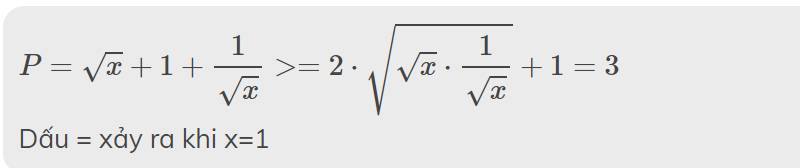
tìm GTNN; GTLN của bt:
1, A=\(\sqrt{x^2-2x+1}+\sqrt{x^2-6x+9}\)
2, B=\(\sqrt{x-2\sqrt{x-1}}+\sqrt{x+2\sqrt{x-1}}\)
Tìm đc mỗi GTNN, cách tìm GTLN chưa chắc chắn lắm nên mk ko lm nha :D
1/ \(A=\sqrt{\left(x-1\right)^2}+\sqrt{\left(3-x\right)^2}=\left|x-1\right|+\left|3-x\right|\ge\left|x-1+3-x\right|=2\)
2/ \(B=\sqrt{x-1-2\sqrt{x-1}+1}+\sqrt{x-1+2\sqrt{x-1}+1}=\sqrt{\left(1-\sqrt{x-1}\right)^2}+\sqrt{\left(\sqrt{x-1}+1\right)^2}\)
\(=\left|1-\sqrt{x-1}\right|+\left|\sqrt{x-1}+1\right|\ge\left|1-\sqrt{x-1}+\sqrt{x-1}+1\right|=2\)
Tìm GTNN, GTLN của \(P=\dfrac{\sqrt{x}-1}{x+2}\)
Tìm GTNN, GTLN cuả \(P=\dfrac{x+\sqrt{x}}{x+\sqrt{x}+1}\)
TXĐ: \(x\ge0\)
a/ Đặt \(\sqrt{x}=t\ge0\Rightarrow P=\dfrac{t-1}{t^2+2}\Leftrightarrow Pt^2-t+2P+1=0\) (1)
Ta tìm điều kiện P để (1) có ít nhất một nghiệm không âm
(*) \(\Delta\ge0\Rightarrow1-4P\left(2P+1\right)\ge0\Rightarrow-8P^2-4P+1\ge0\)
\(\Rightarrow\dfrac{-1-\sqrt{3}}{4}\le P\le\dfrac{-1+\sqrt{3}}{4}\)
(**)Để phương trình có 2 nghiệm đều âm \(\left\{{}\begin{matrix}\dfrac{2P+1}{P}>0\\\dfrac{1}{P}< 0\end{matrix}\right.\) \(\Rightarrow P< \dfrac{-1}{2}\)
\(\Rightarrow\) Để có ít nhất một nghiệm không âm thì \(P\ge\dfrac{-1}{2}\)
Kết hợp (*) và (**) ta được: \(\dfrac{-1}{2}\le P\le\dfrac{-1+\sqrt{3}}{4}\)
Vậy \(P_{min}=\dfrac{-1}{2}\) và \(P_{max}=\dfrac{-1+\sqrt{3}}{4}\)
b/ TXĐ: \(x\ge0\)
\(P=1-\dfrac{1}{x+\sqrt{x}+1}\)
Để \(P_{min}\Rightarrow\dfrac{1}{x+\sqrt{x}+1}\) đạt max, mà \(x+\sqrt{x}+1\ge1\) \(\forall x\ge0\)
\(\Rightarrow\dfrac{1}{x+\sqrt{x}+1}\le1\) \(\forall x\ge0\) \(\Rightarrow P_{min}=1-1=0\)
Để \(P_{max}\Rightarrow\dfrac{1}{x+\sqrt{x}+1}\) đạt min \(\Rightarrow x+\sqrt{x}+1\) đạt max
Mà giá trị max của \(x+\sqrt{x}+1\) không tồn tại \(\Rightarrow P_{max}\) không tồn tại
Cho \(0\le x\le1\). Tìm GTLN vầ GTNN của biểu thức:
\(M=\sqrt{x-\sqrt{x}+1}+\sqrt{\sqrt{x}-x+1}\)