xét dấu biểu thức:
\(f\left(x\right)=\frac{2x-x^2}{3+x}\)
2x-x^2/3+x
Xét dấu các biểu thức tích, thương các tam thức bậc hai
a. \(f\left(x\right)=x^2\left(2-x-x^2\right)\left(x+2\right)\)
b. \(f\left(x\right)=\frac{x^4-3x^3+2x^2}{x^2-x-30}\)

a) F(x) = \(-x^2\left(x-1\right)\left(x+2\right)\left(x+2\right)=\left(1-x\right)x^2\left(x+2\right)^2\\ \)
\(\left\{{}\begin{matrix}x^2\ge0\\\left(x+2\right)^2\ge0\end{matrix}\right.\) => dấu biểu thức chỉ phụ thuộc vào thừa số (1-x)
F(x) =0 khi x={-2,0,1}
F(x) > 0 khi x<1 và khác -2 và 0
f(x) <0 khi x> 1
Tử f(x) =x^2(x^2-3x+2) =x^2(x-1)(x-2)
tương tự a) dấu của tử phụ thuộc (x-1)(x-2)
Mẫu f(x) =x^2 -x-30 =(x-5)(x+6)
Phần hỗ trợ Lập bảng đây khó thao tác
=> viết bằng hệ {điểm tới hạn xet x={-6,0,1,2,5}
Khi => \(\left[{}\begin{matrix}x=0\\x=1\\x=2\end{matrix}\right.\)=>f(x) =0
Khi \(\left[{}\begin{matrix}x=5\\x=-6\end{matrix}\right.\) => f(x) không xác định
Khi \(x< -6\Rightarrow\left\{{}\begin{matrix}Tf\left(x\right)>0\\Mf\left(x\right)>0\end{matrix}\right.\)\(\Rightarrow f\left(x\right)>0\)
khi -6<x<1 \(\Rightarrow\left\{{}\begin{matrix}Tf\left(x\right)>0\\Mf\left(x\right)< 0\end{matrix}\right.\) => f(x) <0
khi 1<x<2 \(\Rightarrow\left\{{}\begin{matrix}Tf\left(x\right)< 0\\Mf\left(x\right)< 0\end{matrix}\right.\) => f(x) >0
khi 2<x<5 \(\Rightarrow\left\{{}\begin{matrix}Tf\left(x\right)>0\\Mf\left(x\right)< 0\end{matrix}\right.\) => f(x) <0
khi x>5 \(\Rightarrow\left\{{}\begin{matrix}Tf\left(x\right)>0\\Mf\left(x\right)>0\end{matrix}\right.\) => f(x) >0

Xét dấu biểu thức sau đây:\(f\left(x\right)=\) \(\dfrac{2x+3}{x+1}+\dfrac{x+6}{-3x-2}\)
Xét dấu các biểu thức sau :
\(f\left(x\right)=\left(-2x+3\right)\left(x-2\right)\left(x+4\right)\)
\(-2x+3=0\Leftrightarrow x=\dfrac{3}{2}\); \(x-2=0\Leftrightarrow x=2\); \(x+4=0\Leftrightarrow x=-4\).
Ta có:
Vậy \(f\left(x\right)=0\) khi \(x=\left\{-4;\dfrac{3}{2};2\right\}\).
\(f\left(x\right)>0\) khi \(\left(-\infty:-4\right)\cup\left(\dfrac{3}{2};2\right)\).
\(f\left(x\right)< 0\) khi \(\left(-4;\dfrac{3}{2}\right)\cup\left(2;+\infty\right)\).
Bài 1. Xét dấu các biểu thức sau:
1. \(f\left(x\right)=\left(x-2\right)\left(5-3x\right)\left(x^2-x+3\right)\left(x^2+2x+1\right)\left(x^2-5x+4\right)\)
2. \(g\left(x\right)=\frac{5}{1-x}+\frac{5x}{x+1}+\frac{1}{x^2-1}\)
Xét dấu biểu thức sau f(x)=\(\frac{2x\left(x+1\right)\left(x-2\right)}{\left(x-3\right)\left(6-x\right)}\)
| x | -∞ -1 0 2 3 6 +∞ |
| x | - | - 0 + | + | + | + |
| x+1 | - 0 + | + | + | + | + |
| x-2 | - | - | - 0 + | + | + |
| x-3 | - | - | - | - 0 + | + |
| 6-x | + | + | + | + | + 0 - |
| f(x) | + 0 - 0 + 0 - || + || - |

Xét dấu của các tam thức bậc hai sau đây:
a) \(f\left( x \right) = 2{x^2} + 4x + 2\)
b) \(f\left( x \right) = - 3{x^2} + 2x + 21\)
c) \(f\left( x \right) = - 2{x^2} + x - 2\)
d) \(f\left( x \right) = - 4x(x + 3) - 9\)
e) \(f\left( x \right) = \left( {2x + 5} \right)\left( {x - 3} \right)\)
a) \(f\left( x \right) = 2{x^2} + 4x + 2\) có \(\Delta = 0\), có nghiệm kép là \({x_1} = {x_2} = - 1\)
và \(a = 2 > 0\)
Ta có bảng xét dấu như sau:
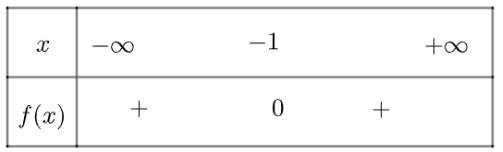
Vậy \(f\left( x \right)\) dương với mọi \(x \ne - 1\)
b) \(f\left( x \right) = - 3{x^2} + 2x + 21\) có \(\Delta = 256 > 0\), hai nghiệm phân biệt là \({x_1} = - \frac{7}{3};{x_2} = 3\)
và \(a = - 3 < 0\)
Ta có bảng xét dấu như sau:
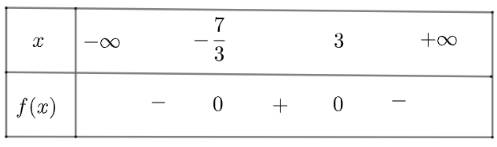
Vậy \(f\left( x \right)\) dương với \(x \in \left( { - \frac{7}{3};3} \right)\) và âm khi \(x \in \left( { - \infty ; - \frac{7}{3}} \right) \cup \left( {3; + \infty } \right)\)
c) \(f\left( x \right) = - 2{x^2} + x - 2\) có \(\Delta = - 15 < 0\), tam thức vô nghiệm
và \(a = - 2 < 0\)
Ta có bảng xét dấu như sau:
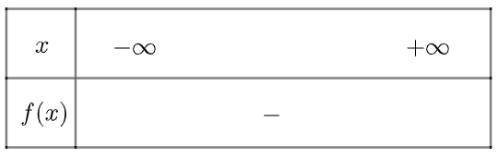
Vậy \(f\left( x \right)\) âm với mọi \(x \in \mathbb{R}\)
d) \(f\left( x \right) = - 4x\left( {x + 3} \right) - 9 = - 4{x^2} - 12x - 9\) có \(\Delta = 0\), tam thức có nghiệm kép \({x_1} = {x_2} = - \frac{3}{2}\) và \(a = - 4 < 0\)
Ta có bảng xét dấu như sau
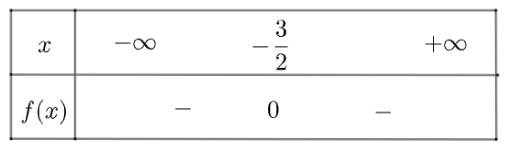
Vậy \(f\left( x \right)\) âm với mọi \(x \ne - \frac{3}{2}\)
e) \(f\left( x \right) = \left( {2x + 5} \right)\left( {x - 3} \right) = 2{x^2} - x - 15\) có \(\Delta = 121 > 0\), có hai nghiệm phân biệt \({x_1} = - \frac{5}{2};{x_2} = 3\) và có \(a = 2 > 0\)
Ta có bảng xét dấu như sau
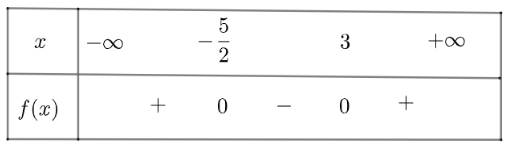
Vậy \(f\left( x \right)\) âm với \(x \in \left( { - \frac{5}{2};3} \right)\) và dương khi \(x \in \left( { - \infty ; - \frac{5}{2}} \right) \cup \left( {3; + \infty } \right)\)
Câu 1 : Xét dấu các biểu thức sau :
a , f(x) = \(\left(2x-1\right)\left(x+3\right)\)
b , f(x)= \(\left(-3x-3\right)\left(x+2\right)\left(x+3\right)\)
c , f(x) = \(\frac{-4}{3x+1}-\frac{3}{2-x}\)
d , f (x) = \(4x^2-1\)
e , f(x)= \(\left(-2x+3\right)\left(x-2\right)\left(x+4\right)\)
f , f(x) = \(\frac{2x+1}{\left(x-1\right)\left(x+2\right)}\)
g , f (x) = \(\frac{3}{2x-1}-\frac{1}{x-2}\)
h , f ( x) = \(\left(4x-1\right)\left(x+2\right)\left(3x-5\right)\left(-2x+7\right)\)
giúp mình với mình đang cần gấp
Xét dấu của các tam thức bậc hai sau:
a) \(f\left( x \right) = 2{x^2} - 3x - 2\)
b) \(g\left( x \right) = - {x^2} + 2x - 3\)
a) \(f\left( x \right) = 2{x^2} - 3x - 2\) có \(\Delta = 25 > 0\), hai nghiệm phân biệt là \({x_1} = - \frac{1}{2};{x_2} = 2\)
và \(a = 2 > 0\)
Ta có bảng xét dấu như sau:
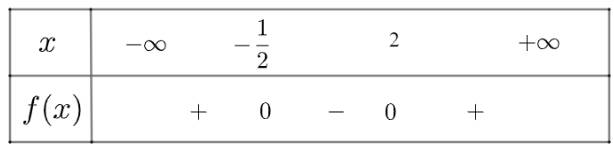
Vậy \(f\left( x \right)\) âm trong khoảng \(\left( { - \frac{1}{2},2} \right)\) và dương trong hai khoảng
\(\left( { - \infty , - \frac{1}{2}} \right)\) và \(\left( {2, + \infty } \right)\)
b) \(g\left( x \right) = - {x^2} + 2x - 3\) có \(\Delta = {2^2} - 4.\left( { - 1} \right).\left( { - 3} \right) = - 8 < 0\) và \(a = - 1 < 0\)
Vậy \(g\left( x \right)\)âm với mọi \(x \in \mathbb{R}\)
Xét dấu của mỗi tam thức bậc hai sau:
a) \(f\left( x \right) = 3{x^2} - 4x + 1\)
b) \(f\left( x \right) = 9{x^2} + 6x + 1\)
c) \(f\left( x \right) = 2{x^2} - 3x + 10\)
d) \(f\left( x \right) = - 5{x^2} + 2x + 3\)
e) \(f\left( x \right) = - 4{x^2} + 8x - 4\)
g) \(f\left( x \right) = - 3{x^2} + 3x - 1\)
a) Ta có \(a = 3 > 0,b = - 4,c = 1\)
\(\Delta ' = {\left( { - 2} \right)^2} - 3.1 = 1 > 0\)
\( \Rightarrow \)\(f\left( x \right)\) có 2 nghiệm \(x = \frac{1}{3},x = 1\). Khi đó:
\(f\left( x \right) > 0\) với mọi x thuộc các khoảng \(\left( { - \infty ;\frac{1}{3}} \right)\) và \(\left( {1; + \infty } \right)\);
\(f\left( x \right) < 0\) với mọi x thuộc các khoảng \(\left( {\frac{1}{3};1} \right)\)
b) Ta có \(a = 9 > 0,b = 6,c = 1\)
\(\Delta ' = 0\)
\( \Rightarrow \)\(f\left( x \right)\) có 1 nghiệm \(x = - \frac{1}{3}\). Khi đó:
\(f\left( x \right) > 0\) với mọi \(x \in \mathbb{R}\backslash \left\{ { - \frac{1}{3}} \right\}\)
c) Ta có \(a = 2 > 0,b = - 3,c = 10\)
\(\Delta = {\left( { - 3} \right)^2} - 4.2.10 = - 71 < 0\)
\( \Rightarrow \)\(f\left( x \right) > 0\forall x \in \mathbb{R}\)
d) Ta có \(a = - 5 < 0,b = 2,c = 3\)
\(\Delta ' = {1^2} - \left( { - 5} \right).3 = 16 > 0\)
\( \Rightarrow \)\(f\left( x \right)\) có 2 nghiệm \(x = \frac{{ - 3}}{5},x = 1\). Khi đó:
\(f\left( x \right) < 0\) với mọi x thuộc các khoảng \(\left( { - \infty ; - \frac{3}{5}} \right)\) và \(\left( {1; + \infty } \right)\);
\(f\left( x \right) > 0\) với mọi x thuộc các khoảng \(\left( { - \frac{3}{5};1} \right)\)
e) Ta có \(a = - 4 < 0,b = 8c = - 4\)
\(\Delta ' = 0\)
\( \Rightarrow \)\(f\left( x \right)\) có 1 nghiệm \(x = 1\). Khi đó:
\(f\left( x \right) < 0\) với mọi \(x \in \mathbb{R}\backslash \left\{ 1 \right\}\)
g) Ta có \(a = - 3 < 0,b = 3,c = - 1\)
\(\Delta = {3^2} - 4.\left( { - 3} \right).\left( { - 1} \right) = - 3 < 0\)
\( \Rightarrow \)\(f\left( x \right) < 0\forall x \in \mathbb{R}\)
Bài 4 Xét dấu biểu thức sau
1 , \(f\left(x\right)=x^2-3x-2-\frac{8}{x^2-3x}\)
2 , \(f\left(x\right)=\frac{1}{x+1}-\frac{1}{x}-\frac{1}{2}\)
3 , \(f\left(x\right)=\frac{x^2-4x+3}{3-2x}-1+x\)
4 , \(f\left(x\right)=\frac{x^2-1}{\left(x^2-3\right)\left(-3x^2+2x+8\right)}\)
5 , \(f\left(x\right)=x^4-5x^2+2x+3\)
6 , \(f\left(x\right)=\frac{x^2+4x+15}{x^2-1}-\frac{x-3}{x+1}-\frac{x-2}{1-x}\)
1.
\(f\left(x\right)=\frac{\left(x^2-3x\right)^2-2\left(x^2-3x\right)-8}{x^2-3x}=\frac{\left(x^2-3x-4\right)\left(x^2-3x+2\right)}{x^2-3x}\)
\(f\left(x\right)=\frac{\left(x+1\right)\left(x-1\right)\left(x-2\right)\left(x-4\right)}{x\left(x-3\right)}\)
Vậy:
\(f\left(x\right)\) ko xác định tại \(x=\left\{0;3\right\}\)
\(f\left(x\right)=0\Rightarrow x=\left\{-1;1;2;4\right\}\)
\(f\left(x\right)>0\Rightarrow\left[{}\begin{matrix}x< -1\\0< x< 1\\2< x< 3\\x>4\end{matrix}\right.\)
\(f\left(x\right)< 0\Rightarrow\left[{}\begin{matrix}-1< x< 0\\1< x< 2\\3< x< 4\end{matrix}\right.\)
2.
\(f\left(x\right)=\frac{2x-2\left(x+1\right)-x\left(x+1\right)}{2x\left(x+1\right)}=\frac{-x^2-x-2}{2x\left(x+1\right)}\)
Vậy:
\(f\left(x\right)\) ko xác định tại \(x=\left\{-1;0\right\}\)
\(f\left(x\right)>0\Rightarrow-1< x< 0\)
\(f\left(x\right)< 0\Rightarrow\left[{}\begin{matrix}x< -1\\x>0\end{matrix}\right.\)
3.
\(f\left(x\right)=\frac{x^2-4x+3+\left(x-1\right)\left(3-2x\right)}{3-2x}=\frac{-x^2+x}{3-2x}=\frac{x\left(1-x\right)}{3-2x}\)
Vậy:
\(f\left(x\right)\) ko xác định tại \(x=\frac{3}{2}\)
\(f\left(x\right)=0\Rightarrow x=\left\{0;1\right\}\)
\(f\left(x\right)>0\Rightarrow\left[{}\begin{matrix}0< x< 1\\x>\frac{3}{2}\end{matrix}\right.\)
\(f\left(x\right)< 0\Rightarrow\left[{}\begin{matrix}x< 0\\1< x< \frac{3}{2}\end{matrix}\right.\)
4.
\(f\left(x\right)=\frac{\left(x-1\right)\left(x+1\right)}{\left(x-\sqrt{3}\right)\left(x+\sqrt{3}\right)\left(2-x\right)\left(3x+4\right)}\)
Vậy:
\(f\left(x\right)\) ko xác định tại \(x=\left\{\pm\sqrt{3};-\frac{4}{3};2\right\}\)
\(f\left(x\right)=0\Rightarrow x=\pm1\)
\(f\left(x\right)>0\Rightarrow\left[{}\begin{matrix}-\sqrt{3}< x< -\frac{4}{3}\\-1< x< 1\\\sqrt{3}< x< 2\end{matrix}\right.\)
\(f\left(x\right)< 0\Rightarrow\left[{}\begin{matrix}x< -\sqrt{3}\\-\frac{4}{3}< x< -1\\1< x< \sqrt{3}\\x>2\end{matrix}\right.\)
5.
\(f\left(x\right)=x^4-x^3-x^2+x^3-x^2-x-3x^2+3x+3\)
\(=x^2\left(x^2-x-1\right)+x\left(x^2-x-1\right)-3\left(x^2-x-1\right)\)
\(=\left(x^2+x-3\right)\left(x^2-x-1\right)\)
Vậy:
\(f\left(x\right)=0\Rightarrow\left[{}\begin{matrix}x=\frac{-1\pm\sqrt{13}}{2}\\x=\frac{1\pm\sqrt{5}}{2}\end{matrix}\right.\)
\(f\left(x\right)>0\Rightarrow\left[{}\begin{matrix}x< \frac{-1-\sqrt{13}}{2}\\\frac{1-\sqrt{5}}{2}< x< \frac{1+\sqrt{5}}{2}\\x>\frac{-1+\sqrt{13}}{2}\end{matrix}\right.\)
\(f\left(x\right)< 0\Rightarrow\left[{}\begin{matrix}\frac{-1-\sqrt{13}}{2}< x< \frac{1-\sqrt{5}}{2}\\\frac{1+\sqrt{5}}{2}< x< \frac{-1+\sqrt{13}}{2}\end{matrix}\right.\)
6.
\(f\left(x\right)=\frac{x^2+4x+15-\left(x-3\right)\left(x-1\right)+\left(x-2\right)\left(x+1\right)}{\left(x-1\right)\left(x+1\right)}=\frac{x^2+7x+10}{\left(x-1\right)\left(x+1\right)}=\frac{\left(x+5\right)\left(x+2\right)}{\left(x-1\right)\left(x+1\right)}\)
Vậy:
\(f\left(x\right)\) ko xác định khi \(x=\pm1\)
\(f\left(x\right)=0\Rightarrow x=\left\{-2;-5\right\}\)
\(f\left(x\right)>0\Rightarrow\left[{}\begin{matrix}x< -5\\-2< x< -1\\x>1\end{matrix}\right.\)
\(f\left(x\right)< 0\Rightarrow\left[{}\begin{matrix}-5< x< -2\\-1< x< 1\end{matrix}\right.\)