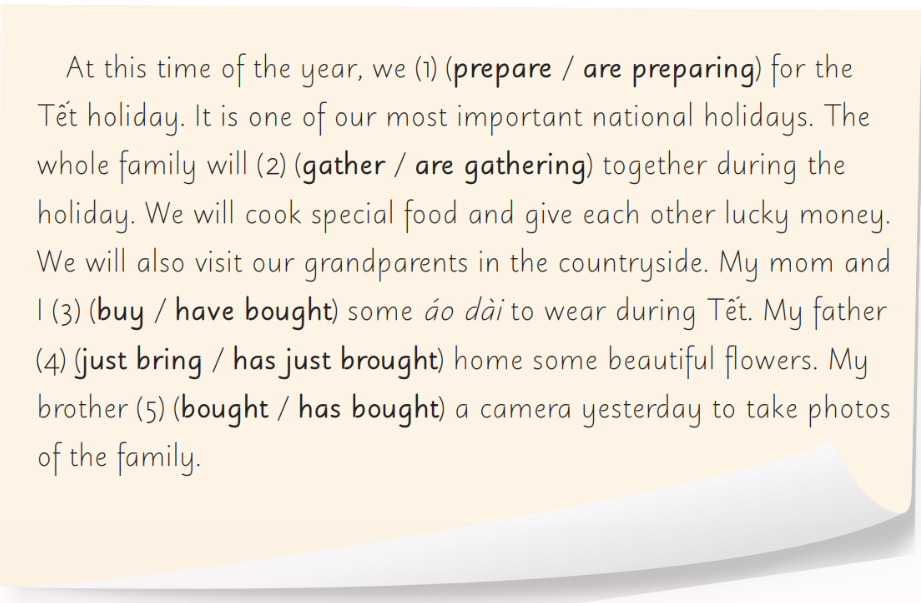
Circle the correct words to complete the paragraph below.

Exercise 2 : Circle the correct words or phrases to complete the following sentences.Exercise 2 : Circle the correct words or phrases to complete the following sentences.
1. Minh is very popular. He has got some / a lot of friends.
2. Linh is very busy. She has got some / lots of homework.
3. Put some / a lot of sugar in my tea. But not too much.
4. There are some / a lot of cars in our city. Too many. I don’t like it.
5. There is some / lots of rice left. Not much but just enough for our breakfast.
6 . I have to go to the market now. There isn’t ____some/ any___ food for our dinner.
7 . Would you like____some/ any___ sugar for your coffee? 8 . There are ___a lot of/ any___ trees in our village, so the air here is very fresh.
9 . I’ m very busy, I have__any / lots of_____ things to do today.
10. We didn’t have___any/ some__ beef left, so we had__some/ any _ fish for lunch
8 . There are ___a lot of/ any___ trees in our village, so the air here is very fresh.
9 . I’ m very busy, I have__any / lots of_____ things to do today.
10. We didn’t have___any/ some__ beef left, so we had__some/ any _ fish for lunch

1. a lot of
2. lots of
3. some
4. a lot of
5. some
6. any
7. some
8. a lot of
9. lots of
10. any, some
1 a lot of
2 lots of
3 some
4 a lot of
5 some
6 any
7 some
8 a lot of
9 lots of
10 any - some

Read the Reading Strategy. Then complete these tasks.
1 Look at question 1 in exercise 4. Read the second paragraph of the text.
2 Circle the correct option and identify the sentence of the paragraph which gives the answer.
3 Which words are used in the sentence instead of the words in the correct option?
A perfect companion
A: Hello there.
B: How are you?
A: I am doing very well. How are you?
B: Fine.
A: Glad to hear it. What's for today?
B: Nothin'.
A: Fair enough. What do you want to study?
B: I dunno.
A: You don't know what you want to study?! Lazy humans!
B: Say what I need to study.
A: You have not yet told me what you want to study.
This conversation is between a visually-impaired student, Nick, and his digital tutor named Ann Sullutor.
Ann Sullutor is the brainchild of a 22nd century scientist modelled on and named after the dedicated tutor of Helen Keller. You can have conversations with Ann Sullutor via a wristwatch or any piece of jewellery. The idea of the digital tutor was to help disabled children study in mainstream schools.
Early in the morning, Ann Sullutor wakes up from a full charge of energy, ready for a 20-hour non-stop working day. Nick is quite independent in familiar situations, but if he comes across something unexpected, he can turn to Ann Sullutor for help by using his voice to control the watch on this wrist. Similarly, if he is in an unfamiliar place, he can get directions from Ann through a tiny set of earphones. In an emergency, for example, if there is an obstacle or unexpected vehicle, Nick receives a tiny vibration as a warning. Ann sends reports to the child's parents on a regular basis or on demand.
Registered in the school system and equipped with an immense database, Ann can easily keep track of Nick's schedule and curriculum. During class, Ann gives off a warning beep when Nick is distracted, quicky converts the new material into braille or dictates what the teacher has just written on board. Ann is there to bridge the gap between Nick and his classmates. In Nick's individual sessions, Ann suggests lessons depending on his preference and ability. She can adapt the lesson to aid Nick's learning process, but she doesn't jump in immediately to offer him a hand. Nick has to work on his own for a while before Ann makes a few suggestions. She may even ask Nick to read some extra materials to get a grasp of the topic. Nick often complains about Ann's persistence and strictness. In his fury, Nick sometimes does wish to turn Ann off for a while, which can only be done by his parents.
Ann Sullutor is much more than a beautifully-designed gadget for a visually-impaired child. She can make a perfect companion to any child that needs a tutor or a friend to talk with.
Reading Strategy In a multiple-choice question, the correct option will match the meaning of the text but use different words. It is therefore important not to automatically assume that a multiple-choice option which contains words from the text is correct. |
* Câu hỏi 1 bài tập 4
1 Ann Sullutor
a is an invention of the 22nd century.
b costs a huge sum of money.
c takes a 20-hour energy charge.
d can't be controlled orally.
Thông tin: “Ann Sullutor is the brainchild of a 22nd century scientist”
(Ann Sullutor là sản phẩm trí tuệ của một nhà khoa học thế kỷ 22.)
Chọn A
Từ được dùng trong câu thay cho từ phương án đúng là: “brainchild” (sản phẩm trí tuệ) thay thế cho “invention” (sự phát minh)

6. Read the Look out! box above and the dialogue below. Circle the correct words to complete the dialogue. Then listen and check.
(Đọc hộp chú ý! ở phía trên và đoạn hội thoại phía dưới. Khoanh tròn các từ đúng để hoàn thành đoạn hội thoại. Sau đó nghe và kiểm tra.)
LOOK OUT! (Chú ý)
In affirmative sentences, much and many often sound very formal. In everyday English, we use a lot of.
(Trong các câu khẳng đinh, much và many nghe có vẻ trang trọng hơn. Trong tiếng Anh hằng ngày, chúng ta dùng a lot of.)
Jack: Look, there's a building with (1) many / some people outside. Turn left just before you get there.
Evie: I can't see (2) any / some people. There isn't (3) many / much light. Hey! What's that noise?
Jack: Nothing. There was (4) any / some rubbish in the road.
Evie: I hate this part of town. There aren't (5) a few/ many nice areas. Let's go north.
Jack: How (6) many / much fuel have we got? Only (7) a few / a little litres.
Evie: Oh no, listen. The police are chasing us now.
Jack: Let me drive. I know (8) a few/ a little tricks.
Mum: Jack, are you doing (9) any / many homework in there?
Jack: Er ... Yes. We're doing (10) a little/ much IT homework.
Evie: Jack! That's not true ...
Jack: Well, we're spending (11) a lot of/ a few time on the computer!
Evie: But we aren't doing (12) some / any work!
1.some | 2. any | 3. much | 4. some | 5. many | 6. much |
7. a few | 8. a few | 9. any | 10. a little | 11. a lot of | 12. any |
Circle the words below to make a complete sentence. .1, ........ the air is now a rerious problem in the world . A, polluted . B, pollution. C, polluting. D, pollutes. 2. She feels tired and sleepy ....... she stay up late last night. A, because. B, so. C, but. D, and. 3," I suggest .........the dripping fancets" . " Good idea " . A, fix. B, to fix. C, fixing. D, fixed. 4, I prefes dogs ........ cats I have cats . A, from. B, over. C, than. D, to
Circle the correct words to complete the Learn this! box. Use the examples in the box and the article to help you.
LEARN THIS! Separable and inseparable phrasal verbs a Two-part phrasal verbs can be separable or inseparable. With separable phrasal verbs, the object can come before or after the particle (for, up, with, etc.). We must work out the answer. OR We must work the answer out. b When the object is a pronoun (her, it, them, etc.) it can only come 1 after/before the particle. We must work it out. c With inseparable phrasal verbs, the object always comes 2 after/before the particle, even when it is a pronoun. She looks after her dad. She looks after him. d Three-part phrasal verbs are always 3 separable / inseparable. We won't run out of energy. We won't run out of it. |
| 1. before | 2. after | 3. inseparable |
LEARN THIS! Separable and inseparable phrasal verbs
a Two-part phrasal verbs can be separable or inseparable. With separable phrasal verbs, the object can come before or after the particle (for, up, with, etc.).
We must work out the answer.
OR We must work the answer out.
b When the object is a pronoun (her, it, them, etc.) it can only come 1 after/before the particle.
We must work it out.
c With inseparable phrasal verbs, the object always comes 2 after/before the particle, even when it is a pronoun.
She looks after her dad. She looks after him.
d Three-part phrasal verbs are always 3 separable / inseparable.
We won't run out of energy. We won't run out of it.
(LEARN THIS! Các cụm động từ có thể tách rời và không thể tách rời
a Cụm động từ gồm hai phần có thể tách rời hoặc không thể tách rời. Với các cụm động từ có thể tách rời, tân ngữ có thể đứng trước hoặc sau tiểu từ (for, up, with, v.v.).
Chúng ta phải tìm ra câu trả lời.
HOẶC Chúng ta phải tìm ra câu trả lời.
b Khi tân ngữ là đại từ (her, it, them, v.v.) nó chỉ có thể đứng trước tiểu từ.
Chúng ta phải giải quyết nó.
c Với cụm động từ không thể tách rời, tân ngữ luôn đứng thứ sau tiểu từ, ngay cả khi nó là đại từ.
Cô chăm sóc cha mình. Cô chăm sóc ông ấy.
d Cụm động từ ba phần luôn không thể tách rời.
Chúng tôi sẽ không cạn kiệt năng lượng. Chúng tôi sẽ không hết nó.)

IV. Read the text below. Complete the gaps (1-3) with appropriate words A-F from the box to obtain a
grammatically and lexically correct text. Fill in the gaps with appropriate letters. There are three
extra words that do not match any of the gaps.
A. invented
B. designed
C. discovered
D. planned
E. first
F. early
CALENDARS
These days, everybody uses calendars to note important dates like birthdays, but when did we start
measuring time?
Until recently, experts believed that people in the Near East made the 1) ………………..……. calendar
5,000 years ago. However, they then 2) ………………..……. an ancient site in Scotland from over
10,000 years ago. At the site, there were 12 holes in the ground. Scientists think that people
3) ………………..……. them to track the movement of the Moon and measure time. It’s an exciting discovery because it shows that people had calendars many centuries ago.
Circle the correct words to complete the Learn this! box. Use the examples in the article to help you.
LEARN THIS!
a. A three-part phrasal verb has 1one / two verb(s) and 2one / two particle(s).
b. Three-part phrasal verbs are 3transitive / intransitive (they have a direct object).
c. The object always goes 4after / before / between the two particles.
d. In questions, the three parts of the phrasal verb usually stay together.
What kind of course did you sign up for?
a. A three-part phrasal verb has 'one verb(s) and 2 two particle(s).
(Một cụm động từ ba phần từ có một động từ và 2 tiểu từ)
b. Three-part phrasal verbs are 3transitive (they have a direct object).
(Các cụm động từ ba phần tử là ngoại độn từ (chúng có tân ngữ trực tiếp theo sau))
c. The object always goes 4after the two particles.
(Tân ngữ luôn đi sau hai tiểu từ.)
d. In questions, the three parts of the phrasal verb usually stay together.
(Trong các câu hỏi, ba phần của cụm động từ thường ở cùng nhau)
What kind of course did you sign up for?
(Bạn đã đăng ký loại khóa học nào?)
Choose the correct words to complete the second paragraph. Write A, B, C or D on the answer sheet. (0.4pt) She had lots of problems with drugs and alcohol, and sometimes she couldn’t remember the words of the songs she was singing. I think she (1)________ very unhappy. The people around her in the music industry did not lift a finger to help her with her problems. She died much too young. I still remember where I was, and what I was doing when I heard the news that she (2)________.
1. A. must be B. might been C. can’t have be D. must have been
2. A. died B. was died C. dyed D. had died
Task 22: Choose the correct words to complete the second paragraph. Write A, B, C or D on the answer sheet. (0.4pt)
She had lots of problems with drugs and alcohol, and sometimes she couldn’t remember the words of the songs she was singing. I think she (1)________ very unhappy. The people around her in the music industry did not lift a finger to help her with her problems. She died much too young. I still remember where I was, and what I was doing when I heard the news that she (2)________.
1. A. must be B. might been C. can’t have be D. must have been
2. A. died B. was died C. dyed D. had died

Circle the correct words to complete the sentences.
1. We helped the farmers herd cattle / poultry.
2. Theyare helping their parents pick plants / fruit in the orchard.
3. At harvest time farmers are busy cutting and collecting food / crops.
4. The driver loaded / unloaded the rice from the back of the truck.
5. People here live by catching / holding fish from nearby lakes and ponds.
1. cattle
2. fruit
3. crops
4. unloaded
5. catching
1.
cattle (n): gia súc => herd cattle: chăn thả gia súc
poultry (n): gia cầm
We helped the farmers herd cattle.
(Chúng tôi giúp những người nông dân chăn gia súc.)
2.
plant (n): cây cối => pick fruit: hái quả
fruit (n): quả
They are helping their parents pick fruit in the orchard.
(Họ đang giúp bố mẹ hái quả trong vườn cây.)
3.
food (n): thức ăn
crop (n): nông sản => collecting crops (n): thu hoạch nông sản
At harvest time farmers are busy cutting and collecting crops.
(Vào mùa thu hoạch, những người nông dân bận rộn cắt và thu hoạch nông sản.)
4.
load (v): chất hàng
unload (v): dỡ hàng
The driver unloaded the rice from the back of the truck.
(Người tài xế dỡ lúa từ thùng hàng của xe tải.)
5.
catch (v): bắt
hold (v): cầm, nắm
People here live by catching fish from nearby lakes and ponds.
(Mọi người ở đấy sống bằng cách bắt cá từ các hồ và đầm ở gần đây.)