a.x2 + y2 + 2x - 6y + 10 =0
b. 2x2 -2xy+ y2 - 4x + 4=0
Chứng minh rằng không có các số x, y thỏa mãn
a) 2x2 +2x +1 = 0
b) x2 + y2 + 2xy +2y +2x +2 =0

a: \(2x^2+2x+1=0\)
\(\text{Δ}=2^2-4\cdot2\cdot1=4-8=-4< 0\)
Vì Δ<0 nên phương trình vô nghiệm
a) \(2x^2+2x+1=0\)
\(\Rightarrow2x^2+2x=-1\)
\(\Rightarrow2x\left(x+1\right)=-1\)
⇒ Pt vô nghiệm
b) \(x^2+y^2+2xy+2x+2y+1=0\)
\(\Rightarrow\left(x^2+y^2+2xy\right)+\left(2x+2y+1\right)=0\)
\(\Rightarrow\left(x+y\right)^2+2\left(x+y+1\right)=0\)
\(\Rightarrow\left\{{}\begin{matrix}\left(x+y\right)^2=0\\2\left(x+y+1\right)=0\end{matrix}\right.\)
\(\Rightarrow\left\{{}\begin{matrix}x+y=0\\x+y+1=0\end{matrix}\right.\)
\(\Rightarrow\left[{}\begin{matrix}x+y=0\\x+y=-1\end{matrix}\right.\)
⇒ Pt vô nghiệm
Hãy cho biết phương trình nào trong các phương trình sau đây là phương trình đường tròn:
2x2 + y2 – 8x + 2y – 1 = 0;
x2 + y2 + 2x – 4y – 4 = 0;
x2 + y2 – 2x – 6y + 20 = 0;
x2 + y2 + 6x + 2y + 10 = 0.
+ 2x2 + y2 – 8x + 2y – 1 = 0 không phải phương trình đường tròn vì hệ số của x2 khác hệ số của y2.
+ Phương trình x2 + y2 + 2x – 4y – 4 = 0 có :
a = –1; b = 2; c = –4 ⇒ a2 + b2 – c = 9 > 0
⇒ phương trình trên là phương trình đường tròn.
+ Phương trình x2 + y2 – 2x – 6y + 20 = 0 có :
a = 1; b = 3; c = 20 ⇒ a2 + b2 – c = –10 < 0
⇒ phương trình trên không là phương trình đường tròn.
+ Phương trình x2 + y2 + 6x + 2y + 10 = 0 có :
a = –3; b = –1; c = 10 ⇒ a2 + b2 – c = 0 = 0
⇒ phương trình trên không là phương trình đường tròn.
Giải phương trình:
a)x2-4x+4=0
b)2x2-x=0
c)x2-5x+6=0
d)x2+y2=0
e)x2+6x+10=0
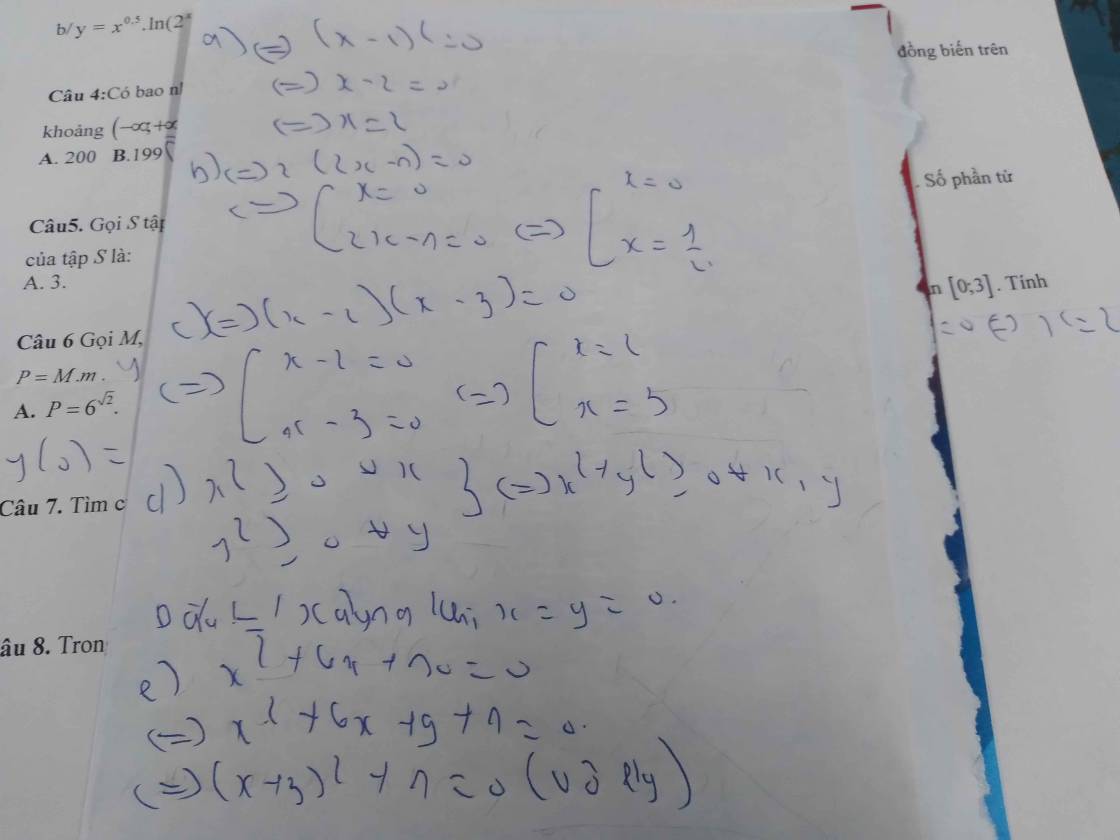
\(a.x^2-4x+4=0\)
\(\left(x-2\right)^2=0\)
=>x=2
b) \(2x^2-x=0\)
\(x\left(2x-1\right)=0\)
=> \(\left[{}\begin{matrix}x=0\\x=\dfrac{1}{2}\end{matrix}\right.\)
c) \(x^2-5x+6=0\)
\(x^2-2x-3x+6=0\)
\(\left(x-2\right)\left(x-3\right)=0\)
=> \(\left[{}\begin{matrix}x=2\\x=3\end{matrix}\right.\)
d) \(x^2+y^2=0\)
Vì \(x^2,y^2\ge0\forall x,y\)
=>x=y=0
e) \(x^2+6x+10=0\)
\(\left(x+3\right)^2+1=0\)
Vì \(\left(x+3\right)^2\ge0\forall x\)
=> VT>0 \(\forall x\)
=> phương trình vô nghiệm
a) \(x^2-4x+4=0\)
\(\Leftrightarrow\left(x-2\right)^2=0\)
\(\Leftrightarrow x-2=0\)
\(\Leftrightarrow x=2\)
b) \(2x^2-x=0\)
\(\Leftrightarrow x\left(2x-1\right)=0\)
\(\Leftrightarrow\left[{}\begin{matrix}x=0\\2x-1=0\end{matrix}\right.\) \(\Leftrightarrow\left[{}\begin{matrix}x=0\\x=\dfrac{1}{2}\end{matrix}\right.\)
c) \(x^2-5x+6=0\)
\(\Leftrightarrow\left[{}\begin{matrix}x=2\\x=3\end{matrix}\right.\) \(\left(a+b+c=0\right)\)
d) \(x^2+y^2=0\)
\(\Leftrightarrow\left\{{}\begin{matrix}x^2=0\\y^2=0\end{matrix}\right.\) \(\Leftrightarrow\left\{{}\begin{matrix}x=0\\y=0\end{matrix}\right.\)
e) \(x^2+6x+10=0\)
\(\Leftrightarrow x^2+6x+9+1=0\)
\(\Leftrightarrow\left(x+3\right)^2+1=0\left(1\right)\)
mà \(\left(x+3\right)^2+1\ge1>0,\forall x\in R\)
Nên phương trình (1) vô nghiệm
1. Tìm x,y:
a) (x+2)2 + (x-3)2 = 2x ( x+ 7)
b) x3- 3x2 + 3x - 126 = 0
c) x2 + y2 - 2x + 4y + 5 = 0
d) 2x2 - 2xy + y2 + 4x + 4 = 0
\(a.\left(x^2+4x+4\right)+\left(x^2-6x+9\right)=2x^2+14x\)
\(x^2+4x+4+x^2-6x+9-2x^2-14x=0\)
\(-18x+13=0\)
\(x=\dfrac{13}{18}\)
Vậy \(S=\left\{\dfrac{13}{18}\right\}\)
\(b.\left(x-1\right)^3-125=0\)
\(\left(x-1\right)^3=125\)
\(x-1=5\)
\(x=6\)
Vậy \(S=\left\{6\right\}\)
\(c.\left(x-1\right)^2+\left(y +2\right)^2=0\)
\(Do\left(x-1\right)^2\ge0\forall x;\left(y+2\right)^2\ge0\forall y\)
\(\Rightarrow\left(x-1\right)^2+\left(y+2\right)^2\ge0\forall x,y\)
Mà \(\left(x-1\right)^2+\left(y+2\right)^2=0\)
\(\Rightarrow\left[{}\begin{matrix}\left(x-1\right)^2=0\\\left(y+2\right)^2=0\end{matrix}\right.\)
\(\Leftrightarrow\left[{}\begin{matrix}x-1=0\\y+2=0\end{matrix}\right.\Leftrightarrow\left[{}\begin{matrix}x=1\\y=-2\end{matrix}\right.\)
Vậy \(S=\left\{1;-2\right\}\)
\(d.x^2-4x+4+x^2-2xy+y^2=0\)
\(\left(x-2\right)^2+\left(x-y\right)^2=0\)
\(\Rightarrow\left[{}\begin{matrix}\left(x-2\right)^2=0\\\left(x-y\right)^2=0\end{matrix}\right.\)
\(\Leftrightarrow\left[{}\begin{matrix}x-2=0\\x-y=0\end{matrix}\right.\Leftrightarrow\left[{}\begin{matrix}x=2\\y=2\end{matrix}\right.\)
Vậy \(S=\left\{2;2\right\}\)

a) A = x2 - 2x + 1 - y2 + 2x - 1
b) A = x2 - 4x + 4 - y2 - 6y - 9
c) A = 4x2 - 4x + 1 - y2 - 8y - 16
d) A = x2 - 2xy + y2 - z2 + zt - t2
a) A = x2 - 2x + 1 - y2 + 2x - 1
= (x2 - 2x + 1)-( y2-2x+1)
= (x-1)2-(y-1)2
= (x-1-y+1)(x-1+y-1)
b) A = x2 - 4x + 4 - y2 - 6y - 9
= (x2 - 4x + 4)-(y2+6y+9)
= (x-2)2-(y+3)2
= (x-2-y-3)(x-2+y+3)
c) A = 4x2 - 4x + 1 - y2 - 8y - 16
= (4x2 - 4x + 1) - (y2+8y+16)
= (2x-1)2-(y+4)2
= (2x-1-y-4)(2x-1+y+4)
d) A = x2 - 2xy + y2 - z2 + 2zt - t2
=(x2 - 2xy + y2)-(z2- 2zt + t2)
= (x-y)2-(z-t)2
=(x-y-z+t)(z-y+z-t)
câu d mik có sửa lại đề vì mik thấy đề hơi sai
a) A =
= x2 - y2 + 2x - 2x + 1 - 1
= x2 - y2 = (x-y) (x+y)
b) A=
= (x-2)2 - (y+3)2 = (x-y-5) (x+y+1)
c) A=
= (2x-1)2 - (y+4)2
= (2x+y+3) (2x-y-5)
d) đề có thể sai
Bài 1) a) (2x+3y)2
b) (25x2-10x+1)
c) (x2-2y)2
d) 16x2-9y2
Bài 2) Tìm GTNN của biểu thức
D= x2+2y2-2xy-6y+2x+2020
Q= 2x2-4xy+y2-4x+6y+10
Bài tập 4: CMR không có các số x, y, z thỏa mãn mỗi đẳng thức sau:
a) 2x2 + y2 - 2xy + x + 2 = 0
b) x2 + 9y2 + 4z2 - 2x + 12y - 4z +20 = 0
c) –x2 - 26y2 +10xy – 20y - 150 = 0
\(a,\Leftrightarrow\left(x^2-2xy+y^2\right)+\left(x^2+x+\dfrac{1}{4}\right)+\dfrac{7}{4}=0\\ \Leftrightarrow\left(x-y\right)^2+\left(x+\dfrac{1}{2}\right)^2+\dfrac{7}{4}=0\\ \Leftrightarrow x,y\in\varnothing\left[\left(x-y\right)^2+\left(x+\dfrac{1}{2}\right)^2+\dfrac{7}{4}\ge\dfrac{7}{4}>0\right]\\ b,\Leftrightarrow\left(x^2-2x+1\right)+\left(9y^2+12y+4\right)+\left(4z^2-4z+1\right)+14=0\\ \Leftrightarrow\left(x-1\right)^2+\left(3y+2\right)^2+\left(2z-1\right)^2+14=0\\ \Leftrightarrow x,y,z\in\varnothing\left[\left(x-1\right)^2+\left(3y+2\right)^2+\left(2z-1\right)^2+14\ge14>0\right]\)
\(c,\Leftrightarrow-\left(x^2-10xy+25y^2\right)-\left(y^2-20y+100\right)-50=0\\ \Leftrightarrow-\left(x-5y\right)^2-\left(y-10\right)^2-50=0\\ \Leftrightarrow x,y\in\varnothing\left[-\left(x-5y\right)^2-\left(y-10\right)^2-50\le-50< 0\right]\)
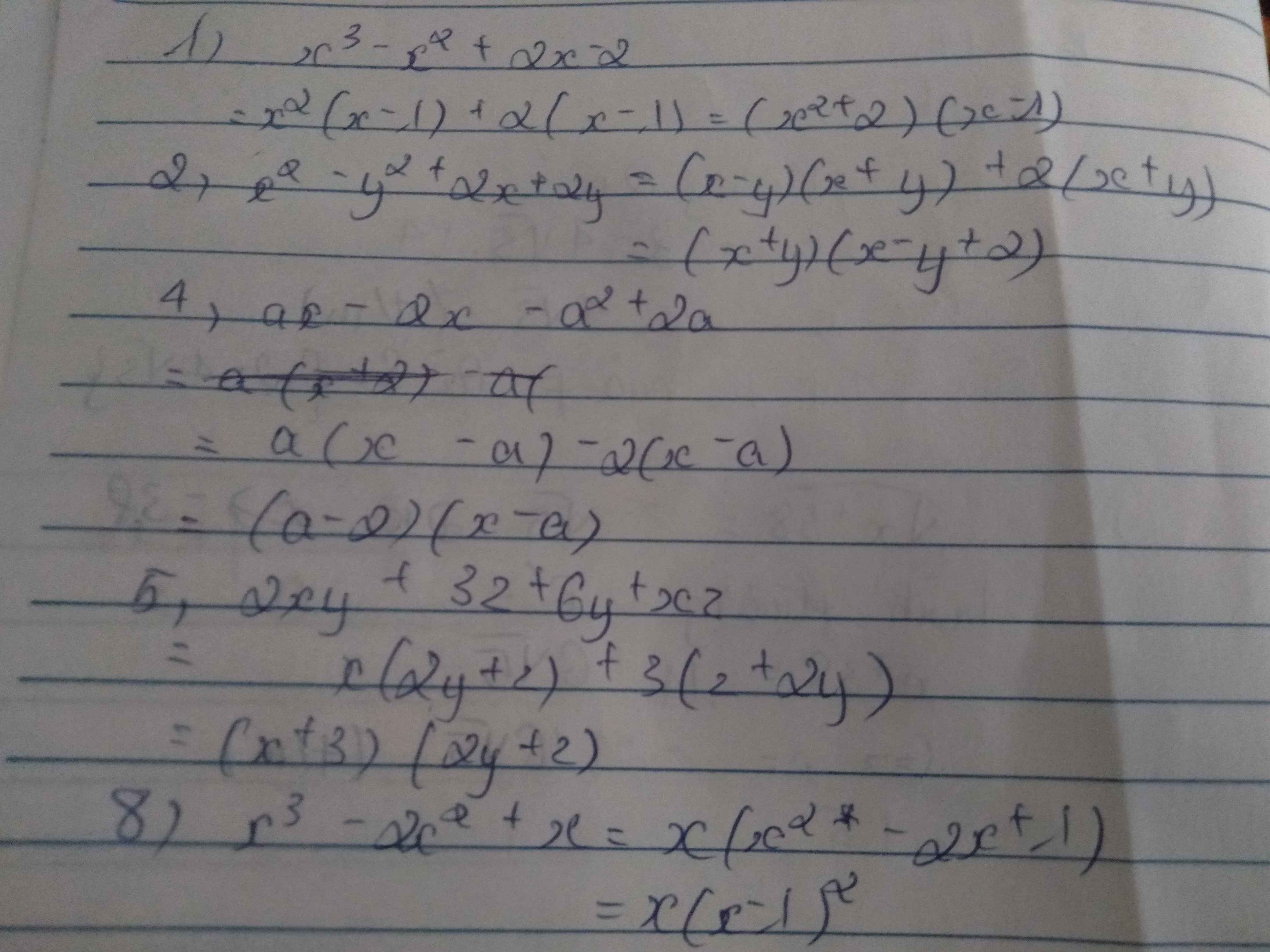
1) x3-x2+2x-2 4) ax-2x-a2+2a 7) x2-6xy-25z2+9y2
2) x2-y2+2x+2y 5) 2xy +3z+6y+xz 8) x3-2x2+x
3) x2/4+2xy+4y2-25 6) x2y2+yz+y3+zx2 9) x4+4
Phương trình nào sau đây là phương trình của đường tròn?
(I) x2+ y2 – 4x +15y -12= 0.
(II) x2+ y2 – 3x +4y +20= 0.
(III) 2x2+ 2y2- 4x + 6y +1= 0 .
A. Chỉ (I).
B. Chỉ (II).
C. Chỉ (III).
D. Chỉ (I) và (III).
Ta xét các phương án:
(I) có:

(II) có:

(III) tương đương : x2+ y2 – 2x - 3y + 0,5= 0.
phương trình này có:
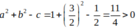
Vậy chỉ (I) và (III) là phương trình đường tròn.
Chọn D.
Phân tích các đa thức sau thành nhân tử:
a,x3+4x-5
b,x3-3x2+4
c,x3+2x2+3x+2
d,x2+2xy+y2+2x-2y-3
e,(x2+3x)2-2(x2+3x)-8
f,(x2+4x+10)2-7(x2+4x+11)+7
a) x3+4x-5 = x3-x2+x2+4x-5=(x3-x2)+(x2-x)+(5x-5)=x2(x-1)+x(x-1)+5(x-1)=(x2+x+5)(x-1)
b) x3-3x2+4=x3-2x2-x2+4=(x3-2x2)-(x2-4)=x2(x-2)-(x-2)(x+2)=(x2-x+2)(x-2)
c) x3+2x2+3x+2=x3+x2+x2+x+2x+2=(x3+x2)+(x2+x)+(2x+2)=x2(x+1)+x(x+1)+2(x+1)=(x2+x+2)(x+1)
d) bạn xem lại đề đúng ko
e) (x2+3x)2-2(x2+3x)-8=x4+6x3+9x2-2x2-6x-8=x4+6x3+7x2-6x-8=x4-x3+7x3-7x2+14x2-14x+8x-8=(x4-x3)+(7x3-7x2)+(14x2-14x)+(8x-8)=x3(x-1)+7x2(x-1)+14x(x-1)+8(x-1)=(x3+7x2+14x+8)(x-1)=(x3+x2+6x2+6x+8x+8)(x-1)=\(\left[\left(x^3+x^2\right)+\left(6x^2+6x\right)+\left(8x+8\right)\right]\left(x-1\right)\)\(=\left[x^2\left(x+1\right)+6x\left(x+1\right)+8\left(x+1\right)\right]\left(x-1\right)\)\(=\left(x^2+6x+8\right)\left(x+1\right)\left(x-1\right)\)\(=\left(x^2+2x+4x+8\right)\left(x+1\right)\left(x-1\right)\)\(=\left[\left(x^2+2x\right)+\left(4x+8\right)\right]\left(x+1\right)\left(x-1\right)\)\(=\left[x\left(x+2\right)+4\left(x+2\right)\right]\left(x+1\right)\left(x-1\right)\)=\(\left(x-1\right)\left(x+1\right)\left(x+2\right)\left(x+4\right)\)
f) (x2+4x+10)2-7(x2+4x+11)+7=(x2+4x+10)2-\(\left[7\left(x^2+4x+11\right)-7\right]\)\(=\left(x^2+4x+10\right)^2-7\left(x^2+4x+10\right)\)\(=\left(x^2+4x+10\right)\left(x^2+4x+3\right)\)
a) Ta có: \(x^3+4x-5\)
\(=x^3-x+5x-5\)
\(=x\left(x-1\right)\left(x+1\right)+5\left(x-1\right)\)
\(=\left(x-1\right)\left(x^2+x+5\right)\)
b) Ta có: \(x^3-3x^2+4\)
\(=x^3+x^2-4x^2+4\)
\(=x^2\left(x+1\right)-4\left(x-1\right)\left(x+1\right)\)
\(=\left(x+1\right)\left(x^2-4x+4\right)\)
\(=\left(x+1\right)\cdot\left(x-2\right)^2\)
c) Ta có: \(x^3+2x^2+3x+2\)
\(=x^3+x^2+x^2+x+2x+2\)
\(=x^2\left(x+1\right)+x\left(x+1\right)+2\left(x+1\right)\)
\(=\left(x+1\right)\left(x^2+x+2\right)\)
d) Ta có: \(x^2+2xy+y^2+2x+2y-3\)
\(=\left(x+y\right)^2+2\left(x+y\right)-3\)
\(=\left(x+y\right)^2+3\left(x+y\right)-\left(x+y\right)-3\)
\(=\left(x+y\right)\left(x+y+3\right)-\left(x+y+3\right)\)
\(=\left(x+y+3\right)\left(x+y-1\right)\)
e) Ta có: \(\left(x^2+3x\right)^2-2\left(x^2+3x\right)-8\)
\(=\left(x^2+3x\right)^2-4\left(x^2+3x\right)+2\left(x^2+3x\right)-8\)
\(=\left(x^2+3x\right)\left(x^2+3x-4\right)+2\left(x^2+3x-4\right)\)
\(=\left(x^2+3x-4\right)\left(x^2+3x+2\right)\)
\(=\left(x+4\right)\left(x-1\right)\left(x+1\right)\left(x+2\right)\)
f) Ta có: \(\left(x^2+4x+10\right)^2-7\left(x^2+4x+11\right)+7\)
\(=\left(x^2+4x+10\right)^2-7\left(x^2+4x+10\right)-7+7\)
\(=\left(x^2+4x+10\right)\left(x^2+4x+10-7\right)\)
\(=\left(x^2+4x+3\right)\left(x^2+4x+10\right)\)
\(=\left(x+1\right)\left(x+3\right)\left(x^2+4x+10\right)\)