Read Lan’s letter. Find examples of formal writing.
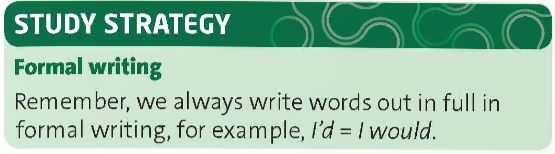
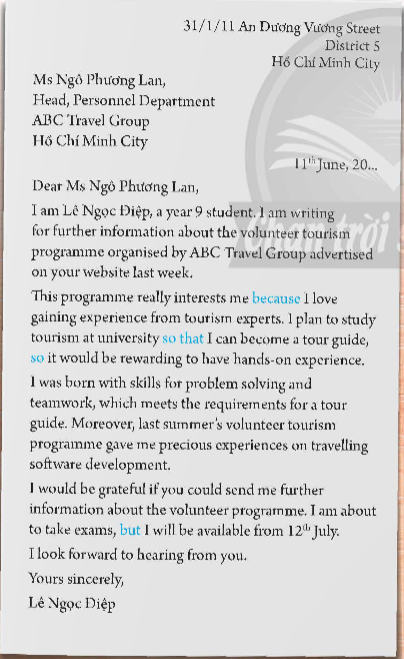

Read the Writing Strategy and do the tasks below.
1. Divide the letter into six paragraphs.
2. Find three examples of short forms. Correct them.
3. Find words and phrases in the letter which would be bette expressed with these more formal words and phrases:
friends I would be grateful if you could inform me
I would certainly be interested receiving a reply
recommendations
4. Find words and phrases in the letter which express these things in a more formal way:
ask about soon sort out tell me about
Writing Strategy 1 Divide your letter into paragraphs. 2 In the first paragraph, which can be a single sentence, say why you are writing. 3 Each paragraph should have its own topic. It is usually best to deal with each point in the task in a separate paragraph. 4 In the final paragraph, which can be a single sentence, say that you expect a reply. 5 Avoid colloquial language and short forms. |

1. Here's a suggested division of the letter into six paragraphs:
Paragraph 1: Introduction and purpose of the letter Paragraph 2: Information about the group Paragraph 3: Dates of stay and availability Paragraph 4: Inquiring about food and drink Paragraph 5: Requesting suggestions about places to visit in Bristol Paragraph 6: Conclusion and expectation of reply
2. Examples of short forms and corrected versions:
- "we're" (we are) - "We are"
- "I'll" (I will) - "I will"
- "can't" (cannot) - "cannot"
3. Words and phrases that could be expressed in a more formal way:
- "friends" - "travel companions"
- "I would be grateful if you could inform me" - "Please inform me"
- "I would certainly be interested" - "I would be interested"
- "recommendations" - "suggestions"
- "receiving a reply" - "receiving a response"
4. Words and phrases that could be expressed in a more formal way:
- "ask about" - "inquire about"
- "soon" - "in the near future"
- "sort out" - "arrange"
- "tell me about" - "inform me about"
Read the Writing Strategy. Then read Ellie's email again and underline.
1 a piece of formal language. How could you make it informal?
2 three different contractions. Can you find any more places where Ellie could have used contractions?
3 an example of a sentence with words omitted at the start. What exactly has been omitted?
Writing Strategy When you write an informal email or letter, • you should avoid formal language. • you can use contractions (you're, it's, etc.). • you sometimes omit words like I, I'm or I've at the start of a sentence (Hope you're well, Got to go now, etc.). |
To: anna@email.com
Hi Anna,
Hope everything is OK with you. We've just moved to a new flat nearer the centre of town. It's brilliant being so close to the shops, and the flat is bigger than our old one. It's quite noisy, though, as there is a lot of traffic. I'd rather it was further from the main road. I met one of our neighbours yesterday. She is about my age and she is very friendly. She has invited me to a party next weekend. Can you go with me? I hope so. To be honest, I'd rather not go alone. Also, would it be OK if I used your bike for a few days? Mine is at the bike shop and I'd rather cycle to school than get the bus.
Got to go now. I'd better finish my homework before bed. I look forward to receiving your reply.
Love,
Ellie
1 a piece of formal language. How could you make it informal?
(phần ngôn ngữ trang trọng. Làm thế nào bạn có thể làm cho nó không trang trọng?)
There is no formal language in Ellie's email.
(Không có ngôn từ trang trọng trong email của Ellie.)
2 three different contractions. Can you find any more places where Ellie could have used contractions?
(ba dạng rút gọn khác nhau. Bạn có thể tìm thấy bất kỳ chỗ nào khác mà Ellie có thể sử dụng các dạng rút gọn không?)
- We've (We have)
- I'd (I would/ I had)
- It's (It is)
There are no other places where Ellie could have used contractions.
(Không có chỗ nào khác mà Ellie có thể sử dụng các dạng rút gọn.)
3 an example of a sentence with words omitted at the start. What exactly has been omitted?
(một ví dụ về một câu với những từ bỏ đi ở đầu. Chính xác những gì đã được bỏ qua?)
"Got to go now."
(Phải đi ngay bây giờ.)
The word "I've" (I have) has been omitted.
(Từ "I've" đã bị lược bỏ.)

3. Read the Writing Strategy. Match the bold conjunctions in the letter with the meaning below.
(Đọc Chiến lược Viết. Nối các từ nối được in đậm trong bức thư với ý nghĩa dưới đây.)
Writing Strategy
Remember when writing a formal letter of complaint:
(Hãy nhớ rằng khi viết một bức thư phàn nàn trang trọng:)
• State the reason for writing clearly in opening paragraph.
(Nêu lý do viết một cách rõ ràng trong đoạn mở đầu.)
• Use formal language. (Sử dụng ngôn ngữ trang trọng.)
• Be clear and concise. (Rõ ràng xúc tích)
• State what you want done. (Nêu điều bạn muốn làm.)
1. because (x2) _____, _____
2. instead of _____
3. if there is not _____
4. for that reason _____
1. since, as (bởi vì) | 2. rather than (thay vì) | 3. unless there is (nếu không có) | 4. so (vậy nên) |
D. Read the information below. Then discuss in pairs if you would use formal or informal writing for each situation in B.
WRITING SKILL: Formal and Informal Writing
| ||
Letters and emails are classified into 2 styles: formal and informal. The tone of your letter or email depends on who you are writing to and how well you know them.
| ||
Formal Writing
| Informal Writing
| |
When to use
| - writing to people we don't know (e.g., an employer) - in business and professional situations
| - writing to people we know well (eg., our friends, our family members) - in personal situations
|
How to write
| - using full sentences and special expressions (sử dụng các câu đầy đủ và cách diễn tả đặc biệt)
Dear Mr. Smith, I am writing to apply for the scholarship of...., Please see my attached high school transcription.
Dear Sir/Madam, I would like to inform you that ... Yours faithfully,)
| - using shorter sentences and contracted forms - leaving words out at times
Hi! I'm having a party. Want to come? Hi guys, Let me tell you about... Love, |
1. send a photo to your grandparents: informal writing
(gửi một bức ảnh cho ông bà của bạn: văn phong thông thường)
2. apply for a scholarship: formal writing
(xin học bổng: văn phong trang trọng)
3. keep in touch with friends from Brazil: informal writing
(giữ liên lạc với bạn bè từ Brazil: văn phong thông thường)
4. send an assignment to your teacher: formal writing
(gửi bài tập cho giáo viên: văn phong trang trọng)
5. invite a friend out tonight: informal writing
(mời một người bạn đi chơi tối nay: văn phong thông thường)
Read the following passage and mark the letter A, B, C, or D on your answer sheet to indicate the correct answer to each of the questions.
The statement: "Colloquialisms, on the other hand, are familiar words and idioms that are understood by almost all speakers of a language and used in informal speech or writing, but not considered acceptable for more formal situations." means:
A. Most of the speakers of a language can use both formal and informal speech in appropriate situations.
B. Familiar situations that are experienced by most people are called colloquialisms.
C. Familiar words and phrases are found in both speech and writing in formal settings.
D. Informal language contains colloquialisms, which are not found in more formal language.
Đáp án: C
Giải thích: Câu này có nghĩa là “Các cụm từ thông tục là những từ ngữ hay thành ngữ quen thuộc được hầu hết mọi người hiểu và được dùng ở bài nói/ bài viết không trang trọng/ thân mật, nhưng không được chấp nhận ở những tình huống trang trọng.” Nghĩa này phù hợp với nghĩa của câu nêu ở câu C: “Ngôn ngữ không trang trọng chứa các cụm từ thông tục – những cụm từ thường không có ở ngôn ngữ trang trọng.”
a. Read about writing complaint emails, then read June's email again and underline the examples of parts 1-4 from the Writing Skill in the email.
(Đọc về cách viết email khiếu nại, sau đó đọc lại email của June và gạch dưới các ví dụ của phần 1-4 từ Kỹ năng Viết trong email.)
Writing Skill Writing complaint emails (Viết thư điện tử phàn nàn) To make complaints effectively in an email, you should use formal language and (Để khiếu nại một cách hiệu quả trong email, bạn nên sử dụng ngôn ngữ trang trọng và) 1. explain why you're writing (giải thích tại sao bạn đang viết email này) I bought a B300 laptop on December 5th, and it has a problem. (Tôi đã mua một máy tính xách tay B300 vào ngày 5 tháng 12 và nó có một vấn đề.) 2. describe the problem (mô tả vấn đề) It crashes when I play games. (Nó bị treo khi tôi chơi trò chơi.) 3. (optional) explain how you tried to fix the problem ((tùy chọn) giải thích cách bạn đã cố gắng khắc phục sự cố) I tried restarting it, but it still does not work. (Tôi đã thử khởi động lại nó, nhưng nó vẫn không hoạt động.) 4. say what you want the store to do (nói những gì bạn muốn cửa hàng làm) I would like you to replace it. (Tôi muốn bạn thay thế nó.) |
Dear Sir or Madam,
(1) On Friday, November 27th, I bought a Link76 laptop from your website and it is not working.
The laptop has two main problems. (2) It overheats when I play games and it keeps crashing when I do my homework. It also sometimes slows down when I watch movies.
(3) I called RocketTech's customer hotline and waited 30 minutes to speak to someone. Finally, I spoke to your colleague, Andy. He said he would speak to his manager and call back in ten minutes. That was three hours ago.
(4) I would like RocketTech to repair my laptop or provide a new one as soon as possible.
I look forward to your reply.
Yours faithfully,
June Evans
You would like to volunteer at the Heart to Heart Charity Office. Write a formal letter of 140-160 words applying for the job. follow the writing plan in.
Read the Learn this! box. Complete the examples and rules. How many more examples of each tense can you find in the article?
LEARN THIS! Future perfect and future continuous a We form the future perfect with will have + past participle. By the weekend, he 1___________ left hospital. b We form the future continuous with will be + -ing form. This time next month, he 2___________ playing football again. c We use the future 3__________to talk about completed action in the future. d We use the future 4___________ to talk about an action in progress in the future. |
1. will have
2. will be
3. perfect
4. continuous

Read the interviews on page 6 again. Find examples of:
1. negative forms of the present simple and present continuous
2. question forms of the present simple and present continuous
3. third person singular forms of the present simple
Tham khảo:
1. negative forms of the present simple and present continuous.
- I don't often tidy my room.
- I'm not playing this morning.
2. question forms of the present simple and present continuous.
- Do you help at home much after school?
- What are you doing in town this morning?
3. third person singular forms of the present simple.
- My mum does it. My dad always cook dinner.
Mark the letter A, B, C, or D on your answer sheet to indicate the most suitable response to complete each of the following exchanges.
Phuong Thao is a student in Ms Lan’s writing class. She is asking for Ms Lan’s comments on her last essay. Select the most suitable response to fill in the blank.
Phuong Thao: “You must have found reading my esssay very tiring.”
Ms Lan: “_______. I enjoyed it.”
A. Not in the least
B. Just in case
C. At all costs
D. You are welcom
Phương Thảo là một học sinh trong lớp học viết của cô Lan. Bạn ấy đang nhờ cô Lan nhận xét về bài luận mới nhất của bạn ấy.
Chọn phản hồi phù hợp nhất điền vào chỗ trống.
Phương Thảo: “Cô ơi chắc cô thấy việc đọc bài luận của em mệt mỏi đúng không cô?”
Ms Lan: “_______. Cô rất thích.”
A. Không hề gì đâu (= Not at all) B. Phòng khi
C. Bằng bất cứ giá nào D. Không có chi => đáp lại lời cảm ơn
Chọn A