B. Answer the questions. Then listen and check your answers.

Look at the photos and answer the questions. Then read the article and check your answers.
1. What job categories can you see?
2. Why do you think some teenagers work in their holidays?


1. Job categories I can see:
Picture A: teaching
Picture B: engineering
Picture C: media
Picture D: finance
2. I think some teenagers work in their holidays to gain valuable work experience and improve soft skills which can be beneficial for their future career prospects.
Listen and check your answers to the quiz. Which answer surprised you the most?
The answer surprised me the most is that The Rubik’s Cube is the best-selling toy in history. ‘Speedcubers’ are experts with the cube and the fastest time to solve the puzzle is less than 5 seconds because it's really a very short time and I don't think a normal man can do it.
(Câu trả lời làm tôi ngạc nhiên nhất là Khối Rubik là món đồ chơi bán chạy nhất trong lịch sử. ‘Speedcubers’ là những chuyên gia với khối lập phương và thời gian nhanh nhất để giải câu đố là dưới 5 giây vì đó thực sự là một khoảng thời gian rất ngắn và tôi không nghĩ một người bình thường có thể làm được.)
Bài nghe:
1. A fad or craze is an activity which become very popular for a short time. Which of these crazes came from Japan?
(Một mốt hoặc ‘cơn sốt’ là một hoạt động trở nên rất phổ biến trong một thời gian ngắn. Những mốt thịnh hành nào sau đây bắt nguồn từ Nhật Bản?)
b. Pokémon
2. When a lot of people ‘like’ and share a photo or video on social media, it gets a lot of ...
(Khi mọi người thích và chia sẻ một bức hình hoặc băng hình trên mạng xã hội, nó nhận được nhiều ...)
b. views (n): lượt xem
3. Bluetooth speakers are small gadgets that you can play music on. They became popular around ...
(Loa Bluetooth là những thiết bị nhỏ mà bạn có thể phát nhạc. Chúng bắt đầu phổ biến vào khoảng ...)
a. 1999
4. Fans on social media look at their favorite celebrity posts. Which footballer was the first to get 100 million Facebook followers?
(Người hâm mộ trên mạng xã hội xem các bài đăng của người nổi tiếng họ yêu thích. Cầu thủ nào là người đầu tiên đạt 100 triệu người theo dõi trên Facebook?)
a. Cristiano Ronaldo
5. Which is the best-selling game app of all time?
(Đâu là ứng dụng chơi điện tử bán chạy nhất mọi thời đại?)
a. Tetris
6. The Rubik’s Cube is the best-selling toy in history. ‘Speedcubers’ are experts with the cube and the fastest time to solve the puzzle is less than ...
(Khối Rubik là đồ chơi bán chạy nhất trong lịch sử. ‘Những người mê tốc độ’ là những chuyên gia về khối lập phương và thời gian nhanh nhất để giải trò chơi này là ít hơn ...)
a. 5 seconds (5 giây)

Complete the chart. Then listen and check your answers.
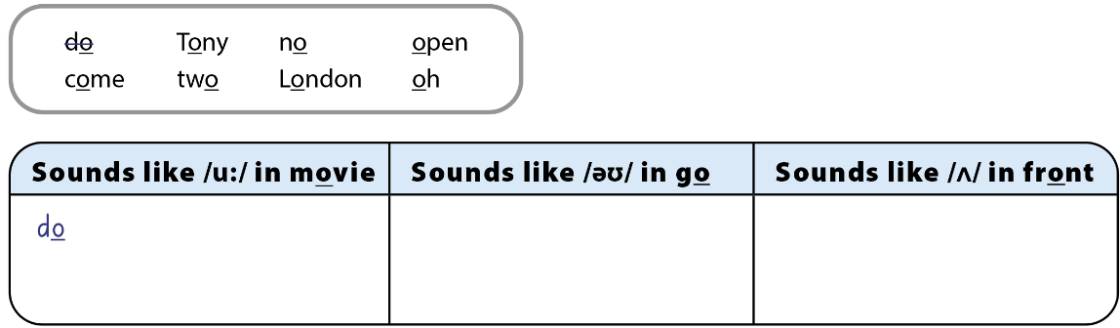
B:
Sounds like /u:/ in movie: two
Sounds like /əʊ/ in go: no,oh,open
Sounds like /ʌ/ in front: tony, london, come
Check the meaning of the phrases in the box and complete the questionnaire. Listen and check. Then ask and answer the questions with a partner.
do homework enrol in fail exams get a qualification get good marks get into college go to lessons obey rules pass exams take classes |
Plan your ideal school!
What is your ideal school like? Choose from these ideas.
1. Type of school
What kind of school do you decide to 1........... yourself in?
a Single-sex school
b. Boarding school
c. Mixed school
d. Homeschooling
2. Subjects
Traditional school subjects are a bit boring, so you want a school where you can take 2………. in:
a. dance, theatre and singing.
b. skateboarding.
c. graffiti art.
d. sailing.
e. other (please tell us what!)
3. Timetable
What hours do you choose to go to 3…………?
a. from 8.30 a.m. to 3.30 p.m.
b. from 9.00 a.m to 4.00 p.m.
c. from 10.00 a.m to 2.00 p.m.
d. A timetable? No, thanks. I go to lessons when I feel like it.
4. Study
It's important to do 4………… How much would you do at your ideal school?
a. 2-3 hours a day
b. 4-5 hours a week
c. More than ten hours a week
d. Homework is so old-fashioned. We don't have it at my ideal school!
5. Rules
What happens if you don't 5…….. rules at your school?
a. You get extra homework.
b. Nothing.
c. You stay at home for a week.
d. You spend your lunchtime in class.
6. School leavers
You're finally in your last year. The most Important thing for you is to:
a. 6..…..….. exams so you can get 7…..…… and find a job.
b. not 8…………. exams.
c. get 9………… and get 10……..… to study for your future career.
d. enjoy your last year with your friends.
1. enrol
2. classes
3. lessons
4. homework
5. obey
6. pass
7. aqualification
8. fail
9. good marks
10. into college
Listen and check your answers. Then tell a partner which changes you would make.
The changes I would make if I ruled the world are: helping all children go to school and stopping bullying in schools.

Exercise 1. Look at pictures 1-9. Then complete the questions with the words in the box. Listen and check your answers.
(Nhìn vào các bức tranh 1-9. Sau đó hoàn thành câu hỏi với các từ trong khung. Nghe và kiểm tra câu trả lời của em.)
art English geography Spanish history PE1 science ICT2 maths PE = Physical Education ICT = Information and Communication Technology 1. Are you good at……………? 2. When’s our next……….exam? 3. Are you a/an……..genius? 4. Is your………..notebook organised? 5. Have we got a/an………..class tomorrow? 6. Do you study other languages, like………..? 7. Have you got……………homework today? 8. Do you think that our textbook is interesting? 9. How many………..teachers are there in the school?
1. PE
2. geography
3. maths
4. science
5. ICT
6. Spanish
7. history
8. English
9. art
1. Are you good at PE?
(Bạn có giỏi môn thể dục không?)
2. When’s our next geography exam?
(Khi nào thì kỳ thi Địa lý tiếp theo của chúng ta?)
3. Are you a maths genius?
(Bạn có phải là một thiên tài toán học không?)
4. Is your science notebook organised?
(Sổ ghi chép khoa học của bạn có được sắp xếp không?)
5. Have we got an ICT class tomorrow?
(Ngày mai chúng ta có tiết học Công nghệ thông tin và truyền thông không?)
6. Do you study other languages, like Spanish?
(Bạn có học các ngôn ngữ khác, như tiếng Tây Ban Nha không?)
7. Have you got history homework today?
(Hôm nay bạn có bài tập Lịch sử không?)
8. Do you think that our English textbook is interesting?
(Bạn có nghĩ sách giáo khoa tiếng Anh của chúng ta thú vị không?)
9. How many art teachers are there in the school?
(Có bao nhiêu giáo viên mỹ thuật trong trường?)

Listen and check your answers to exercise 2. Which of the qualities from exercise 1 do you think Nellie Bly showed? Justify your answer with evidence from the text.
Billy showed three qualities:
(Billy đã thể hiện ba đức tính)
- determination
(quyết tâm)
Thông tin: “Nellie Bly was determined to be an investigative journalist who wrote about serious issues, like women's rights and the problems of factory workers.”
(Nellie Bly quyết tâm trở thành một nhà báo điều tra viết về các vấn đề nghiêm trọng, như quyền của phụ nữ và các vấn đề của công nhân nhà máy.)
- intelligence
(thông minh)
Thông tin: “she pretended to be insane so that she could become a patient at a psychiatric hospital in New York and find out about the conditions there.”
(Cô ấy giả điên để có thể trở thành bệnh nhân tại một bệnh viện tâm thần ở New York và tìm hiểu về điều kiện ở đó.)
- self-confidence
(tự tin)
Thông tin: “She was willing to challenge the status quo and write about serious issues, despite the fact that female journalists at the time were mostly writing about fashion and gardening.”
(Cô ấy sẵn sàng thách thức hiện trạng và viết về những vấn đề nghiêm trọng, mặc dù thực tế là các nhà báo nữ vào thời điểm đó chủ yếu viết về thời trang và làm vườn.)
B. Complete the chart. Use the words in the box. Then listen and check your answers.
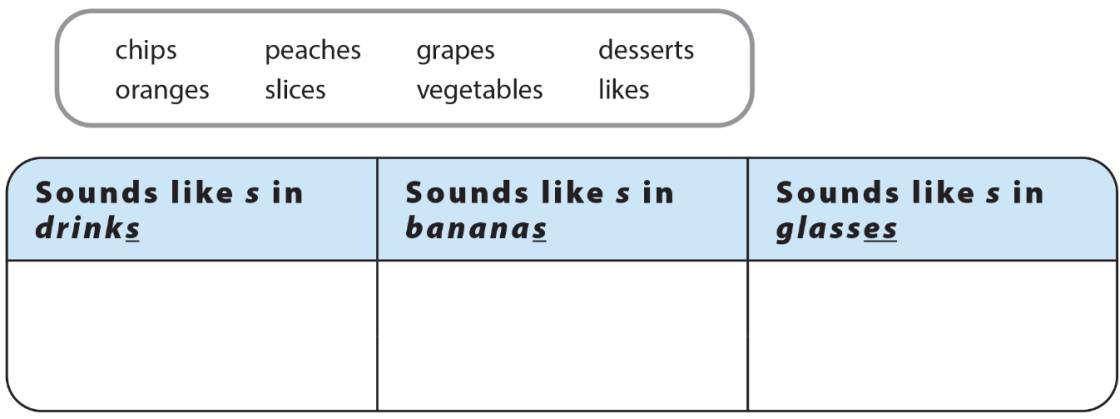
Sounds like s in drinks (Âm s như trong drinks) | Sounds likes s in bananas (Âm s như trong bananas) | Sounds like s in glasses (Âm s như trong glasses) |
- chips - grapes - desserts - likes | - vegetables | - peaches - oranges - slices |

Exercise 1. Look at the first photo and answer the questions. Then read the text and check your answers.
(Nhìn bức ảnh đầu tiên và trả lời câu hỏi. Sau đó đọc văn bản và kiểm tra câu trả lời của em.)

1. Where is Ben?
2. What is he doing?
I can still learn
Most children between five and eighteen in Britain must go to school. But the situation is different for me. I play tennis and I must practise a lot, and I often go to other countries to play in tournaments. How can I still learn? Luckily, digital learning helps me.
When I am absent from school, I do online courses. Computers help me with the subjects, and I can learn at my own speed. When there is no tournament, I come back to school and I can do the tests easily. My friends also help me if I have any problems.
This new learning way makes me happy and keeps me up with my friends. I can still learn when I am not at school. That is why digital learning becomes more and more popular.
* keep up with: to do whatever is necessary to stay level or equal with someone or something
1. Ben is at home.
(Ben đang ở đâu? – Ben đang ở nhà.)
2. He is studying.
(Bạn ấy đang làm gì? – Bạn ấy đang học.)
Tạm dịch văn bản:
Tôi vẫn có thể học
Hầu hết trẻ em từ 5 đến 18 tuổi ở Anh phải đến trường. Nhưng trường hợp của tôi thì khác. Tôi chơi quần vợt và tôi phải luyện tập rất nhiều, và tôi thường đến các quốc gia khác để thi đấu trong các giải đấu. Làm thế nào tôi vẫn có thể học được? May mắn thay, học tập kỹ thuật số giúp tôi.
Khi tôi nghỉ học, tôi tham gia các khóa học trực tuyến. Máy tính giúp tôi giải các môn học và tôi có thể học với tốc độ của riêng mình. Khi không có giải đấu, tôi trở lại trường và tôi có thể làm các bài kiểm tra một cách dễ dàng. Bạn bè của tôi cũng giúp tôi nếu tôi có bất kỳ vấn đề nào.
Cách học mới này giúp tôi cảm thấy vui vẻ và theo kịp bạn bè. Tôi vẫn có thể học khi tôi không ở trường. Đó là lý do tại sao học kỹ thuật số ngày càng trở nên phổ biến.
* theo kịp: làm bất cứ điều gì cần thiết để duy trì mức độ hoặc bằng với ai đó hoặc điều gì đó