Tìm GTLN của \(A\text{=}3x\text{+}\sqrt{2-x^2}\)

Những câu hỏi liên quan

Cho biểu thức: \(P=\frac{3x^2-x}{3x+2}:\frac{3x^3-x^2+12x-4}{x+2\left(x+1\right)}\)
\(\text{a) Rút gọn P}\)
\(\text{b) Tìm GTNN và GTLN của P}\)


dk 3x+2
P= \(\frac{x\left(3x-1\right)}{3x+2}.\frac{3x+2}{\left(3x-1\right)x^2+4\left(3x-1\right)}=\frac{x\left(3x-1\right)}{3x+2}.\frac{3x+2}{\left(3x-1\right)\left(x^2+4\right)}=\)\(\frac{x}{x^2+4}\)
dk \(\hept{\begin{cases}3x-1\ne0\\3x+2\ne0\end{cases}< =>\hept{\begin{cases}x\ne\frac{1}{3}\\x\ne\frac{-2}{3}\end{cases}}}\)(1)
P(x2+4) = x <=> Px2-x+4P=0
để phương trình trên có nghiệm thỏa mãn (1) <=> \(\hept{\begin{cases}P\frac{1}{3^2}-\frac{1}{3}+4P\ne0\\P\frac{4}{9}+\frac{2}{3}+4P\ne0\\1^2-4.P.\left(4P\right)\ge0\end{cases}< =>\hept{\begin{cases}P\ne\frac{3}{37}\\P\ne\frac{-3}{20}\\\frac{-1}{4}\le P\le\frac{1}{4}\end{cases}}}\)
Vậy P max = 1/4 khi \(\frac{1}{4}x^2-x+1=0< =>x=2\)
P min = -1/4 khi \(\frac{-1}{4}x^2-x-1=0< =>x=-2\)
Đúng 0
Bình luận (0)

Tìm GTLN của biểu thức : -X-\(\sqrt{\text{x}}\)+2

ÔI, em nhầm rùi
= -(\(\sqrt{x}\)+ 1/2) +1/4 +2
GTLN = 9/4
Lần này không sai đâu chị
Đúng 0
Bình luận (0)


E nhầm rồi kìa. Làm gì có giá trị x nào thảo mãn được cái đó e
Đúng 0
Bình luận (0)
Xem thêm câu trả lời

\(\text{Tìm GTNN, GTLN (nếu có)}\)
\(A=2x-2\sqrt{3x+1}-1\)

\(\text{Tìm GTLN của:}\)
\(P=\sqrt{x-2}+\sqrt{4-x}\)
\(\text{P.S:}\)\(\text{(dùng HĐT)}\)

Áp dụng BĐT Bu-nhi-a-cốp-xki ta được:
\(\sqrt{x-2}+\sqrt{4-x}\le\sqrt{\left(1^2+1^2\right)\left(x-2+4-x\right)}=\sqrt{2\cdot2}=2\)
Dấu "=" xảy ra khi và chỉ khi \(\sqrt{x-2}=\sqrt{4-x}\)
\(\Leftrightarrow x=3\)
Đúng 0
Bình luận (0)


9 tháng 2 2022 lúc 20:49
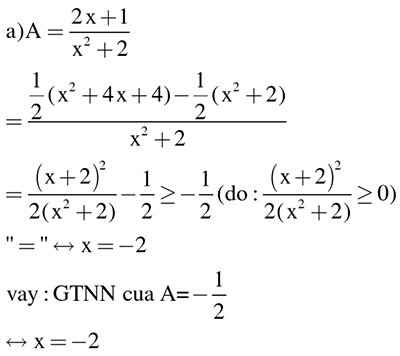
Tìm GTLN GTNN của A=\(\dfrac{\text{ 2x+1}}{\text{x^2+2 }}\)


\(A=\dfrac{2x+1}{x^2+2}\)
\(\Leftrightarrow Ax^{2\:}+2A=2x+1\)
+) \(A=0\Rightarrow x=-\dfrac{1}{2}\)
+) \(A\ne0\)
\(Ax^2+2A=2x+1\)
\(\Leftrightarrow Ax^{2\:}-2x=1-2A\)
\(\Leftrightarrow x^2-2.\dfrac{x}{A}=\dfrac{1-2A}{A}\)
\(\Leftrightarrow x^2-2.x.\dfrac{1}{A}+\dfrac{1}{A^2}=\dfrac{1-2A}{A}+\dfrac{1}{A^2}\)
\(\Leftrightarrow\left(x-\dfrac{1}{A}\right)^2=\dfrac{A-2A^2+1}{A^2}\)
\(\Leftrightarrow\left(x-\dfrac{1}{A}\right)^2=\dfrac{\left(1-A\right)\left(2A+1\right)}{A^2}\)
Vì \(\left\{{}\begin{matrix}\left(x-\dfrac{1}{A}\right)^2\ge0\left(\forall x,A\ne0\right)\\A^2\ge0\end{matrix}\right.\)
⇒ \(\left(1-A\right)\left(2A+1\right)\ge0\)
⇒ \(-\dfrac{1}{2}\le A\le1\)
Còn lại tụ làm nha
Đúng 2
Bình luận (0)

\(A=\dfrac{2x+1}{x^2+2}=\dfrac{x^2+2-x^2-2+2x+1}{x^2+2}\\ =1-\dfrac{-\left(x-1\right)^2}{x^2+2}\\ Do\left(x-1\right)^2\ge0\Rightarrow\dfrac{-\left(x-1\right)^2}{x^2+2}\ge0\\ \Rightarrow\dfrac{-\left(x-1\right)^2}{x^2+2}=0\Leftrightarrow\dfrac{-\left(x-1\right)^2}{x^2+2}+1\le1\)
\(Dấu"="\Leftrightarrow A=1\\ \Leftrightarrow x-1=0\Rightarrow x=1\\ Vậy.P_{max}=1.khi.x=1\\ A=\dfrac{2x+1}{x^2+2}\rightarrow2A+1=\dfrac{2.\left(2x+1\right)}{x^2+2}+1\\ =\dfrac{4x+2+x^2+2}{x^2+2}=\dfrac{x^2+4x+2}{x^2+2}=\dfrac{\left(x+2\right)^2}{x^2+2}\\ Do\left(x+2\right)^2\ge0\Leftrightarrow\dfrac{\left(x+2\right)^2}{x^2+2}\ge0\)
\(Dấu"="\Leftrightarrow A=\dfrac{1}{2}khi.x=-2\\ \Rightarrow2A+1\ge0\Rightarrow2A\ge-1\Rightarrow A>-\dfrac{1}{2}\\ Vậy.MinA=-\dfrac{1}{2}.khi.x=-2\)
Đúng 1
Bình luận (0)



\(\text{Tìm GTNN, GTLN (nếu có) của biểu thức:}\)
\(A=\sqrt{5+3x}+\sqrt{3-2x}\)

tìm GTLN của B=√2x-3+√x-1+√7-3x với 3/2 < x <7/3

tìm GTLN bt x + y + z = xyz
\(A=\frac{2}{\sqrt{\text{x}^2+1}}+\frac{1}{\sqrt{y^2+1}}+\frac{1}{\sqrt{z^2+1}}\)
\(\text{Cho }\frac{1}{a}+\frac{1}{b}+\frac{1}{c}=3\)
\(\text{Tìm GTLN của }P=\frac{1}{\sqrt{a^2-ab+b^2}}+\frac{1}{\sqrt{b^2-bc+c^2}}+\frac{1}{\sqrt{c^2-ca+a^2}}\)


\(P=\frac{1}{\sqrt{\frac{1}{2}\left(a-b\right)^2+\frac{1}{2}\left(a^2+b^2\right)}}+\frac{1}{\sqrt{\frac{1}{2}\left(b-c\right)^2+\frac{1}{2}\left(b^2+c^2\right)}}+\frac{1}{\sqrt{\frac{1}{2}\left(c-a\right)^2+\frac{1}{2}\left(c^2+a^2\right)}}\)
\(\Rightarrow P\le\frac{1}{\sqrt{\frac{1}{2}\left(a^2+b^2\right)}}+\frac{1}{\sqrt{\frac{1}{2}\left(b^2+c^2\right)}}+\frac{1}{\sqrt{\frac{1}{2}\left(c^2+a^2\right)}}\)
\(\Rightarrow P\le\frac{1}{\sqrt{\frac{1}{4}\left(a+b\right)^2}}+\frac{1}{\sqrt{\frac{1}{4}\left(b+c\right)^2}}+\frac{1}{\sqrt{\frac{1}{4}\left(c+a\right)^2}}\)
\(\Rightarrow P\le\frac{2}{a+b}+\frac{2}{b+c}+\frac{2}{c+a}\)
\(\Rightarrow P\le\frac{2}{4}\left(\frac{1}{a}+\frac{1}{b}+\frac{1}{b}+\frac{1}{c}+\frac{1}{c}+\frac{1}{a}\right)=\frac{1}{a}+\frac{1}{b}+\frac{1}{c}=3\)
\(\Rightarrow P_{max}=3\) khi \(a=b=c=1\)
Đúng 0
Bình luận (2)
Không có điều kiện a;b;c dương thì ko biết giải kiểu gì đâu bạn
Đúng 0
Bình luận (1)