Look, listen and complete.
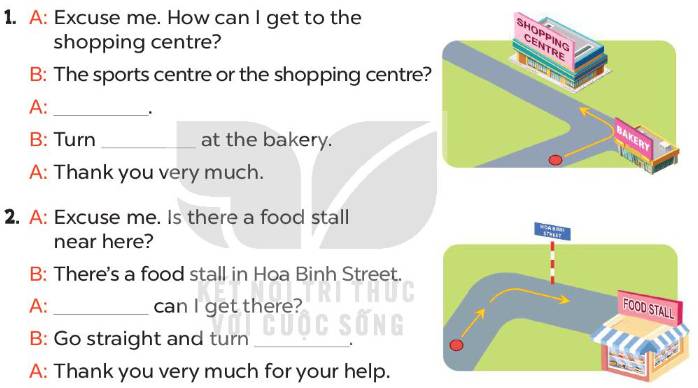

6. Read the Look out! box above and the dialogue below. Circle the correct words to complete the dialogue. Then listen and check.
(Đọc hộp chú ý! ở phía trên và đoạn hội thoại phía dưới. Khoanh tròn các từ đúng để hoàn thành đoạn hội thoại. Sau đó nghe và kiểm tra.)
LOOK OUT! (Chú ý)
In affirmative sentences, much and many often sound very formal. In everyday English, we use a lot of.
(Trong các câu khẳng đinh, much và many nghe có vẻ trang trọng hơn. Trong tiếng Anh hằng ngày, chúng ta dùng a lot of.)
Jack: Look, there's a building with (1) many / some people outside. Turn left just before you get there.
Evie: I can't see (2) any / some people. There isn't (3) many / much light. Hey! What's that noise?
Jack: Nothing. There was (4) any / some rubbish in the road.
Evie: I hate this part of town. There aren't (5) a few/ many nice areas. Let's go north.
Jack: How (6) many / much fuel have we got? Only (7) a few / a little litres.
Evie: Oh no, listen. The police are chasing us now.
Jack: Let me drive. I know (8) a few/ a little tricks.
Mum: Jack, are you doing (9) any / many homework in there?
Jack: Er ... Yes. We're doing (10) a little/ much IT homework.
Evie: Jack! That's not true ...
Jack: Well, we're spending (11) a lot of/ a few time on the computer!
Evie: But we aren't doing (12) some / any work!

1.some | 2. any | 3. much | 4. some | 5. many | 6. much |
7. a few | 8. a few | 9. any | 10. a little | 11. a lot of | 12. any |
2. Look at the Key Phrases. Cover the dialogue and try to complete the Key Phrases. Then watch or listen and check.
(Nhìn vào các cụm từ khóa. Che đoạn hội thoại và cố gắng hoàn thành các cụm từ khóa. Sau đó xem hoặc nghe và kiểm tra.)
KEY PHRASES Talking about the weekend 1. ..... was your weekend? 2. ........good / bad news! 3. ……………were you with? 4........ don't you come next time? 5. Sure. .......... not? 6. Text me...........you're going. |
KEY PHRASES (CỤM TỪ KHÓA) Talking about the weekend (Nói về cuối tuần) 1. How was your weekend? (Cuối tuần của bạn thế nào?) 2. That's good / bad news! (Đó là tin tốt / xấu!) 3. Who were you with? (Bạn đã đi cùng với ai?) 4. Why don't you come next time? (Tại sao lần sau bạn không đến?) 5. Sure. Why not? (Chắc chắn rồi. Tại sao không?) 6. Text me when you're going. (Hãy nhắn cho tôi khi bạn đi nhé.) |
Exercise 1. Check the meanings of the verbs in the box. Look at the quiz and complete the questions with eight of the verbs. Listen and check your answers.
(Kiểm tra nghĩa của các động từ trong khung. Nhìn câu đố và hoàn thành các câu hỏi với 8 động từ. Nghe và kiểm tra câu trả lời của em.)
swim drink hear communicate fly jump survive kill climb grow move run see (x2) |
Animal skills quiz
Some animals are fast, some are big and strong. Some are intelligent, some are dangerous. What do you know about animals and their skills?
1. Can elephants (1)..................... with their ears and their feet?
a. Yes, they can.
b. No, they can't
c. Some can and some can't.
2. How big can a gorilla? (2).....................
a. 150 kilos.
b. 200 kilos.
c. 250 kilos.
3. Some scorpions are dangerous. Can a scorpion (3)..................... a human?
a. Yes, it can.
b. No, it can't.
c. Some can and some can't.
4. Camels don't (4)..................... a lot of water. How many months can a camel (5)..................... without water?
a. Three months.
b. Six months.
c. Nine months.
5. How far can an eagle (6).....................? It can (7)..................... a small animal from a distance of
a. 500 metres.
b. one kilometre.
c. more than one kilometre.
6. Ostriches can't (8)..................... but how fast can they (9).....................?
a. Six kilometres an hour.
b. Sixteen kilometres an hour.
c. Sixty-five kilometres an hour.
1.hear
2.grow
3.kill
4.drink
5.survive
6.see
7.see
8.fly
9.run
1. Can elephants (1) hear with their ears and their feet?
(Voi có nghe được bằng tai và bằng chân không?)
2. How big can a gorilla (2) grow?
(Một con khỉ đột có thể phát triển lớn đến mức nào?)
3. Some scorpions are dangerous. Can a scorpion (3) kill a human?
(Một số loài bọ cạp rất nguy hiểm. Bọ cạp có thể giết người không?)
4. Camels don't (4) drink a lot of water. How many months can a camel (5) survive without water?
(Lạc đà không uống nhiều nước. Lạc đà có thể sống được bao nhiêu tháng nếu không có nước?)
5. How far can an eagle (6) see? It can (7) see a small animal from a distance of
(Đại bàng có thể nhìn thấy bao xa? Nó có thể nhìn thấy một con vật nhỏ từ khoảng cách…)
6. Ostriches can't (8) fly but how fast can they (9) run?
(Đà điểu không thể bay nhưng chúng chạy nhanh đến mức nào?)
Nội dung bài nghe:
1. Can the elephants here with their ears and their feet?
2. How big can a gorilla grow?
3. Some scorpions are dangerous. Can a scorpion kill a human?
4. Camels don't drink a lot of water. How many months can a camel survive without water?
5. How far can an eagle see? It can see a small animal from a distance of… .
6. Ostriches can’t fly, but how fast can they run?

Listen. Complete the conversation
1.
Joyce: Hey, there’s a new boy in class.
Ben: Oh, really? What does he (1)_____?
Joyce: He’s (2)___________ and he has (3)________hair
2.
Mike: A girl is looking for you.
Tina: What(4)_________she look like? Is it Mary?
Mike: No, she looks (5)_____Mary. She has (6)________
1- look like
2. tall
3. blond
4. does
Hướng dẫn dịch
1.
Joyce: Hey, lớp mình có một bạn nam mới á?
Ben: Thật á? Bạn ấy trông như thế nào vậy?
Joyce: Bạn ấy cao và có mái tóc vàng
Look, listen and repeat.
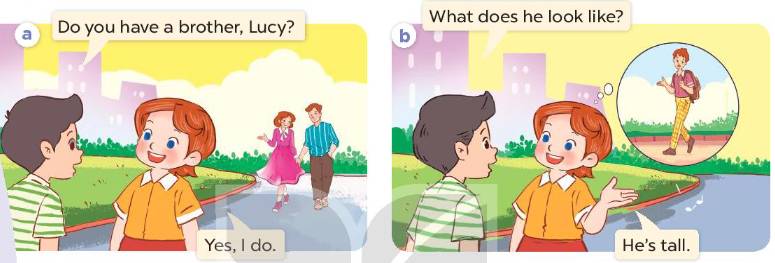
a.
Do you have a brother, Lucy? (Bạn có anh trai không Lucy?)
Yes, I do. (Tôi có.)
b.
What does he look like? (Anh ấy trông như thế nào?)
He’s tall. (Anh ấy cao.)
Look, listen and repeat.
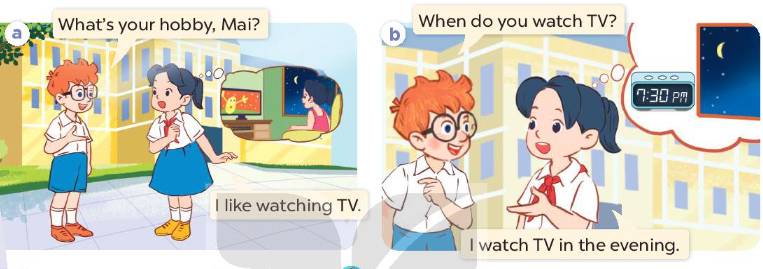
a.
What’s your hobby, Mai? (Sở thích của bạn là gì, Mai?)
I like watching TV. (Tôi thích xem Ti vi.)
b.
When do you watch TV? (Bạn xem ti vi khi nào?)
I watch TV in the evening. (Tôi xem ti vi vào buổi tối.)
Look, listen and repeat.
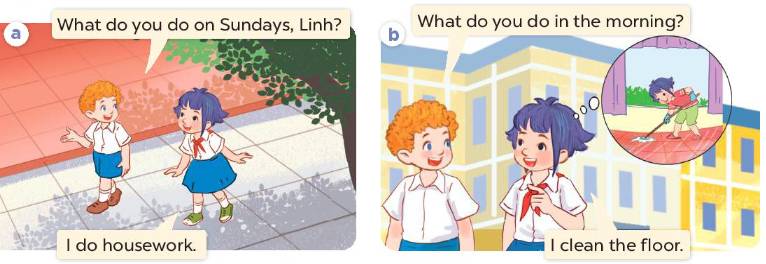
a.
What do you do on Sundays, Linh? (Bạn làm gì vào mỗi chủ nhật Linh?)
I do the housework. (Tôi làm việc nhà.)
b.
What do you do in the morning? (Bạn làm gì vào buổi sáng?)
I clean the floor. (Tôi lau nhà.)
Look, listen and repeat.
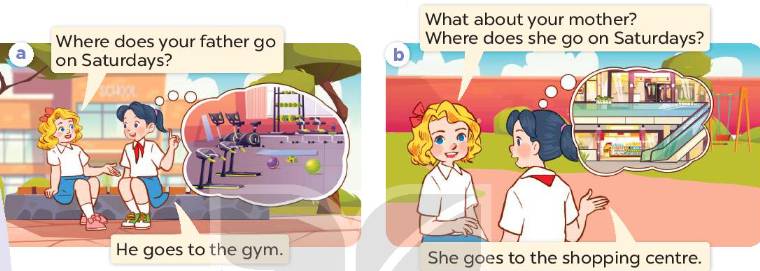
a.
Where does your father go on Saturdays? (Bố cậu đi đâu vào thứ bảy?)
He goes to the gym. (Ông ấy đi tập thể dục.)
b.
What about your mother? Where does she go on Saturdays? (Mẹ của bạn thì sao? Bà ấy đi đâu vào thứ bảy?)
She goes to the shopping center. (Bà ấy đi đến trung tâm thương mại.)
Look, listen and repeat.
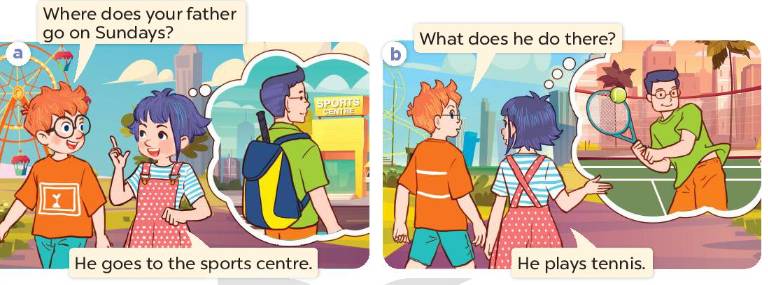
a.
Where does your father go on Sundays? (Bố của bạn đi đâu vào Chủ Nhật?)
He goes to the sport centre. (Ông ấy đi trung tâm thể thao.)
b.
What does he do there? (Ông ấy làm gì ở đó?)
He plays tennis. (Ông ấy chơi tennis.)