Giải phương trình:
\(\log^2_{\dfrac{1}{5}}x^2+\log_5x+2=0\)
Giải phương trình : \(\log^2_{\frac{1}{2}}x^2-\log_4x^4-20=0\)

-log22 x2_ log2x2- 20=0
↔ pt này vô ng bạn ơi!!! xem lại đầu bài.
Bài này phương trình có tận 4 nghiệm chứ không phải vô nghiệm đâu bạn Đỗ đại học nhé
Điều kiện \(x\ne0\)
Ta có từ phương trình ban đầu cho \(\Leftrightarrow4\log_2^2\left|x\right|-2\log_2\left|x\right|-20=0\)
\(\Leftrightarrow2\log_2^2\left|x\right|-\log_2\left|x\right|-10=0\)
Đặt \(t=\log_2\left|x\right|\) ta được phương trình \(2t^2-t-10=0\Leftrightarrow\begin{cases}t=-2\\t=\frac{5}{2}\end{cases}\)
Với \(t=2\Rightarrow\log_2\left|x\right|=-2\Leftrightarrow\left|x\right|=\frac{1}{4}\Leftrightarrow x=\pm\frac{1}{4}\)
Với \(t=\frac{5}{2}\Rightarrow\log_2\left|x\right|=\frac{5}{2}\Leftrightarrow\left|x\right|=\sqrt{32}\Leftrightarrow x=\pm\sqrt{32}\)
Vậy phương trình có 4 nghiệm : \(x=\frac{1}{4};x=-\frac{1}{4};x=\sqrt{32};x=-\sqrt{32}\)

Câu 11: Nghiệm của phương trình \(\log^2_{\frac{1}{2}} (x-2)-(2-x)\log_{2} (x-2)+3(x-5)=0\) là?
Giải các bất phương trình lôgarit sau :
a) \(\dfrac{\ln x+2}{\ln x-1}< 0\)
b) \(\log^2_{0,2}x-\log_{0,2}x-6\le0\)
c) \(\log\left(x^2-x-2\right)< 2\log\left(3-x\right)\)
d) \(\ln\left|x-2\right|+\ln\left|x+4\right|\le3\ln2\)
giải bất phương trình
a) \(log_5x>6\)
b) \(log_7x< 2\)
c) \(log_2x\le3\)
d) \(log_{\dfrac{1}{3}}x>27\)
a.
ĐKXĐ: \(x>0\)
\(log_5x>6\Rightarrow x>6^5\Rightarrow x>7776\)
b.
ĐKXĐ: \(x>0\)
\(log_7x< 2\Rightarrow\left\{{}\begin{matrix}x>0\\x< 7^2\end{matrix}\right.\) \(\Rightarrow0< x< 49\)
c.
\(log_2x\le3\Rightarrow\left\{{}\begin{matrix}x>0\\x\le3^2\end{matrix}\right.\) \(\Rightarrow0< x\le9\)
d.
\(log_{\dfrac{1}{3}}x>27\Rightarrow\left\{{}\begin{matrix}x>0\\x< \left(\dfrac{1}{3}\right)^{27}\end{matrix}\right.\)
\(\Rightarrow0< x< \dfrac{1}{3^{27}}\)
Giải các phương trình sau :
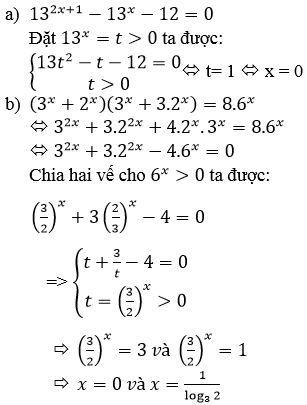
a) \(13^{2x+1}-13^x-12=0\)
b) \(\left(3^x+2^x\right)\left(3^x+3.2^x\right)=8.6^x\)
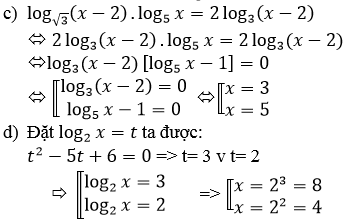
c) \(\log_{\sqrt{3}}\left(x-2\right).\log_5x=2.\log_3\left(x-2\right)\)
d) \(\log^2_2x-5\log_2x+6=0\)
a) Đặt t = 13x > 0 ta được phương trình:
13t2 – t – 12 = 0 ⇔ (t – 1)(13t + 12) = 0
⇔ t = 1 ⇔ 13x = 1 ⇔ x = 0
b)
Chia cả hai vế phương trình cho 9x ta được phương trình tương đương
(1+(23)x)(1+3.(23)x)=8.(23)x(1+(23)x)(1+3.(23)x)=8.(23)x
Đặt t=(23)xt=(23)x (t > 0) , ta được phương trình:
(1 + t)(1 + 3t) = 8t ⇔ 3t2 – 4t + 1 = 0 ⇔ t∈{13,1}t∈{13,1}
Với t=13t=13 ta được nghiệm x=log2313x=log2313
Với t = 1 ta được nghiệm x = 0
c) Điều kiện: x > 2
Vì nên phương trình đã cho tương đương với:
[log3(x−2)=0log5x=1⇔[x=3x=5[log3(x−2)=0log5x=1⇔[x=3x=5
d) Điều kiện: x > 0
log22x – 5log2x + 6 = 0
⇔(log2x – 2)(log2x – 3) = 0
⇔ x ∈ {4, 8}
Giải các bất phương trình :
a) \(2^{2x-1}+2^{2x-2}+2^{2x-3}\ge448\)
b) \(\left(0,4\right)^x-\left(2,5\right)^{x+1}>1,5\)
c) \(\log_3\left[\log_{\dfrac{1}{2}}\left(x^2-1\right)\right]< 1\)
d) \(\log^2_{0,2}x-5\log_{0,2}x< -6\)
1, \(log_{5x}\dfrac{5}{x}+log^{2_{ }}_5x=1\)
2, \(log_5\left(5^x-1\right).log_{25}\left(5^{x+1}-5\right)=1\)
3, \(2\left(log_3x^{ }\right)^2=log_3x.log_3\left(\sqrt{2x+1}-1\right)\)
- giải hộ 3 phương trình trên với
1/ ĐKXĐ: \(x>0\)
\(log_{5x}5-log_{5x}x+log_5^2x=1\)
\(\Leftrightarrow\dfrac{1}{log_55x}-\dfrac{1}{log_x5x}+log_5^2x=1\)
\(\Leftrightarrow\dfrac{1}{1+log_5x}-\dfrac{1}{1+log_x5}+log_5^2x-1=0\)
\(\Leftrightarrow\dfrac{1}{1+log_5x}-\dfrac{log_5x}{1+log_5x}+\left(log_5x-1\right)\left(log_5x+1\right)=0\)
\(\Leftrightarrow\dfrac{1-log_5x}{1+log_5x}-\left(1-log_5x\right)\left(1+log_5x\right)=0\)
\(\Leftrightarrow\left(1-log_5x\right)\left(\dfrac{1}{1+log_5x}-\left(1+log_5x\right)\right)=0\)
\(\Leftrightarrow\left[{}\begin{matrix}1-log_5x=0\\\dfrac{1}{1+log_5x}=1+log_5x\end{matrix}\right.\) \(\Leftrightarrow\left[{}\begin{matrix}1-log_5x=0\\1+log_5x=1\\1+log_5x=-1\end{matrix}\right.\) \(\Leftrightarrow\left[{}\begin{matrix}x=5\\x=1\\x=\dfrac{1}{25}\end{matrix}\right.\)
2/ ĐKXĐ: \(x>0\)
\(log_5\left(5^x-1\right).log_{25}\left(5^{x+1}-5\right)=1\)
\(\Leftrightarrow log_5\left(5^x-1\right).log_{5^2}5\left(5^x-1\right)=1\)
\(\Leftrightarrow log_5\left(5^x-1\right)\left(1+log_5\left(5^x-1\right)\right)=2\)
\(\Leftrightarrow log_5^2\left(5^x-1\right)+log_5\left(5^x-1\right)-2=0\)
\(\Leftrightarrow\left[{}\begin{matrix}log_5\left(5^x-1\right)=1\\log_5\left(5^x-1\right)=-2\end{matrix}\right.\) \(\Leftrightarrow\left[{}\begin{matrix}5^x-1=5\\5^x-1=\dfrac{1}{25}\end{matrix}\right.\) \(\Leftrightarrow\left[{}\begin{matrix}5^x=6\\5^x=\dfrac{26}{25}\end{matrix}\right.\)
\(\Leftrightarrow\left[{}\begin{matrix}x=log_56\\x=log_5\dfrac{26}{25}\end{matrix}\right.\)
3/ ĐKXĐ: \(x>0\)
\(2log_3^2x-log_3x.log_3\left(\sqrt{2x+1}-1\right)=0\)
\(\Leftrightarrow log_3x\left(2log_3x-log_3\left(\sqrt{2x+1}-1\right)\right)=0\)
\(\Leftrightarrow\left[{}\begin{matrix}log_3x=0\Rightarrow x=1\\2log_3x-log_3\left(\sqrt{2x+1}-1\right)=0\left(1\right)\end{matrix}\right.\)
Xét (1): \(log_3x^2=log_3\left(\sqrt{2x+1}-1\right)\Leftrightarrow x^2=\sqrt{2x+1}-1\)
\(\Leftrightarrow x^2+1=\sqrt{2x+1}\Leftrightarrow x^4+2x^2+1=2x+1\)
\(\Leftrightarrow x^4+2x^2-2x=0\Leftrightarrow x\left(x^3+2x-2\right)=0\)
\(\Leftrightarrow\left[{}\begin{matrix}x=0\left(l\right)\\x^3+2x-2=0\end{matrix}\right.\) ????
Pt bậc 3 kia có nghiệm rất xấu, chỉ giải được bằng công thức Cardano mà bậc phổ thông không học, nên bạn có chép đề sai không vậy?

Giải mỗi phương trình sau:
a) \({\log _5}\left( {2x - 4} \right) + {\log _{\frac{1}{5}}}\left( {x - 1} \right) = 0\)
b) \({\log _2}x + {\log _4}x = 3\)
a)
ĐK: \(\left\{{}\begin{matrix}2x-4>0\\x-1>0\end{matrix}\right.\Leftrightarrow x>1\)
\(\log_5\left(2x-4\right)+\log_{\dfrac{1}{5}}\left(x-1\right)=0\\ \Leftrightarrow\log_5\left(2x-4\right)-\log_5\left(x-1\right)=0\\ \Leftrightarrow\log_5\left(\dfrac{2x-4}{x-1}\right)=\log_51\\ \Leftrightarrow\dfrac{2x-4}{x-1}=1\\ \Leftrightarrow2x-4=x-1\\ \Leftrightarrow x=3\left(tm\right)\)
Vậy x = 3.
b) ĐK: x > 0
\(\log_2x+\log_4x=3\\ \Leftrightarrow\log_2x+\dfrac{1}{2}\log_2x=3\\ \Leftrightarrow\left(1+\dfrac{1}{2}\right)\log_2x=3\\ \Leftrightarrow\dfrac{3}{2}\log_2x=3\\ \Leftrightarrow\log_2x=2\\ \Leftrightarrow x=4\left(tm\right)\)
Vậy x= 4
1/ Giải phương trình sau:
\(tan^2\left(x+\dfrac{\pi}{3}\right)+\left(\sqrt{3}-1\right)tan\left(x+\dfrac{\pi}{3}\right)-\sqrt{3}=0\)
2/ Tìm hệ số của số hạng chứa \(x^{26}\) trong khai triển \(\left(\dfrac{1}{x^4}+x^7\right)^n\) . Biết \(C^2_{n+2}-4C^n_{n+1}=2\left(n+1\right)\) (n ∈ N* ; x > 0)
Câu 2:
\(\Leftrightarrow\dfrac{\left(n+2\right)!}{2!\cdot n!}-4\cdot\dfrac{\left(n+1\right)!}{n!\cdot1!}=2\left(n+1\right)\)
\(\Leftrightarrow\dfrac{\left(n+1\right)\left(n+2\right)}{2}-4\cdot\dfrac{n+1}{1}=2\left(n+1\right)\)
\(\Leftrightarrow\left(n+1\right)\left(n+2\right)-8\left(n+1\right)=4\left(n+1\right)\)
=>(n+1)(n+2-8-4)=0
=>n=-1(loại) hoặc n=10
=>\(A=\left(\dfrac{1}{x^4}+x^7\right)^{10}\)
SHTQ là: \(C^k_{10}\cdot\left(\dfrac{1}{x^4}\right)^{10-k}\cdot x^{7k}=C^k_{10}\cdot1\cdot x^{11k-40}\)
Số hạng chứa x^26 tương ứng với 11k-40=26
=>k=6
=>Số hạng cần tìm là: \(210x^{26}\)