Tìm x, biết:
a) x2-x-30=0
b)-2x2-4x+2=0
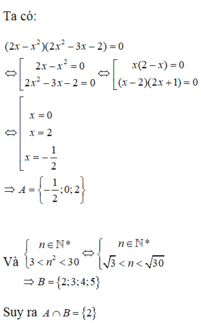
Cho hai tập A = x ∈ ℝ ( 2 x − x 2 ) ( 2 x 2 − 3 x − 2 ) = 0 và B = n ∈ ℕ * 3 < n 2 < 30 . Tìm A ∩ B .
A. A ∩ B = 2 ; 4
B. A ∩ B = 2
C. A ∩ B = 4 ; 5
D. A ∩ B = 3

Giải các phương trình tích sau:
1.a)(3x – 2)(4x + 5) = 0 b) (2,3x – 6,9)(0,1x + 2) = 0
c)(4x + 2)(x2 + 1) = 0 d) (2x + 7)(x – 5)(5x + 1) = 0
2. a)(3x + 2)(x2 – 1) = (9x2 – 4)(x + 1)
b)x(x + 3)(x – 3) – (x + 2)(x2 – 2x + 4) = 0
c)2x(x – 3) + 5(x – 3) = 0 d)(3x – 1)(x2 + 2) = (3x – 1)(7x – 10)
3.a)(2x – 5)2 – (x + 2)2 = 0 b)(3x2 + 10x – 8)2 = (5x2 – 2x + 10)2
c)(x2 – 2x + 1) – 4 = 0 d)4x2 + 4x + 1 = x2
4. a) 3x2 + 2x – 1 = 0 b) x2 – 5x + 6 = 0
c) x2 – 3x + 2 = 0 d) 2x2 – 6x + 1 = 0
e) 4x2 – 12x + 5 = 0 f) 2x2 + 5x + 3 = 0
Bài 1:
a) (3x - 2)(4x + 5) = 0
<=> 3x - 2 = 0 hoặc 4x + 5 = 0
<=> 3x = 2 hoặc 4x = -5
<=> x = 2/3 hoặc x = -5/4
b) (2,3x - 6,9)(0,1x + 2) = 0
<=> 2,3x - 6,9 = 0 hoặc 0,1x + 2 = 0
<=> 2,3x = 6,9 hoặc 0,1x = -2
<=> x = 3 hoặc x = -20
c) (4x + 2)(x^2 + 1) = 0
<=> 4x + 2 = 0 hoặc x^2 + 1 # 0
<=> 4x = -2
<=> x = -2/4 = -1/2
d) (2x + 7)(x - 5)(5x + 1) = 0
<=> 2x + 7 = 0 hoặc x - 5 = 0 hoặc 5x + 1 = 0
<=> 2x = -7 hoặc x = 5 hoặc 5x = -1
<=> x = -7/2 hoặc x = 5 hoặc x = -1/5
bài 2:
a, (3x+2)(x^2-1)=(9x^2-4)(x+1)
(3x+2)(x-1)(x+1)=(3x-2)(3x+2)(x+1)
(3x+2)(x-1)(x+1)-(3x-2)(3x+2)(x+1)=0
(3x+2)(x+1)(1-2x)=0
b, x(x+3)(x-3)-(x-2)(x^2-2x+4)=0
x(x^2-9)-(x^3+8)=0
x^3-9x-x^3-8=0
-9x-8=0
tự tìm x nha
Cho biểu thức P= 1+ 3/x2+5x+6 : ( 8x2/ 4x3-8x2 - 3x/ 3x2-12 -1/x+2)
A) Rút gọn P
B) Tìm các giá trị của x để P= 0; P= 1
C) Tìm cã giá trị của x để P> 0
Cho biểu thức
Q= (2x-x2/ 2x2 +8 - 2x2/ 3x3-2x2+4x-8) (2/x2 + 1-x/x)
A) Rút gọn Q
B) Tìm giá trị nguyên của x để Q có giá trị nguyên
Bài 1:
a) Ta có: \(P=1+\dfrac{3}{x^2+5x+6}:\left(\dfrac{8x^2}{4x^3-8x^2}-\dfrac{3x}{3x^2-12}-\dfrac{1}{x+2}\right)\)
\(=1+\dfrac{3}{\left(x+2\right)\left(x+3\right)}:\left(\dfrac{8x^2}{4x^2\left(x-2\right)}-\dfrac{3x}{3\left(x-2\right)\left(x+2\right)}-\dfrac{1}{x+2}\right)\)
\(=1+\dfrac{3}{\left(x+2\right)\left(x+3\right)}:\left(\dfrac{4}{x-2}-\dfrac{x}{\left(x-2\right)\left(x+2\right)}-\dfrac{1}{x+2}\right)\)
\(=1+\dfrac{3}{\left(x+2\right)\left(x+3\right)}:\dfrac{4\left(x+2\right)-x-\left(x-2\right)}{\left(x-2\right)\left(x+2\right)}\)
\(=1+\dfrac{3}{\left(x+2\right)\left(x+3\right)}\cdot\dfrac{\left(x-2\right)\left(x+2\right)}{4x+8-x-x+2}\)
\(=1+3\cdot\dfrac{\left(x-2\right)}{\left(x+3\right)\left(2x+10\right)}\)
\(=1+\dfrac{3\left(x-2\right)}{\left(x+3\right)\left(2x+10\right)}\)
\(=\dfrac{\left(x+3\right)\left(2x+10\right)+3\left(x-2\right)}{\left(x+3\right)\left(2x+10\right)}\)
\(=\dfrac{2x^2+10x+6x+30+3x-6}{\left(x+3\right)\left(2x+10\right)}\)
\(=\dfrac{2x^2+19x-6}{\left(x+3\right)\left(2x+10\right)}\)
Tìm x biết:
a. x3 – 25x = 0 b. 3x(x- 2) – x + 2 = 0
c. x2 – 4x - 5 = 0 d.x3 – x2 + 3x – 3 = 0
e. x3 + 27 + ( x + 3)( x – 9) = 0
a: \(\Leftrightarrow x\left(x-5\right)\left(x+5\right)=0\)
\(\Leftrightarrow\left[{}\begin{matrix}x=0\\x=5\\x=-5\end{matrix}\right.\)
1. Tìm x,y:
a) (x+2)2 + (x-3)2 = 2x ( x+ 7)
b) x3- 3x2 + 3x - 126 = 0
c) x2 + y2 - 2x + 4y + 5 = 0
d) 2x2 - 2xy + y2 + 4x + 4 = 0
\(a.\left(x^2+4x+4\right)+\left(x^2-6x+9\right)=2x^2+14x\)
\(x^2+4x+4+x^2-6x+9-2x^2-14x=0\)
\(-18x+13=0\)
\(x=\dfrac{13}{18}\)
Vậy \(S=\left\{\dfrac{13}{18}\right\}\)
\(b.\left(x-1\right)^3-125=0\)
\(\left(x-1\right)^3=125\)
\(x-1=5\)
\(x=6\)
Vậy \(S=\left\{6\right\}\)
\(c.\left(x-1\right)^2+\left(y +2\right)^2=0\)
\(Do\left(x-1\right)^2\ge0\forall x;\left(y+2\right)^2\ge0\forall y\)
\(\Rightarrow\left(x-1\right)^2+\left(y+2\right)^2\ge0\forall x,y\)
Mà \(\left(x-1\right)^2+\left(y+2\right)^2=0\)
\(\Rightarrow\left[{}\begin{matrix}\left(x-1\right)^2=0\\\left(y+2\right)^2=0\end{matrix}\right.\)
\(\Leftrightarrow\left[{}\begin{matrix}x-1=0\\y+2=0\end{matrix}\right.\Leftrightarrow\left[{}\begin{matrix}x=1\\y=-2\end{matrix}\right.\)
Vậy \(S=\left\{1;-2\right\}\)
\(d.x^2-4x+4+x^2-2xy+y^2=0\)
\(\left(x-2\right)^2+\left(x-y\right)^2=0\)
\(\Rightarrow\left[{}\begin{matrix}\left(x-2\right)^2=0\\\left(x-y\right)^2=0\end{matrix}\right.\)
\(\Leftrightarrow\left[{}\begin{matrix}x-2=0\\x-y=0\end{matrix}\right.\Leftrightarrow\left[{}\begin{matrix}x=2\\y=2\end{matrix}\right.\)
Vậy \(S=\left\{2;2\right\}\)
a. (x – 1)(5x + 3) = (3x – 8)(x – 1)
b. 3x(25x + 15) – 35(5x + 3) = 0
c. (2 – 3x)(x + 11) = (3x – 2)(2 – 5x)
d. (2x2 + 1)(4x – 3) = (2x2 + 1)(x – 12)
e. (2x – 1)2 + (2 – x)(2x – 1) = 0
f. (x + 2)(3 – 4x) = x2 + 4x + 4
\(a,\left(x-1\right)\left(5x+3\right)=\left(3x-8\right)\left(x-1\right)\)
\(\left(x-1\right)\left(5x+3-3x+8\right)=0\)
\(\left(x-1\right)\left(2x+11\right)=0\)
\(\Rightarrow\orbr{\begin{cases}x-1=0\\2x+11=0\end{cases}\Rightarrow\orbr{\begin{cases}x=1\\2x=-11\end{cases}\Rightarrow}\orbr{\begin{cases}x=1\\x=-\frac{11}{2}\end{cases}}}\)
\(b,3x\left(25x+15\right)-35\left(5x+3\right)=0\)
\(15x\left(5x+3\right)-35\left(5x+3\right)=0\)
\(\left(5x+3\right).5\left(3x-7\right)=0\)
\(\Rightarrow\orbr{\begin{cases}5x+3=0\\5\left(3x-7\right)=0\end{cases}\Rightarrow\orbr{\begin{cases}5x=-3\\3x-7=0\end{cases}\Rightarrow}\orbr{\begin{cases}x=-\frac{3}{5}\\3x=7\end{cases}\Rightarrow}\orbr{\begin{cases}x=-\frac{3}{5}\\x=\frac{7}{3}\end{cases}}}\)
\(c,\left(2-3x\right)\left(x+11\right)=\left(3x-2\right)\left(2-5x\right)\)
\(\left(3x-2\right)\left(2-5x\right)+\left(3x-2\right)\left(x+11\right)=0\)
\(\left(3x-2\right)\left(2-5x+x+11\right)=0\)
\(\left(3x-2\right)\left(13-4x\right)=0\)
\(\Rightarrow\orbr{\begin{cases}3x-2=0\\13-4x=0\end{cases}\Rightarrow\orbr{\begin{cases}3x=2\\4x=13\end{cases}\Rightarrow}\orbr{\begin{cases}x=\frac{2}{3}\\x=\frac{13}{4}\end{cases}}}\)
còn đâu tự lm lười :_#
1) Phân tích đa thức thành nhân tử
a) 2x4-4x3+2x2
b) 2x2-2xy+5x-5y
2) Tìm x, biết:
a) 4x(x-3)-x+3=0
b)(2x-3)2-(x+1)2=0
1.
a) \(2x^4-4x^3+2x^2\)
\(=2x^2\left(x^2-2x+1\right)\)
\(=2x^2\left(x-1\right)^2\)
b) \(2x^2-2xy+5x-5y\)
\(=\left(2x^2-2xy\right)+\left(5x-5y\right)\)
\(=2x\left(x-y\right)+5\left(x-y\right)\)
\(=\left(x-y\right)\cdot\left(2x+5\right)\)
2 .
a,
\(4x\left(x-3\right)-x+3=0\)
⇒\(4x\left(x-3\right)-\left(x-3\right)=0\)
⇒\(\left(x-3\right)\left(4x-1\right)=0\)
⇒\(\left[{}\begin{matrix}x-3=0\\4x-1=0\end{matrix}\right.\)
⇔\(\left[{}\begin{matrix}x=3\\4x=1\end{matrix}\right.\)
⇔\(\left[{}\begin{matrix}x=3\\x=\dfrac{1}{4}\end{matrix}\right.\)
vậy \(x\in\left\{3;\dfrac{1}{4}\right\}\)
b,
\(\)\(\left(2x-3\right)^2-\left(x+1\right)^2=0\)
⇒\(\left(2x-3-x-1\right)\left(2x-3+x+1\right)\) = 0
⇒\(\left(x-4\right)\left(3x-2\right)=0\)
⇔\(\left[{}\begin{matrix}x-4=0\\3x-2=0\end{matrix}\right.\)
⇔\(\left[{}\begin{matrix}x=4\\3x=2\end{matrix}\right.\)
⇔\(\left[{}\begin{matrix}x=4\\x=\dfrac{2}{3}\end{matrix}\right.\)
vậy \(x\in\left\{4;\dfrac{2}{3}\right\}\)
Cho biểu thức : P = x 2 - 2 x 2 x 2 + 8 - 2 x 2 8 - 4 x + 2 x 2 - x 3 1 - 1 x - 2 x 2 x ≠ 0 , x ≠ 2
a) Rút gọn biểu thức P
b) Tính giá trị biểu thức P với x = 1/2
a) Ta có: 2x2 + 8 = 2(x2 + 4).
8 – 4x + 2x2 – x3
= (8 – x3) - ( 4x - 2x2)
= (2 – x).(4 + 2x + x2) - 2x.(2 - x)
= (2 – x).(4 + 2x + x2 – 2x)
= (2 - x). (4 + x2 )
* Do đó:
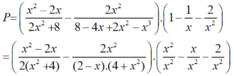
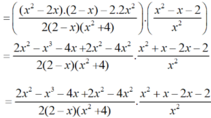
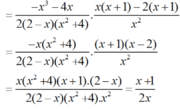
b) Tại x = 1 2 hàm số đã cho xác định nên thay x = 1 2 vào biểu thức rút gọn của P ta được:

Tìm x biết:
a) x 6 + 2 x 3 +1 = 0; b) x(x - 5) = 4x - 20;
c) x 4 -2 x 2 =8-4 x 2 ; d) ( x 3 - x 2 ) - 4 x 2 + 8x-4 = 0.
a) x = -1. b) x = 4 hoặc x = 5.
c) x = ± 2 . d) x = 1 hoặc x = 2.
giúp mình giải bài này với
giải phương trình
a) ( x2-2x+1)- 4 = 0(x2-2x+1)-4=0
b) x2-x= -2x+2x2-x=-2x+2
c) 4x2+4x+1= x24x2+4x+1= x2
d)x2-5x+6= 0x2-5x+6=0
\(a.\left(x^2-2x+1\right)-4=0\\\Leftrightarrow \left(x-1\right)^2-2^2=0\\\Leftrightarrow \left(x-1-2\right)\left(x-1+2\right)=0\\ \Leftrightarrow\left(x-3\right)\left(x+1\right)=0\\\Leftrightarrow \left[{}\begin{matrix}x-3=0\\x+1=0\end{matrix}\right.\Rightarrow\left[{}\begin{matrix}x=3\\x=-1\end{matrix}\right.\)
Vậy tập nghiệm của phương trình trên là \(S=\left\{3;-1\right\}\)
\(b.x^2-x=-2x+2\\\Leftrightarrow x^2-x+2x-2=0\\\Leftrightarrow x\left(x-1\right)+2\left(x-1\right)=0\\\Leftrightarrow \left(x+2\right)\left(x-1\right)=0\\\Leftrightarrow \left[{}\begin{matrix}x+2=0\\x-1=0\end{matrix}\right.\Rightarrow\left[{}\begin{matrix}x=-2\\x=1\end{matrix}\right.\)
Vậy tập nghiệm của phương trình trên là \(S=\left\{-2;1\right\}\)
\(c.4x^2+4x+1=x^2\\ \Leftrightarrow4\left(x^2+x+\frac{1}{4}\right)-x^2=0\\ \Leftrightarrow4\left(x+\frac{1}{2}\right)^2-x^2=0\\ \Leftrightarrow\left[2\left(x+\frac{1}{2}\right)-x\right]\left[2\left(x-\frac{1}{2}\right)+x\right]=0\\ \Leftrightarrow\left[{}\begin{matrix}2\left(x+\frac{1}{2}\right)-x=0\\2\left(x+\frac{1}{2}\right)+x=0\end{matrix}\right.\Rightarrow\left[{}\begin{matrix}2x+1-x=0\\2x+1+x=0\end{matrix}\right.\Rightarrow\left[{}\begin{matrix}x=-1\\x=-\frac{1}{3}\end{matrix}\right.\)
Vậy tập nghiệm của phương trình trên là \(S=\left\{-1;-\frac{1}{3}\right\}\)
\(d.x^2-5x+6=0\\ \Leftrightarrow x^2-2x-3x+6=0\\\Leftrightarrow x\left(x-2\right)-3\left(x-2\right)=0\\ \Leftrightarrow\left(x-3\right)\left(x-2\right)=0\\\Leftrightarrow \left[{}\begin{matrix}x-2=0\\x-3=0\end{matrix}\right.\Rightarrow\left[{}\begin{matrix}x=2\\x=3\end{matrix}\right.\)
Vậy tập nghiệm của phương trình trên là \(S=\left\{2;3\right\}\)