Giải phương trình: x4=4x+1
Giải các phương trình sau:
a, (9x2 - 4)(x + 1) = (3x +2)(x2 - 1)
b, (x - 1)2 - 1 + x2 = (1 - x)(x + 3)
c, (x2 - 1)(x + 2)(x - 3) = (x - 1)(x2 - 4)(x + 5)
d, x4 + x3 + x + 1 = 0
e, x3 - 7x + 6 = 0
f, x4 - 4x3 + 12x - 9 = 0
g, x5- 5x3 + 4x = 0
h, x4 - 4x3 + 3x2 + 4x - 4 = 0

a, \(\Leftrightarrow\left(9x^2-4\right)\left(x+1\right)-\left(3x+2\right)\left(x-1\right)\left(x+1\right)=0\)
\(\Leftrightarrow\left(x+1\right)\left(\left(9x^2-4\right)-\left(\left(3x+2\right)\left(x-1\right)\right)\right)=0\)
\(\Leftrightarrow\left(x+1\right)\left(9x^2-4-\left(3x^2-x-2\right)\right)=0\)
\(\Leftrightarrow\left(x+1\right)\left(9x^2-4-3x^2+x+2\right)=0\)
\(\Leftrightarrow\left(x+1\right)\left(3x^2+x-2\right)=0\)
\(\Leftrightarrow\left(x+1\right)=0;3x^2+x-2=0\)
=> x=-1
với \(3x^2+x-2=0\)
ta sử dụng công thức bậc 2 suy ra : \(x=\dfrac{2}{3};x=-1\)
Vậy ghiệm của pt trên \(S\in\left\{-1;\dfrac{2}{3}\right\}\)
b: \(\Leftrightarrow x^2-2x+1-1+x^2=x+3-x^2-3x\)
\(\Leftrightarrow2x^2-2x=-x^2-2x+3\)
\(\Leftrightarrow3x^2=3\)
hay \(x\in\left\{1;-1\right\}\)
c: \(\Leftrightarrow\left(x-1\right)\left(x+1\right)\left(x+2\right)\left(x-3\right)-\left(x-1\right)\left(x-2\right)\left(x+2\right)\left(x+5\right)=0\)
\(\Leftrightarrow\left(x-1\right)\left(x+2\right)\left[\left(x+1\right)\left(x-3\right)-\left(x-2\right)\left(x+5\right)\right]=0\)
\(\Leftrightarrow\left(x-1\right)\left(x+2\right)\left(x^2-2x-3-x^2-3x+10\right)=0\)
\(\Leftrightarrow\left(x-1\right)\left(x+2\right)\left(-5x+7\right)=0\)
hay \(x\in\left\{1;-2;\dfrac{7}{5}\right\}\)
Giải các phương trình sau:
a) 2 x − 1 3 + 6 3 x − 1 2 = 2 x + 1 3 + 6 x + 2 3 ;
b) x − 2 2 + 3 − 2 x 2 − 4 x − 4 x − 5 = x + 3 2 ;
c) x − 3 + 2 x − 3 − 1 3 = 3 − x 4 ;
d) x + 4 3 − 1 7 = 2 − x 7 + x 3 + x + 1 .
Gi ải các phương trình sau
e) x3-7x+6=0
f) x4-4x3+12x-9=0
g)x5-5x3+4x=0
h) x4-4x3+3x2+4x-4=0
a.
\(x^3-7x+6=0\)
\(\Leftrightarrow x^3-3x^2+2x+3x^2-9x+6=0\)
\(\Leftrightarrow x\left(x^2-3x+2\right)+3\left(x^2-3x+2\right)=0\)
\(\Leftrightarrow\left(x^2-3x+2\right)\left(x+3\right)=0\)
\(\Leftrightarrow\left(x^2-x-2x+2\right)\left(x+3\right)=0\)
\(\Leftrightarrow\left[x\left(x-1\right)-2\left(x-1\right)\right]\left(x+3\right)=0\)
\(\Leftrightarrow\left(x-1\right)\left(x-2\right)\left(x+3\right)=0\)
\(\Rightarrow\left[{}\begin{matrix}x=1\\x=2\\x=-3\end{matrix}\right.\)
f.
\(x^4-4x^3+12x-9=0\)
\(\Leftrightarrow x^4-4x^3+3x^2-3x^2+12x-9=0\)
\(\Leftrightarrow x^2\left(x^2-4x+3\right)-3\left(x^2-4x+3\right)=0\)
\(\Leftrightarrow\left(x^2-4x+3\right)\left(x^2-3\right)=0\)
\(\Leftrightarrow\left(x^2-x-3x+3\right)\left(x^2-3\right)=0\)
\(\Leftrightarrow\left[x\left(x-1\right)-3\left(x-1\right)\right]\left(x^2-3\right)=0\)
\(\Leftrightarrow\left(x-1\right)\left(x-3\right)\left(x^2-3\right)=0\)
\(\Rightarrow\left[{}\begin{matrix}x=1\\x=3\\x=\pm\sqrt{3}\end{matrix}\right.\)
g.
\(x^5-5x^3+4x=0\)
\(\Leftrightarrow x\left(x^4-5x^2+4\right)=0\)
\(\Leftrightarrow x\left(x^4-x^2-4x^2+4\right)=0\)
\(\Leftrightarrow x\left[x^2\left(x^2-1\right)-4\left(x^2-1\right)\right]=0\)
\(\Leftrightarrow x\left(x^2-1\right)\left(x^2-4\right)=0\)
\(\Leftrightarrow x\left(x-1\right)\left(x+1\right)\left(x-2\right)\left(x+2\right)=0\)
\(\Rightarrow\left[{}\begin{matrix}x=0\\x=\pm1\\x=\pm2\end{matrix}\right.\)
giải phương trình sau:
a. (9x2-4)(x+1) = (3x+2) (x2-1)
b. (x-1)2-1+x2 = (1-x)(x+3)
c. (x2-1)(x+2)(x-3) = (x-1)(x2-4)(x+5)
d. x4+x3+x+1=0
e. x3-7x+6 = 0
f. x4-4x3+12x-9 = 0
g. x5-5x3+4x = 0
h. x4-4x3+3x2+4x-4 = 0
m.n jup vs
Giải phương trình 1 - x 4 - x 2 = x - 1
A. x = 0
B. x = 5 4
C. x = 0; x = 5 4
D. Đáp án khác
Để phương trình x 4 + 4 x + m 4 + x 4 + 4 x + m 4 = 6 có đúng hai nghiệm thực phân biệt thì tất cả các giá trị thực của m là
A. m < 19
B. m > 19
C. m ≤ 19
D. m ≥ 19
Giải các phương trình: x4 + 5x2 + 1 = 0
x4 + 5x2 + 1 = 0 (1)
Đặt x2 = t, t > 0.
(1) trở thành: t2 + 5t + 1 = 0 (2)
Giải (2):
Có a = 1; b = 5; c = 1
⇒ Δ = 52 – 4.1.1 = 21 > 0
⇒ Phương trình có hai nghiệm:
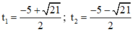
Cả hai nghiệm đều < 0 nên không thỏa mãn điều kiện.
Vậy phương trình (1) vô nghiệm.
1) Cho phương trình x 4 + m x 2 - m - 1 = 0(m là tham số)
a) Giải phương trình khi m = 2
1) x 4 + m x 2 - m - 1 = 0
a) Khi m = 2, phương trình trở thành: x 4 + 2 x 2 – 3 = 0
Đặt x 2 = t (t ≥ 0). Khi đó ta có phương trình: t 2 + 2t - 3 = 0
⇒ Phương trình có nghiệm t = 1 và t = -3 (do phương trình có dạng a + b + c = 0)
Do t ≥ 0 nên t = 1 ⇒ x 2 = 1 ⇒ x = ±1
Giải phương trình:
a) x4 - 2x3 + x2 - 4x +4 = 0
b) x4 + 2x3 - 3 = 0
c) 2x4 - 100x + 98 = 0
d) (x + 1)(x + 2)(x + 3)(x + 4) = 24
d: Ta có: \(\left(x+1\right)\left(x+2\right)\left(x+3\right)\left(x+4\right)=24\)
\(\Leftrightarrow\left(x^2+5x+4\right)\left(x^2+5x+6\right)-24=0\)
\(\Leftrightarrow x\left(x+5\right)=0\)
\(\Leftrightarrow\left[{}\begin{matrix}x=0\\x=-5\end{matrix}\right.\)
Giải phương trình: x 4 + x 3 + x 2 + x + 1 = 0
Ta thấy x = 1 không phải nghiệm của phương trình nên nhân 2 vế của phương trình với x - 1 ta có:
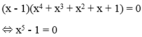
⇔ x = 1(KTM)
Vậy phương trình đã cho vô nghiệm.