Complete the sentences. Use will or be going to and the verbs in parentheses.
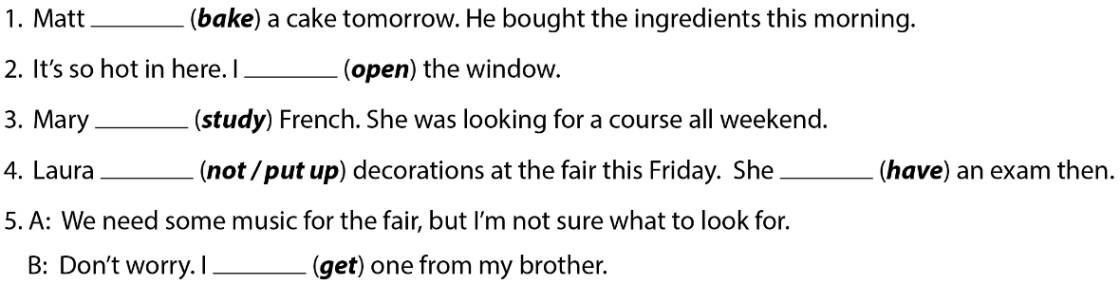
Exercise 1: Complete the sentences. Use the correct form of be going to and the verbs in brackets. Use contractions where possible.
*Note: do not use short form ('m/'s/'re). Use "am", "is" or "are" to complete the sentences.
1. I (take) Answer some photos at the weekend.
2. They (order) Answer a pizza for dinner.
3. We (not play) Answer football tomorrow.
4. Paul (get) Answer a summer job.
5. (you / phone) Answer me tonight?
6. (Greg / start) Answer university next year?

’m = am (I’m)
’re = are (you’re, we’re, they’re)
’s = is and has (he’s, she’s, it’s)
’ve = have (’ve, you’ve, we’ve, they’ve)
’ll = will (I’ll, you’ll, he’ll, she’ll, it’ll, we’ll, they’ll)
’d = had and would (I’d, you’d, he’d, she’d, it’d, we’d, they’d)
1 am going to take
2 are going to order
3 are not going to play
4 is going to get
5 are you going to phone
6 Is Greg going to start

Complete the sentences with the correct form of will or be going to and the verbs in brackets. Write which rule in the Learn this! box you are following.
1. That train ______________ (not stop) here - It's going too fast.
2. ‘We ______________ (spend) the weekend in Paris.’
‘Lucky you. You ______________ (have) a great time!’
3. ‘Help! I ______________ (drop) one of these boxes.’
‘Don't worry. I______________(take) one for you.’
4. I______________ (go) into town this afternoon. But I ______________ (not be) home late, I promise.
1. isn’t going to stop
2. are going to spend – will have
3. am going to drop – will take
4. am going to – won’t be
Complete the sentences by using the verbs in brackets and shall/ will or the correct form of be going to:
Craig: Hey Mark! What (0) are you going to do (you do) during half term?
Mark: You (7) ___________ (not believe) it but I (8) __________ (visit) Switzerland!
Craig: Really? That's so exciting! Switzerland is great. I'm sure you (9) _________ (love) it!
Mark: I think so, too. My family and I (10) __________ (stay) at a hotel near the Swiss Alps.
Craig: Wow!
Mark: Yeah, it's great I (11) __________ (play) in the snow every day. My brother and I (12) __________ also __________ (try) to learn how to ski.
Craig: You're so lucky. I wish I could go with you.
Mark: Maybe you ca. (13) __________ (I/ ask) my parents?
Craig: Definitely!
Mark: OK then. I (14) __________ (talks) to them tonight.
Craig: Great!
Mark: I think we should go to class now or we (15) __________ (be) late.
Craig: You're right. Let's go!
giúp mình nhá!Thanks
7 - won't believe
8 - will visit
9 - will love
10 - will stay
11 - will play
12 - will / try
13 - can I ask
14 - will talk
15 - will be
7 won't believe
8 am going to
9 will love
10 are going to stay
11 am going to play
12 will also try
13 Shall I ask
14 am going to talk
15 will be
I. Complete the sentences with the correct form of will or be going to and the verbs in brackets.
1. Are you tired? I _________ (take) you home.
2. I _________ (watch) a DVD tonight. Do you want to come round?
3. What _________ you _________ (wear) for your first day at work?
4. We haven’t got any sugar. I _________ (get) some in town later.
5. Look at the time! We _________ (be) late.
6. Oh, no! That cyclist _________ (hit) the black dog.
7. I _________ (see) you later.
8. _________ you _________ .(ask) him round for a drink?
II. Complete the short exchanges, using the correct form of will or be going to.
1. A It’s looking very dark outside.
B Yes, it _________ rain.
2. A It’s a bit cold in this room.
B OK. I _________ close the window.
3. A Can you come out this evening?
B I _________ know until I ask my parents.
4. A Are you doing anything on Sunday morning?
B No. I _________ stay in bed all morning.
5. A The white shirt is €15, and the blue shirt is €20.
B I _________ have the blue one, please.
6. A Have you got any plans for the summer?
B No. We _________ do anything this year.
1. Are you tired? I _____will take____ (take) you home.
2. I ____am going to watch_____ (watch) a DVD tonight. Do you want to come round?
3. What ____will _____ you ____wear_____ (wear) for your first day at work?
4. We haven’t got any sugar. I _____will get____ (get) some in town later.
5. Look at the time! We ____are going to be_____ (be) late.
6. Oh, no! That cyclist ___is going to hit______ (hit) the black dog.
7. I _____will see____ (see) you later.
8. ______Will___ you ______ask___ .(ask) him round for a drink?
II. Complete the short exchanges, using the correct form of will or be going to.
1. A It’s looking very dark outside.
B Yes, it ____is going to _____ rain.
2. A It’s a bit cold in this room.
B OK. I ____will_____ close the window.
3. A Can you come out this evening?
B I ____will not know until I ask my parents.
4. A Are you doing anything on Sunday morning?
B No. I ______am going to stay___ stay in bed all morning.
5. A The white shirt is €15, and the blue shirt is €20.
B I ______will have the blue one, please.
6. A Have you got any plans for the summer?
B No. We _____are going to____ do anything this year.
I. Complete the sentences. Put the verbs in brackets into the conditional sentences type 1 and type 2.
1. The bell (ring)…………..….. if there (be) …………..…..…..a fire.
2. If you (not learn) …………..…..…..how to use a computer, it will be hard to find a job.
3. I (offer)…………..…..….. to give you a lift if I had my car here.
4. If you(drive)…………..…..…..from London to Glasgow, which way would you go?
5. We (not have) …………..…..…..any money if we didn’t work.
6. If we reuse things, this(minimize) …………..…..…..the dependence of making new things.
7. If I were you, I (not wait) …………..…..….., I (go) …………..…..…..now.
8. If Mr. Tom was still head teacher, he(not permit) …………..…..….. such bad behavior.
9. If we (recycle) …………..…..…..glass, we(reduce) …………..…..…..air pollution by 20 percent.
10. If you (hear) …………..…..…..loud noise too often, you(have) …………..…..….. hearing loss.
II. Write the sentences with “if” for each situation. Use the conditional sentence type 1.
(5 points)
1. You drive fast. You have an accident.->………………………………………………..
2. He doesn’t stop smoking, he dies of lung cancer.->……………………………………
3. Your English is good. They accept you. ->…………………………………………
4. They don’t open the door. The room is very dark.
->………………………………………………..
5. We pollute the river. We don’t have water to use.
->………………………………………………..
III. Find the word which has different sound in the part underlined.
1. A. around B. various C. sound D. mountains
2. A. follow B. powder C. show D. borrow
3. A. typhoon B. cyclone C. shy D. sunny
4. A. thunder B. result C. erupt D. volume
IV Choose one word whose stress pattern is different from the others.
5. A. fantastic B. historic C. comic D. symbolic
6. A. economic B. phonetic C. energetic D. geographic
2, don't learn
3, would offer
4, drived
5, wouldn't have
6, will minimize
7, wouldn't wait, are going
8, wouldn't permit
Complete the following sentences with either “be going to” or “the present progressive”. Use the verbs in brackets
1. I can’t go any farther. I (sit) ______________ on that bench for a while
2. The games (start) ______________ at o’clock tomorrow. I hope you can be there
3. The service here is very slow. I (complain) ______________ to the manager, if we’re not served soon.
4. The two leaders (meet) ______________ for talks later this afternoon.
5. I have to get up early tomorrow. I (teach) ______________ a physics class at 8.00 in the morning.
6. Clear the area! The bomb (explode) ______________
7. The Browns (go) ______________ to the cinema this evening.
8. We (have) ______________ an English-speaking club meeting next week. Would you like to come?
1. am going to sit
is going to start
am going to complain
are meeting
am teaching
is exploding
is going to go
are having
1 am going to sit
2 is starting
3 am going to complain
4 are meeting
5 am teaching
6 is going to explode
7 are going
8 are going to have

2. Complete the sentences with the affirmative or negative form of be going to and the verbs in brackets.
(Hoàn thành các câu với dạng khẳng định hoặc phủ định của be going to và các động từ trong ngoặc.)
I'm going to see (see) a film at the cinema.
(Tôi sẽ đi xem một bộ phim ở rạp chiếu phim.)
They aren't going to go (go) to school tomorrow. X
(Họ sẽ không đi học vào ngày mai.)
1. You.................. (visit) your grandparents tomorrow. ✓
2. They..................... (travel) by train. X
3. Lily.................. (buy) a guidebook for Hà Nội. ✓
4. I................ (take) my phone or my tablet. ✓
5. We............... (stay) in a modern hotel. ✓
6. Pavel............... (study) Vietnamese next year. X
are going to visit
aren't going to travel
is going to buy
am going to take
are going to stay
isn't going to study
1. You are going to visit your grandparents tomorrow.
(Bạn sẽ về thăm ông bà vào ngày mai.)
2. They aren't going to travel by train.
(Họ sẽ không đi du lịch bằng tàu hỏa.)
3. Lily is going to buy a guidebook for Hà Nội.
(Lily sẽ mua một cuốn sách hướng dẫn về Hà Nội.)
4. I am not taking my phone or my tablet.
(Tôi sẽ không lấy điện thoại hoặc máy tính bảng của mình.)
5. We are going to stay in a modern hotel.
(Chúng tôi sẽ ở trong một khách sạn hiện đại.)
6. Pavel isn't going to study Vietnamese next year.
(Pavel sẽ không học tiếng Việt vào năm tới.)
III. Complete the following sentences with either “be going to” or “the present progressive”. Use the verbs in brackets
1. I can’t go any farther. I (sit) ______________ on that bench for a while
2. The games (start) ______________ at o’clock tomorrow. I hope you can be there
3. The service here is very slow. I (complain) ______________ to the manager, if we’re not served soon.
4. The two leaders (meet) ______________ for talks later this afternoon.
5. I have to get up early tomorrow. I (teach) ______________ a physics class at 8.00 in the morning.
6. Clear the area! The bomb (explode) ______________
7. The Browns (go) ______________ to the cinema this evening.
8. We (have) ______________ an English-speaking club meeting next week. Would you like to come?
Use used to or didn’t use to with the verbs from the box to complete the sentences.
be kill transport dye |
In many places in the world, people ………………… cloth with natural materials.