Cho hình hộp ABCD.A’B’C’D’. Chứng minh rằng:
a) \(\overrightarrow {AB} + \overrightarrow {DD'} + \overrightarrow {C'D'} = \overrightarrow {CC'} \);
b) \(\overrightarrow {AB} + \overrightarrow {CD'} - \overrightarrow {CC'} = \overrightarrow 0 \);
c) \(\overrightarrow {BC} - \overrightarrow {CC'} + \overrightarrow {DC} = \overrightarrow {A'C} \)
Bài 6. Vectơ trong không gian
Bài 2.4 (SGK Kết nối tri thức với cuộc sống trang 58)
Thảo luận (1)
Bài 2.3 (SGK Kết nối tri thức với cuộc sống trang 58)
Một chiếc bàn cân đối hình chữ nhật được đặt trên mặt sàn nằm ngang, mặt bàn song song với mặt sàn và bốn chân bàn vuông góc với mặt sàn như Hình 2.29. Trọng lực tác dụng lên bàn (biểu thị bởi vectơ overrightarrow a ) phân tán đều qua bốn chân bàn và gây nên các phản lực từ mặt sàn lên các chân bàn (biểu thị bởi các vectơ overrightarrow b ,overrightarrow c ,overrightarrow d ,overrightarrow e ).a) Hãy chỉ ra mối quan hệ về phương và hướng của các vectơ overrightarrow a ,overrightarrow b ,overrigh...
Đọc tiếp
Một chiếc bàn cân đối hình chữ nhật được đặt trên mặt sàn nằm ngang, mặt bàn song song với mặt sàn và bốn chân bàn vuông góc với mặt sàn như Hình 2.29. Trọng lực tác dụng lên bàn (biểu thị bởi vectơ \(\overrightarrow a \)) phân tán đều qua bốn chân bàn và gây nên các phản lực từ mặt sàn lên các chân bàn (biểu thị bởi các vectơ \(\overrightarrow b ,\overrightarrow c ,\overrightarrow d ,\overrightarrow e \)).
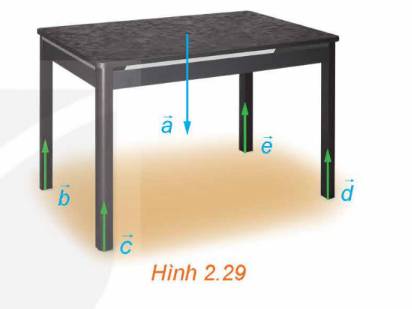
a) Hãy chỉ ra mối quan hệ về phương và hướng của các vectơ \(\overrightarrow a ,\overrightarrow b ,\overrightarrow c ,\overrightarrow d \) và \(\overrightarrow e \).
b) Giải thích vì sao các vectơ \(\overrightarrow b ,\overrightarrow c ,\overrightarrow d ,\overrightarrow e \) đôi một bằng nhau.
Thảo luận (1)Hướng dẫn giảia) Các vectơ \(\overrightarrow a ,\overrightarrow b ,\overrightarrow c ,\overrightarrow d \) và \(\overrightarrow e \) có cùng phương; các vectơ \(\overrightarrow a ,\overrightarrow b ,\overrightarrow c ,\overrightarrow d \) cùng hướng với nhau và ngược hướng với vectơ \(\overrightarrow e \).
b) Vì trọng lực tác dụng lên bàn phân tán đều qua bốn chân bàn và gây nên các phản lực từ mặt sàn lên các chân bàn nên các vectơ \(\overrightarrow b ,\overrightarrow c ,\overrightarrow d ,\overrightarrow e \) có độ lớn bằng nhau. Mà các vectơ \(\overrightarrow a ,\overrightarrow b ,\overrightarrow c ,\overrightarrow d \) cùng hướng với nhau. Do đó, các vectơ \(\overrightarrow b ,\overrightarrow c ,\overrightarrow d ,\overrightarrow e \) đôi một bằng nhau.
(Trả lời bởi Hà Quang Minh)
Bài 2.8 (SGK Kết nối tri thức với cuộc sống trang 58)
Trong Luyện tập 8, ta đã biết trọng tâm của tứ diện ABCD là một điểm I thỏa mãn overrightarrow {AI} 3overrightarrow {IG} , ở đó G là trọng tâm của tam giác BCD. Áp dụng tính chất trên để tính khoảng cách từ trọng tâm của một khối rubik (đồng chất) hình tứ diện đều đến một mặt của nó, biết rằng chiều cao của khối rubik là 8cm (H.2.30).
Đọc tiếp
Trong Luyện tập 8, ta đã biết trọng tâm của tứ diện ABCD là một điểm I thỏa mãn \(\overrightarrow {AI} = 3\overrightarrow {IG} \), ở đó G là trọng tâm của tam giác BCD. Áp dụng tính chất trên để tính khoảng cách từ trọng tâm của một khối rubik (đồng chất) hình tứ diện đều đến một mặt của nó, biết rằng chiều cao của khối rubik là 8cm (H.2.30).
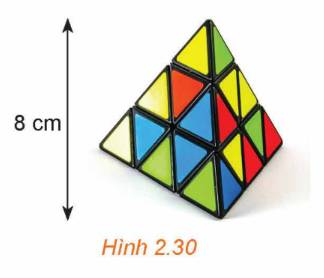
Thảo luận (1)Hướng dẫn giảiĐặt tên khối rubik là tứ diện đều ABCD có G là trọng tâm tam giác BCD, I là trọng tâm tứ diện ABCD. Do đó, \(\overrightarrow {AI} = 3\overrightarrow {IG} \Rightarrow IG = \frac{1}{4}AG\)
Vì chiều cao của rubik bằng 8cm nên \(AG = 8cm \Rightarrow IG = \frac{1}{4}.8 = 2\left( {cm} \right)\)
Vậy khoảng cách từ trọng tâm của một khối rubik (đồng chất) hình tứ diện đều đến một mặt của nó bằng 2cm.
(Trả lời bởi Hà Quang Minh)
Bài 2.5 (SGK Kết nối tri thức với cuộc sống trang 58)
Cho hình lăng trụ tam giác ABC.A’B’C’ có \(\overrightarrow {AA'} = \overrightarrow a ,\overrightarrow {AB} = \overrightarrow b \) và \(\overrightarrow {AC} = \overrightarrow c \). Hãy biểu diễn các vectơ sau qua các vectơ \(\overrightarrow a ,\overrightarrow b ,\overrightarrow c \):
a) \(\overrightarrow {AB'} \);
b) \(\overrightarrow {B'C} \);
c) \(\overrightarrow {BC'} \).
Thảo luận (1)Hướng dẫn giảia) Vì A’ABB’ là hình bình hành nên \(\overrightarrow {AB'} = \overrightarrow {AA'} + \overrightarrow {AB} = \overrightarrow a + \overrightarrow b \)
b) Vì A’ABB’ là hình bình hành nên \(\overrightarrow {AA'} = \overrightarrow {BB'} = \overrightarrow a \)
Ta có: \(\overrightarrow {BC} = \overrightarrow {BA} + \overrightarrow {AC} = - \overrightarrow b + \overrightarrow c \)
Vì C’CBB’ là hình bình hành nên
+ \(\overrightarrow {B'C'} = \overrightarrow {BC} = - \overrightarrow b + \overrightarrow c \)
+ \(\overrightarrow {B'C} = \overrightarrow {B'C'} + \overrightarrow {B'B} = - \overrightarrow b + \overrightarrow c - \overrightarrow a \)
c) Vì C’CBB’ là hình bình hành nên \(\overrightarrow {BC'} = \overrightarrow {BC} + \overrightarrow {BB'} = - \overrightarrow b + \overrightarrow c + \overrightarrow a \)
(Trả lời bởi Hà Quang Minh)
Bài 2.7 (SGK Kết nối tri thức với cuộc sống trang 58)
Cho hình chóp S.ABC. Trên cạnh SA, lấy điểm M sao cho \(SM = 2AM\). Trên cạnh BC, lấy điểm N sao cho \(CN = 2BN\). Chứng minh rằng \(\overrightarrow {MN} = \frac{1}{3}\left( {\overrightarrow {SA} + \overrightarrow {BC} } \right) + \overrightarrow {AB} \).
Thảo luận (1)Hướng dẫn giảiTa có: \(\overrightarrow {MN} = \overrightarrow {MA} + \overrightarrow {AC} + \overrightarrow {CN} = \frac{1}{3}\overrightarrow {SA} + \overrightarrow {AB} + \overrightarrow {BC} + \frac{2}{3}\overrightarrow {CB} \)
\( = \frac{1}{3}\overrightarrow {SA} + \overrightarrow {BC} - \frac{2}{3}\overrightarrow {BC} + \overrightarrow {AB} = \frac{1}{3}\left( {\overrightarrow {SA} + \overrightarrow {BC} } \right) + \overrightarrow {AB} \) (đpcm)
Ta có: \(\overrightarrow {MN} = \overrightarrow {MA} + \overrightarrow {AC} + \overrightarrow {CN} = \frac{1}{3}\overrightarrow {SA} + \overrightarrow {AB} + \overrightarrow {BC} + \frac{2}{3}\overrightarrow {CB} \)
\( = \frac{1}{3}\overrightarrow {SA} + \overrightarrow {BC} - \frac{2}{3}\overrightarrow {BC} + \overrightarrow {AB} = \frac{1}{3}\left( {\overrightarrow {SA} + \overrightarrow {BC} } \right) + \overrightarrow {AB} \) (đpcm)
(Trả lời bởi Hà Quang Minh)
Bài 2.9 (SGK Kết nối tri thức với cuộc sống trang 59)
Ba sợi dây không giãn với khối lượng không đáng kể được buộc chung một đầu và được kéo căng về ba hướng khác nhau (H.2.31). Nếu các lực kéo làm cho ba sợi dây ở trạng thái đứng yên thì khi đó ba sợi dây nằm trên cùng một mặt phẳng. Hãy giải thích vì sao.

Thảo luận (1)Hướng dẫn giảiGiá của các vectơ \(\overrightarrow {AC} \) và \(\overrightarrow {AE} \) cùng nằm trên mặt phẳng (ACDE). (1)
Vì DCAE là hình bình hành nên \(\overrightarrow {AC} + \overrightarrow {AE} = \overrightarrow {AD} \) (quy tắc hình bình hành)
Vì các lực kéo làm cho ba sợi dây ở trạng thái đứng yên nên \(\overrightarrow {AD} = - \overrightarrow {AB} \), do đó hai vectơ \(\overrightarrow {AD} \) và \(\overrightarrow {AB} \) có giá cùng nằm trên một mặt phẳng (ACDE). (2)
Từ (1) và (2) suy ra ba vectơ \(\overrightarrow {AC} \), \(\overrightarrow {AE} \) và \(\overrightarrow {AB} \) có giá cùng nằm trên mặt phẳng (ACDE).
Vậy khi các lực kéo làm cho ba sợi dây ở trạng thái đứng yên thì khi đó ba sợi dây nằm trên cùng một mặt phẳng
(Trả lời bởi Hà Quang Minh)
Bài 2.11 (SGK Kết nối tri thức với cuộc sống trang 59)
Trong không gian, cho hai vectơ \(\overrightarrow a \) và \(\overrightarrow b \) có cùng độ dài bằng 1. Biết rằng góc giữa hai vectơ đó là \({45^0}\), hãy tính:
a) \(\overrightarrow a .\overrightarrow b \);
b) \(\left( {\overrightarrow a + 3\overrightarrow b } \right).\left( {\overrightarrow a - 2\overrightarrow b } \right)\)
c) \({\left( {\overrightarrow a + \overrightarrow b } \right)^2}\).
Thảo luận (1)Hướng dẫn giảia) \(\overrightarrow a \cdot \overrightarrow b = \left| {\overrightarrow a } \right| \cdot \left| {\overrightarrow b } \right| \cdot \cos \left( {\overrightarrow a ,\overrightarrow b } \right) = 1.1.\cos {45^0} = \frac{{\sqrt 2 }}{2}\)
b) \(\left( {\overrightarrow a + 3\overrightarrow b } \right).\left( {\overrightarrow a - 2\overrightarrow b } \right) = {\overrightarrow a ^2} + \overrightarrow a .\overrightarrow b - 6{\overrightarrow b ^2} = 1 + \frac{{\sqrt 2 }}{2} - 6.1 = - 5 + \frac{{\sqrt 2 }}{2}\)
c) \({\left( {\overrightarrow a + \overrightarrow b } \right)^2} = {\overrightarrow a ^2} + 2\overrightarrow a .\overrightarrow b + {\overrightarrow b ^2} = 1 + 2.\frac{{\sqrt 2 }}{2} + 1 = 2 + \sqrt 2 \)
(Trả lời bởi Hà Quang Minh)
Bài 2.12 (SGK Kết nối tri thức với cuộc sống trang 59)
Cho tứ diện ABCD. Chứng minh rằng:
a) \(\overrightarrow {AB} .\overrightarrow {CD} = \overrightarrow {AC} .\overrightarrow {CD} + \overrightarrow {BC} .\overrightarrow {DC} \);
b) \(\overrightarrow {AB} .\overrightarrow {CD} + \overrightarrow {AC} .\overrightarrow {DB} + \overrightarrow {AD} .\overrightarrow {BC} = 0\).
Thảo luận (1)Hướng dẫn giảia) Ta có: \(\overrightarrow {AC} .\overrightarrow {CD} + \overrightarrow {BC} .\overrightarrow {DC} = \overrightarrow {AC} .\overrightarrow {CD} - \overrightarrow {BC} .\overrightarrow {CD} = \overrightarrow {CD} \left( {\overrightarrow {AC} + \overrightarrow {CB} } \right) = \overrightarrow {CD} .\overrightarrow {AB} \) (đpcm)
b) \(\overrightarrow {AB} .\overrightarrow {CD} + \overrightarrow {AC} .\overrightarrow {DB} + \overrightarrow {AD} .\overrightarrow {BC} = \overrightarrow {AB} .\overrightarrow {CD} + \left( {\overrightarrow {AB} + \overrightarrow {BC} } \right).\overrightarrow {DB} + \left( {\overrightarrow {AB} + \overrightarrow {BD} } \right).\overrightarrow {BC} \)
\( = \overrightarrow {AB} .\overrightarrow {CD} + \overrightarrow {AB} .\overrightarrow {DB} + \overrightarrow {BC} .\overrightarrow {DB} + \overrightarrow {AB} .\overrightarrow {BC} + \overrightarrow {BD} .\overrightarrow {BC} \)
\( = \overrightarrow {AB} .\left( {\overrightarrow {CD} + \overrightarrow {DB} + \overrightarrow {BC} } \right) + \left( {\overrightarrow {BC} .\overrightarrow {DB} + \overrightarrow {BD} .\overrightarrow {BC} } \right) = \overrightarrow {AB} .\left( {\overrightarrow {CB} + \overrightarrow {BC} } \right) + \overrightarrow {BC} \left( {\overrightarrow {DB} + \overrightarrow {BD} } \right) = 0\)
(Trả lời bởi Hà Quang Minh)
Bài 2.10 (SGK Kết nối tri thức với cuộc sống trang 59)
Cho hình lăng trụ tứ giác đều ABCD.A’B’C’D’ có độ dài mỗi cạnh đáy bằng 1 và độ dài mỗi cạnh bên bằng 2. Hãy tính góc giữa các cặp vectơ sau đây và tính tích vô hướng của mỗi cặp vectơ đó:
a) \(\overrightarrow {AA'} \) và \(\overrightarrow {C'C;} \)
b) \(\overrightarrow {AA'} \) và \(\overrightarrow {BC;} \)
c) \(\overrightarrow {AC} \) và \(\overrightarrow {B'A'} \).
Thảo luận (1)Hướng dẫn giảia) Vì AA’//CC’ nên hai vectơ \(\overrightarrow {AA'} \) và \(\overrightarrow {C'C} \) ngược hướng nhau.
Suy ra, \(\left( {\overrightarrow {AA'} ,\overrightarrow {C'C} } \right) = {180^0}\).
Do đó, \(\overrightarrow {AA'} .\overrightarrow {C'C} = \left| {\overrightarrow {AA'} } \right|.\left| {\overrightarrow {C'C} } \right|.\cos \left( {\overrightarrow {AA'} ,\overrightarrow {C'C} } \right) = 2.2.\cos {180^0} = - 4\)
b) Vì A’ADD’ là hình chữ nhật nên \(\widehat {A'AD} = {90^0}\)
Vì ABCD là hình vuông nên \(\overrightarrow {BC} = \overrightarrow {AD} \). Do đó, \(\left( {\overrightarrow {AA'} ,\overrightarrow {BC} } \right) = \left( {\overrightarrow {AA'} ,\overrightarrow {AD} } \right) = \widehat {A'AD} = {90^0}\)
Ta có: \(\overrightarrow {AA'} .\overrightarrow {BC} = \overrightarrow {AA'} .\overrightarrow {AD} = \left| {\overrightarrow {AA'} } \right|.\left| {\overrightarrow {AD} } \right|.\cos \left( {\overrightarrow {AA'} ,\overrightarrow {AD} } \right) = 2.1.\cos {90^0} = 0\)
c) Vì A’ABB’ là hình chữ nhật nên \(\overrightarrow {B'A'} = \overrightarrow {BA} \).
Vì ABCD là hình vuông nên \(\widehat {CAB} = {45^0}\) và \(AC = \sqrt 2 \)
Ta có: \(\overrightarrow {AC} .\overrightarrow {B'A'} = - \overrightarrow {AC} .\overrightarrow {AB} = - \left| {\overrightarrow {AC} } \right|.\left| {\overrightarrow {AB} } \right|.\cos \left( {\overrightarrow {AC} ,\overrightarrow {AB} } \right) = - \sqrt 2 .1.\cos {45^0} = - 1\)
(Trả lời bởi Hà Quang Minh)
Bài 2.6 (SGK Kết nối tri thức với cuộc sống trang 58)
Cho hình chóp tứ giác S. ABCD. Chứng minh rằng tứ giác ABCD là hình bình hành nếu và chỉ nếu \(\overrightarrow {SA} + \overrightarrow {SC} = \overrightarrow {SB} + \overrightarrow {SD} \).
Thảo luận (1)Hướng dẫn giảiChứng minh: Nếu tứ giác ABCD là hình bình hành thì \(\overrightarrow {SA} + \overrightarrow {SC} = \overrightarrow {SB} + \overrightarrow {SD} \)
Gọi O là tâm hình bình hành ABCD. Khi đó, O là trung điểm của AC, BD.
Suy ra \(\overrightarrow {OC} = - \overrightarrow {OA} ,\overrightarrow {OD} = - \overrightarrow {OB} \)
Ta có: \(\overrightarrow {SA} + \overrightarrow {SC} = \overrightarrow {SO} + \overrightarrow {OA} + \overrightarrow {SO} + \overrightarrow {OC} = 2\overrightarrow {SO} + \left( {\overrightarrow {OA} - \overrightarrow {OA} } \right) = 2\overrightarrow {SO} \)
\(\overrightarrow {SB} + \overrightarrow {SD} = \overrightarrow {SO} + \overrightarrow {OB} + \overrightarrow {SO} + \overrightarrow {OD} = 2\overrightarrow {SO} + \left( {\overrightarrow {OB} - \overrightarrow {OB} } \right) = 2\overrightarrow {SO} \)
Do đó, \(\overrightarrow {SA} + \overrightarrow {SC} = \overrightarrow {SB} + \overrightarrow {SD} \)
Chứng minh: Nếu \(\overrightarrow {SA} + \overrightarrow {SC} = \overrightarrow {SB} + \overrightarrow {SD} \) thì tứ giác ABCD là hình bình hành:
Ta có: \(\overrightarrow {SA} + \overrightarrow {SC} = \overrightarrow {SB} + \overrightarrow {SD} \Leftrightarrow \overrightarrow {SA} - \overrightarrow {SB} = \overrightarrow {SD} - \overrightarrow {SC} \Leftrightarrow \overrightarrow {BA} = \overrightarrow {CD} \)
Suy ra, hai vectơ \(\overrightarrow {BA} \) và \(\overrightarrow {CD} \) cùng hướng và có độ lớn bằng nhau.
Suy ra, \(AB = CD,\) AB//CD. Khi đó, tứ giác ABCD là hình bình hành.
Vậy tứ giác ABCD là hình bình hành nếu và chỉ nếu \(\overrightarrow {SA} + \overrightarrow {SC} = \overrightarrow {SB} + \overrightarrow {SD} \)
(Trả lời bởi Hà Quang Minh)