

Nguyễn Quốc Đạt
- Giáo viên CTVVIP
-

Cập nhật ảnh bìa

Tải lên
Từ máy tính của bạn
Cập nhật ảnh đại diện

Tải lên
Từ máy tính của bạn
Học tại trường
Chưa có thông tin
Đến từ
Quảng Bình , Chưa có thông tin
Số lượng câu hỏi
31763
Số lượng câu trả lời
32091
Điểm GP
595
Điểm SP
1704
Người theo dõi (79)


Đang theo dõi (12)





Chủ đề:
VIII. Looking backCâu hỏi:
Read the sentences using fall-rise intonation (  ). Then listen and compare. Practise saying them in pairs.
1. Shall we look for a part-time job to earn some pocket money?
2. Do you feel like doing a vegetarian cooking course?
3. Would you please give me some advice on how to set my goals?
4. Could you help me improve my communication skills?
Chủ đề:
VII. Communication and culture / CLILCâu hỏi:
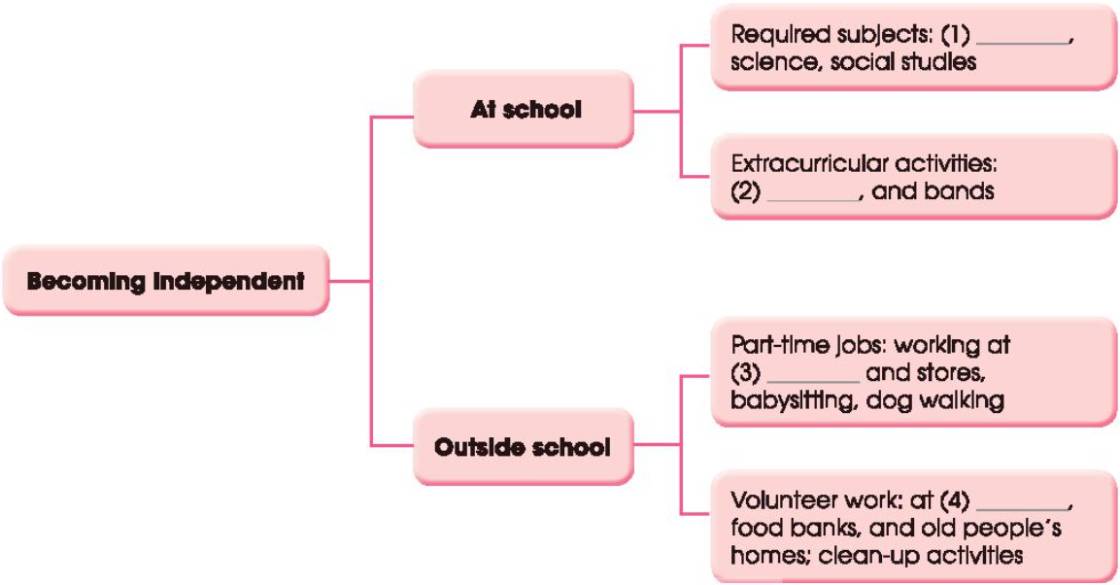
Read the text below and complete the diagram. Use no more than THREE words for each gap.
American parents usually encourage independence in their teenage children, and it is normal for teens to want more responsibility and freedom for their choices.
American teenagers often start high school with a basic plan of classes they need to take to get a high school diploma. Some subjects like English, maths, science, or social studies are required, others can be selected. Schools also provide extracurricular activities, such as sports, clubs, and bands. American teenagers who plan to go to college study hard to get good grades. They are highly motivated and very confident, and take responsibility for their learning.
Many American teenagers have part-time jobs as they want to gain work experience and learn how to manage their money. Many teens work at fast-food restaurants and stores, or do babysitting, and dog walking for neighbours. They also volunteer at local hospitals, food banks, and old people's homes, or take part in clean-up activities to improve their neighbourhood. This community service counts towards the volunteer hours that some schools require for university admission.
The teenage years form an important period of their development that influences adult life. The main goal of this period for most American teenagers is becoming independent, and they work hard both at school and outside school to achieve this goal.
Chủ đề:
VII. Communication and culture / CLILCâu hỏi:
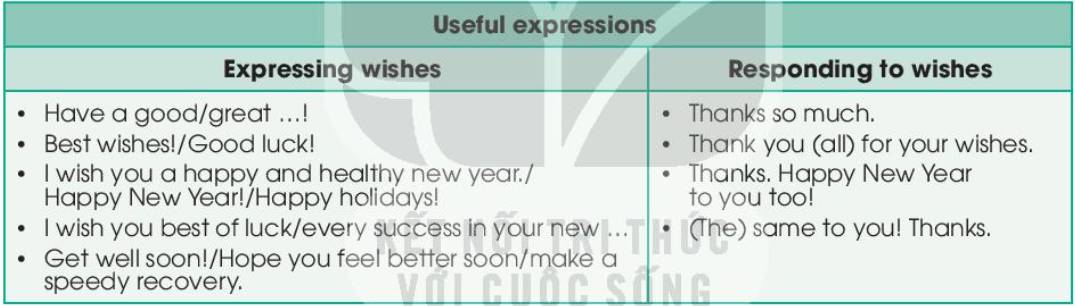
Work in pairs. Use the models in 1 to make similar conversations for these situations. One of you is Student A, the other is Student B. Use the expressions below to help you.
1. Student A is going to take an exam. Student B is expressing his/her wishes for Student A’s success.
2. Student B is not feeling well. Student A is expressing his/her wishes for Student B’s recovery.
Chủ đề:
VII. Communication and culture / CLILCâu hỏi:
Listen and complete the conversations with the expressions in the box. Then practise them in pairs.
A. Same to you
B. Have a great time
C. Happy New Year
D. Thanks so much
1.
Nam: Hey, I heard that you‘re going on a trip to Singapore tomorrow. (1) __________________!
Mike: Yep. (2) ________________.
2.
Kevin: Hi, Mai. (3) ________________! Wishing you a great year ahead!
Mai: Thanks, Kevin. (4) _______________! Hope all your dreams come true!
Chủ đề:
VI. WritingCâu hỏi:
Work in pairs. Read the following ideas and decide if they are pros or cons of self-study. Think of other pros and cons to add.
| Pros | Cons |
1. Self-study gives learners more freedom (e.g. they decide what to study and how). |
|
|
2. Learners need more time to learn things (e.g. they work on their own, with no one to push them or help them). |
|
|
3. Learners become responsible (e.g. they set their learning goals and make plans to achieve them). |
|
|
4. Learners may not develop certain life skills (e.g. good communication and relationship skills) |
|
|
5. Self-study makes learners confident ( e.g. they realise they can complete tasks by themselves) |
|
|
6. Learners may not learn practical skills (e.g. they may focus too much on learning, and may not apply the academic skills to real life) |
|
|
Chủ đề:
V. ListeningCâu hỏi:
Listen to the conversation again and answer each of the following questions using no more than THREE words or a number.
1. How many characteristics of independent learners does Mike find on the website?
2. What do independent learners take responsibility for?
3. What do they use to help them achieve their learning goals?
4. What are they not afraid of doing?
Chủ đề:
V. ListeningCâu hỏi:
Listen to a conversation between Mai and Mike, and choose the correct answers A, B, or C.
1. What is the conversation mainly about?
A. What motivates independent learners.
B. Independent learners’ sense of responsibility.
C. What makes a successful independent learner.
2. What makes independent learners study hard?
A. Their motivation for learning.
B. Their learning goals.
C. The responsibility for their own learning.
3. What do independent learners do if the task they are working on is too difficult?
A. They give up and move on to something harder.
B. They make every effort to finish it.
C. They ask questions about it.
4. Which of the following descriptions of independent leamers is NOT mentioned?
A. They're self-motivated and responsible.
B. They‘re confident and highly organised.
C. They’re curious about the world and they don't give up.