

Nguyễn Quốc Đạt
- Giáo viên CTVVIP
-

Cập nhật ảnh bìa

Tải lên
Từ máy tính của bạn
Cập nhật ảnh đại diện

Tải lên
Từ máy tính của bạn
Học tại trường
Chưa có thông tin
Đến từ
Quảng Bình , Chưa có thông tin
Số lượng câu hỏi
31763
Số lượng câu trả lời
30932
Điểm GP
587
Điểm SP
1685
Người theo dõi (79)


Đang theo dõi (11)





Chủ đề:
V. ListeningCâu hỏi:
Listen to the conversation again and answer each of the following questions using no more than THREE words or a number.
1. How many characteristics of independent learners does Mike find on the website?
2. What do independent learners take responsibility for?
3. What do they use to help them achieve their learning goals?
4. What are they not afraid of doing?
Chủ đề:
V. ListeningCâu hỏi:
Listen to a conversation between Mai and Mike, and choose the correct answers A, B, or C.
1. What is the conversation mainly about?
A. What motivates independent learners.
B. Independent learners’ sense of responsibility.
C. What makes a successful independent learner.
2. What makes independent learners study hard?
A. Their motivation for learning.
B. Their learning goals.
C. The responsibility for their own learning.
3. What do independent learners do if the task they are working on is too difficult?
A. They give up and move on to something harder.
B. They make every effort to finish it.
C. They ask questions about it.
4. Which of the following descriptions of independent leamers is NOT mentioned?
A. They're self-motivated and responsible.
B. They‘re confident and highly organised.
C. They’re curious about the world and they don't give up.
Chủ đề:
V. ListeningCâu hỏi:
Tick (✓) the columns to complete the following table about you. Compare your answer in pairs.
| Yes | No |
1. Are you interested in learning new things? |
|
|
2. Do you set your learning goals and make plans to achieve them? |
|
|
3. Do you try to understand a problem on your own before asking for help? |
|
|
4. Do you want to know more about the world? | |
Chủ đề:
IV. SpeakingCâu hỏi:
Read the following instructions on how to do laundry. Circle the correct answers.
There are several simple steps in doing laundry. First of all, (1) sort / don’t sort your clothes by colour. You should separate them into whites and colours and wash them separately. (2) Secondly / Finally, add the washing powder or liquid. Read the instructions on the packet to make sure you use the right amount. Then, (3) load / you load the washing machine and turn it on. Make sure you place the items one at atime. Don’t put too many items as they need room to move about in the water. When the washing machine stops, (4) remove / you will remove the wet clothes. You can hang the items to dry, or put them in the dryer. Remember that air-drying clothes saves energy and money. (5) Finally / Afterwards, don’t forget to hang or fold each item. You could also iron your clothes before storing them in the wardrobe or drawer.
Chủ đề:
IV. SpeakingCâu hỏi:
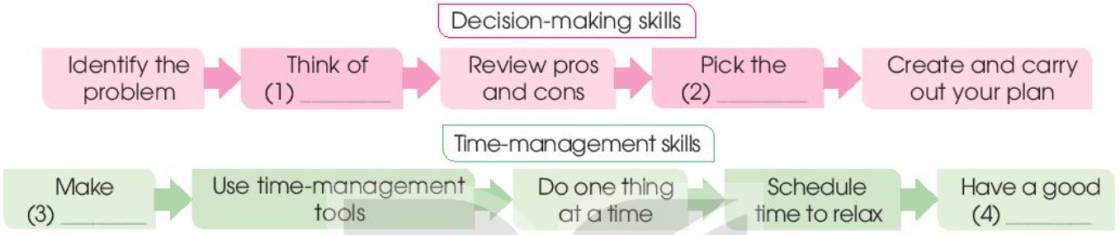
Work in pairs. Discuss these questions.
a. Have you ever done your laundry? If yes, how did you do it?
b. Below are some steps to do laundry. Put them in the correct order.

A. Hang or fold, and store your own clothes
B. Sort the clothes by colour
C. Remove the wet clothes from the washing machine and dry them
D. Add the washing powder or liquid
E. Load the washing machine and turn it on
Chủ đề:
III. ReadingCâu hỏi:
Read the text again and match the highlighted phrases in the text with their meanings.
1. get around | a. to start doing something regularly so that it becomes a habit |
2. come up with | b. to perform and complete something |
3. carry out | c. to go or travel to different places |
4. get into the habit of | d. to use something to achieve a particular result or benefit |
5. make use of | e. to produce or find an answer or a solution |