Work in groups. Name some endangered animals in Viet Nam. Share what you know about them.
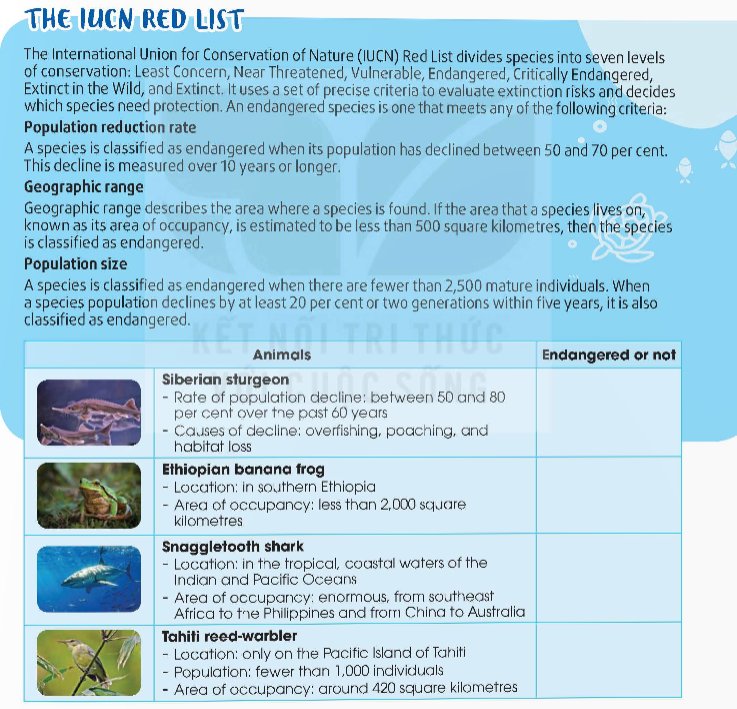
Read the following text. Put a tick (✓) if the animals in the table are classified as endangered and a cross (x) if they are not.

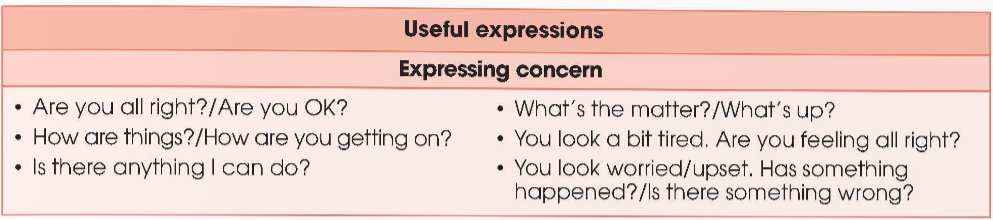
Work in pairs. Use the models in 1 to make similar conversations for these situations. One of you is A, the other is B. Use the expressions on page 109 to help you.
1. A looks worried because he/she hasn't collected enough information about endangered species for his/her biology project. B expresses concern about him/her.
2. B didn't join a school field trip to the Endangered Species Rescue Centre. A expresses concern about him/her.

Thảo luận (1)Hướng dẫn giải1.
A: I don't know what I'm going to do for my endangered species presentation.
(Tôi không biết mình sẽ làm gì trong bài thuyết trình về các loài có nguy cơ tuyệt chủng.)
B: What's the matter? You look worried.
(Có chuyện gì vậy? Bạn trông có vẻ lo lắng.)
A: I haven't been able to find enough information about the Sumatran orangutan. I really want to do a good job on this project.
(Tôi chưa thể tìm thấy đủ thông tin về đười ươi Sumatra. Tôi thực sự muốn làm tốt dự án này.)
B: Is there anything I can do? Maybe we can search together online after school?
(Tôi có thể làm gì được không? Có lẽ chúng ta có thể cùng nhau tìm kiếm trực tuyến sau giờ học?)
2.
A: Hey, I was surprised you weren't on the field trip to the rescue center today!
(Này, tôi rất ngạc nhiên là hôm nay bạn không tham gia chuyến đi thực tế đến trung tâm cứu hộ!)
B: Yeah, I wasn't feeling well enough to go this morning.
(Ừ, sáng nay tôi cảm thấy không khỏe để đi.)
A: You look a bit tired. Are you feeling alright?
(Trông bạn có vẻ hơi mệt mỏi. Bạn có cảm thấy ổn không?)
B: I'm feeling better now, thanks for asking.
(Bây giờ tôi thấy khỏe hơn rồi, cảm ơn vì đã hỏi thăm.)
(Trả lời bởi Nguyễn Quốc Đạt)
Listen and complete the conversations with the expressions in the box. Then practise them in pairs.
A. Has something happened? B. Is there something wrong? C. Is there anything I can do to help? D. Do you feel better now? |
1.
Nam: Hi, Linda. Why didn't you come to Cuc Phuong National Park with us yesterday? We were worried about you. (1) _______________
Linda: I had a stomachache, so I had to stay at home and rest.
Nam: Sorry to hear that. (2) _______________
Linda: I'm fine now. Thanks for asking.
2.
Mai: You look worried. (3) _______________
Nam: No, I'm just a bit nervous about my presentation on wildlife protection tomorrow.
Mai: (4) _______________
Nam: If you could look at my slides, it would be great. Thanks so much in advance, Mai.
Thảo luận (1)Hướng dẫn giải
1. A 2. D 3. B 4. C 1.
Nam: Hi, Linda. Why didn't you come to Cuc Phuong National Park with us yesterday? We were worried about you. Has something happened?
(Chào Linda. Tại sao hôm qua bạn không đến Vườn quốc gia Cúc Phương cùng chúng tôi? Chúng tôi đã lo lắng cho bạn. Có chuyện gì đã xảy ra à?)
Linda: I had a stomachache, so I had to stay at home and rest.
(Tôi bị đau bụng nên phải ở nhà nghỉ ngơi.)
Nam: Sorry to hear that. Do you feel better now?
(Rất tiếc khi nghe điều đó. Bây giờ bạn có cảm thấy tốt hơn không?)
Linda: I'm fine now. Thanks for asking.
(Giờ tôi ổn rồi. Cảm ơn vì đã hỏi thăm.)
2.
Mai: You look worried. Is there something wrong?
(Trông bạn có vẻ lo lắng. Có điều gì bất ổn à?)
Nam: No, I'm just a bit nervous about my presentation on wildlife protection tomorrow.
(Không, tôi chỉ hơi lo lắng về bài thuyết trình của mình về bảo vệ động vật hoang dã vào ngày mai.)
Mai: Is there anything I can do to help?
(Tôi có thể giúp gì được không?)
Nam: If you could look at my slides, it would be great. Thanks so much in advance, Mai.
(Nếu bạn có thể xem slide của tôi thì thật tuyệt. Cảm ơn trước rất nhiều, Mai.)
(Trả lời bởi Nguyễn Quốc Đạt)