Choose one of the problems in 1 and write a problem-solving report (180 words). Use the model in 2 and the outline with useful expressions below to help you.
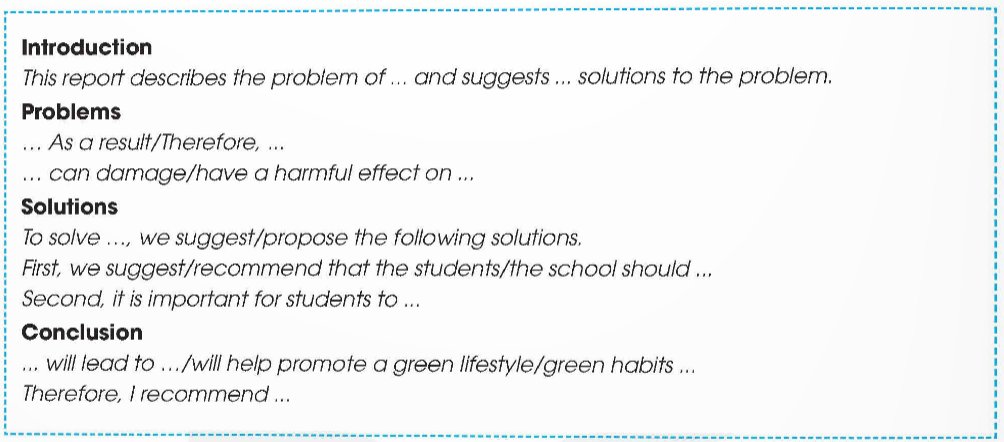
Choose one of the problems in 1 and write a problem-solving report (180 words). Use the model in 2 and the outline with useful expressions below to help you.
Read a problem-solving report and match the sections (A-D) with the correct headings (1-4).
1. Conclusion
2. Problems
3. Introduction
4. Solutions
A. ____
This report describes the problem of single-use plastics in our school and suggests three main solutions to the problem.
B. ____
Many students at our school buy bottled water or takeaway food. As a result, hundreds of water bottles and single-use plastic containers are thrown away every day. Besides, students often put containers with leftovers in them into the recycling bin, which can lead to contaminating the recyclable waste. This means our school produces a lot of plastic waste that goes to landfills and has a harmful effect on the environment.
C. ____
To solve this problem, we propose the following solutions. First, we suggest that the school should provide more recycling bins. Second, the Youth Union should hold regular sessions to teach students how to recycle properly. Third, we recommend that we make use of plastic waste in arts and crafts projects, for example, for making plant pots or bird feeders.
D. ____
Reusing and recycling single-use plastics will lead to a greener school environment and help promote a green lifestyle among young people. Therefore, we recommend you put the suggested solutions into practice as soon as possible.
Thảo luận (1)Hướng dẫn giải
1. B
2. C
3. D
4. A
Hướng dẫn dịch:
A. Giới thiệu
Báo cáo này mô tả vấn đề nhựa sử dụng một lần ở trường học của chúng ta và đề xuất ba giải pháp chính cho vấn đề này.
B. Vấn đề
Nhiều học sinh ở trường chúng ta mua nước đóng chai hoặc đồ ăn mang đi. Kết quả là hàng trăm chai nước và hộp nhựa dùng một lần bị vứt đi mỗi ngày. Ngoài ra, học sinh thường bỏ các thùng đựng thức ăn thừa vào thùng tái chế, điều này có thể gây ô nhiễm rác tái chế. Điều này có nghĩa là trường học của chúng ta thải ra rất nhiều rác thải nhựa được đưa đi chôn lấp và gây ảnh hưởng xấu đến môi trường.
C. Giải pháp
Để giải quyết vấn đề này, chúng tôi đề xuất các giải pháp sau. Đầu tiên, chúng tôi đề nghị nhà trường nên cung cấp thêm thùng tái chế. Thứ hai, Đoàn thanh niên nên tổ chức thường xuyên các buổi dạy học sinh cách tái chế rác thải đúng cách. Thứ ba, chúng tôi đề xuất rằng chúng ta nên tận dụng rác thải nhựa trong các dự án thủ công mỹ nghệ, chẳng hạn như làm chậu cây hoặc máng đựng thức ăn cho chim.
D. Kết luận
Tái sử dụng và tái chế nhựa dùng một lần sẽ mang lại môi trường học đường xanh hơn và giúp thúc đẩy lối sống xanh trong giới trẻ. Vì vậy, chúng tôi khuyên bạn nên áp dụng các giải pháp được đề xuất vào thực tế càng sớm càng tốt.
(Trả lời bởi Nguyễn Quốc Đạt)
Work in pairs. Complete the notes using the words in the box.
| compost piles automatic public transport recycle |
Problems & consequences | Green solutions |
Many single-use plastic products are thrown in rubbish bins. They take many years to decompose in landfills. | Use them in arts and crafts projects (e.g. making plant pots) or (1) _____ them |
People leave the lights on and the water running in restrooms. This is a waste of electricity and water. | Install (2) _____ lights and sensor taps that turn off when no one is around |
Dry leaves are sometimes burnt in the schoolyard. This can cause air pollution and fires. | Create (3) ______ |
Many parents drive their children to school and pick them up from school every day. This causes traffic jams, noise, and air pollution at the school gate. | Encourage more students to cycle or walk to school, or use (4) _____ to go to school (e.g. free bus tickets, cycle-to-school programme) |
Thảo luận (1)Hướng dẫn giải
1. reuse
2. automatic
3. compost piles
4. public transport
Hướng dẫn dịch:
(Trả lời bởi Nguyễn Quốc Đạt)
Vấn đề & hậu quả
Giải pháp xanh
Nhiều sản phẩm nhựa dùng một lần bị vứt vào thùng rác. Chúng phải mất nhiều năm để phân hủy ở các bãi chôn lấp.
Sử dụng chúng trong các dự án thủ công và nghệ thuật (ví dụ: làm chậu cây) hoặc tái sử dụng chúng
Mọi người để đèn sáng và nước chảy trong nhà vệ sinh. Đây là sự lãng phí điện và nước.
Lắp đèn tự động và vòi cảm biến tắt khi không có người xung quanh
Lá khô thỉnh thoảng bị đốt ở sân trường. Điều này có thể gây ô nhiễm không khí và hỏa hoạn.
Tạo đống phân trộn
Nhiều phụ huynh lái xe đưa con đến trường và đón con về trường hàng ngày. Điều này gây ra ùn tắc giao thông, tiếng ồn và ô nhiễm không khí ở cổng trường.
Khuyến khích nhiều học sinh đạp xe hoặc đi bộ đến trường hoặc sử dụng phương tiện giao thông công cộng để đến trường (ví dụ: vé xe buýt miễn phí, chương trình đạp xe đến trường)