Finished? Write some sentences using defining and non-defining clauses.
Language focus: Defining and non-defining relative clauses
Finished? (SGK Friends Plus - Trang 63)
Thảo luận (1)
Activity 6 (SGK Friends Plus - Trang 63)
USE IT! Write definitions for places, things and people using relative clauses. Then read your definitions to a partner. Can they guess what it is?
E.g.: It’s an animal which lives in the Caribbean and swims under water …
Thảo luận (1)Hướng dẫn giải- It is a place where people dine and enjoy meals prepared by chefs.
(Đó là nơi mọi người dùng bữa và thưởng thức những bữa ăn do các đầu bếp chế biến.)
- It is a device that processes information and performs various tasks using electronic components.
(Đó là thiết bị xử lý thông tin và thực hiện nhiều nhiệm vụ khác nhau bằng cách sử dụng các linh kiện điện tử.)
- It is a place where people can borrow books and access other educational resources for reading and research.
(Đó là nơi mọi người có thể mượn sách và tiếp cận các nguồn tài liệu giáo dục khác để đọc và nghiên cứu.)
(Trả lời bởi Nguyễn Quốc Đạt)
Activity 5 (SGK Friends Plus - Trang 63)
Listen and repeat. What is the difference between that in the two sentences?
1. That course sounds like a lot of fun.
2. You’ll visit places that you didn’t know existed.
Activity 4 (SGK Friends Plus - Trang 63)
Rewrite the sentences using defining or non-defining relative clauses.1. The book was very interesting. I borrowed it from the school library.The book __________________________________________________.2. Minh’s bicycle broke down. He had to take a bus to school.Minh __________________________________________________.3. All the students passed. They studied hard for the test.All the students __________________________________________________.4. Ha Long Bay is a magnificent natural wonder. It is...
Đọc tiếp
Rewrite the sentences using defining or non-defining relative clauses.
1. The book was very interesting. I borrowed it from the school library.
The book __________________________________________________.
2. Minh’s bicycle broke down. He had to take a bus to school.
Minh __________________________________________________.
3. All the students passed. They studied hard for the test.
All the students __________________________________________________.
4. Ha Long Bay is a magnificent natural wonder. It is located in Quảng Ninh province.
Ha Long Bay __________________________________________________.
5. We’re going to a place. We can see lions there.
We’re going __________________________________________________.
Activity 3 (SGK Friends Plus - Trang 63)
Read the examples and study the rules.a. The student who (that) won the math contest last year is from Hà Tĩnh.b. Hà Nội, which is the capital of Việt Nam, is famous for its landscapes.RULES 1. A defining clause gives information about the noun or pronoun it modifies. Defining clauses do not have commas. We use that instead of who, which in informal style.2. A non-defining clause gives extra information about the noun or pronoun it modifies and has a commas at the start. In non-defining clauses,...
Đọc tiếp
Read the examples and study the rules.
a. The student who (that) won the math contest last year is from Hà Tĩnh.
b. Hà Nội, which is the capital of Việt Nam, is famous for its landscapes.
RULES
1. A defining clause gives information about the noun or pronoun it modifies. Defining clauses do not have commas. We use that instead of who, which in informal style.
2. A non-defining clause gives extra information about the noun or pronoun it modifies and has a commas at the start. In non-defining clauses, we don’t use that.
Thảo luận (1)Hướng dẫn giải1. The book which I borrowed from the school library was very interesting.
(Cuốn sách mà tôi mượn nó từ thư viện trường rất thú vị.)
Giải thích: dùng đại từ quan hệ “which” thay thế cho danh từ chỉ vật “the book”
2. Minh, whose bicycle broke down, had to take a bus to school.
(Minh, xe đạp cậu ấy bị hỏng, đã phải bắt xe buýt tới trường.)
Giải thích: dùng đại từ quan hệ “whose” thay thế cho từ chỉ sự sở hữu “Minh’s”, “Minh” là tên riêng => dùng câu mệnh đề quan hệ không xác định
3. All the students who studied hard for the test passed.
(Tất cả những học sinh học tập chăm chỉ cho kỳ thi thì đều đã vượt qua.)
Giải thích: dùng đại từ quan hệ “who” thay thế cho từ chỉ người “all the students”
4. Ha Long Bay, which is located in Quảng Ninh province, is a magnificent natural wonder.
(Vịnh Hạ Long thuộc tỉnh Quảng Ninh là một kỳ quan thiên nhiên tráng lệ.)
Giải thích: dùng đại từ quan hệ “which” thay thế cho từ chỉ vật “Ha Long Bay”, “Ha Long Bay” là tên riêng => dùng câu mệnh đề quan hệ không xác định
5. We’re going to a place where we can see lions.
(Chúng ta sẽ đến một nơi mà chúng ta có thể nhìn thấy sư tử.)
Giải thích: dùng “where” thay thế cho từ chỉ địa điểm “a place
(Trả lời bởi Nguyễn Quốc Đạt)
Activity 2 (SGK Friends Plus - Trang 63)
Complete the sentences with who, whose, where or which. Which pronouns can be replaced with that?
1. I don’t know _____ bag this is.
2. Alaska is a place _____ you can see wild bears.
3. Is there anyone here _____ can speak Japanese?
4. Tom is the man _____ lives next door.
5. Sailing is something _____ I’d like to try.
Thảo luận (1)Hướng dẫn giải
1. I don’t know whose bag this is.
(Tôi không biết đây là túi của ai.)
Giải thích: whose + N: cái gì của ai
2. Alaska is a place where you can see wild bears.
(Alaska là nơi mà bạn có thể nhìn thấy những chú gấu hoang dã.)
Giải thích: where + S + V: nơi mà => dùng thay thế cho từ chỉ địa điểm “a place”
3. Is there anyone here who can speak Japanese?
(Ở đây có ai nói được tiếng Nhật không?)
Giải thích: who + V: người mà => dùng thay thế cho từ chỉ người “anyone”
4. Tom is the man who lives next door.
(Tom là người đàn ông sống bên cạnh.)
Giải thích: who + V: người mà => dùng thay thế cho từ chỉ người “the man”
5. Sailing is something which I’d like to try.
(Chèo thuyền là thứ tôi muốn thử.)
Giải thích: which + S + V: cái mà => dùng thay thế cho từ chỉ vật “something”
- “who” and “which” can be replaced with “that”.
(“who” và “which” có thể được thay thế bằng “that”.)
(Trả lời bởi Nguyễn Quốc Đạt)

Activity 1 (SGK Friends Plus - Trang 63)
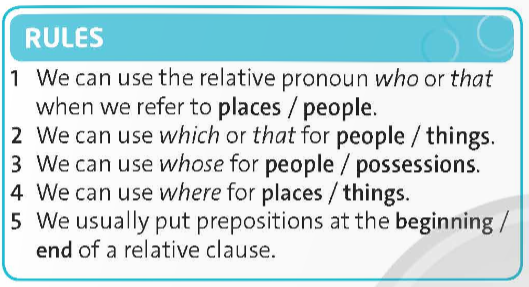
Study sentences a-f. Then choose the correct options to complete the rules.a. It’s good to do something that challenges you.b. You’ll be with people who have similar interests.c. You’ll visit some amazing destinations where the only inhabitants are wild animals.d. There are adults on board whose job is to teach you about sailing.e. That’s something which I’m worried about.f. People that apply must be hard-working.
Đọc tiếp
Study sentences a-f. Then choose the correct options to complete the rules.
a. It’s good to do something that challenges you.
b. You’ll be with people who have similar interests.
c. You’ll visit some amazing destinations where the only inhabitants are wild animals.
d. There are adults on board whose job is to teach you about sailing.
e. That’s something which I’m worried about.
f. People that apply must be hard-working.
Thảo luận (1)Hướng dẫn giải
1. We can use the relative pronoun who or that when we refer to people.
(Chúng ta có thể sử dụng đại từ quan hệ “who” hoặc “that” khi đề cập đến người.)
2. We can use which or that for things.
(Chúng ta có thể dùng “which” hoặc “that” cho sự vật.)
3. We can use whose for possessions.
(Chúng ta có thể dùng “whose” cho sự sở hữu.)
4. We can use where for places.
(Chúng ta có thể dùng “where” để chỉ địa điểm.)
5. We usually put prepositions at the beginning of a relative clause.
(Chúng ta thường đặt giới từ ở đầu mệnh đề quan hệ.)
(Trả lời bởi Nguyễn Quốc Đạt)
