


1:
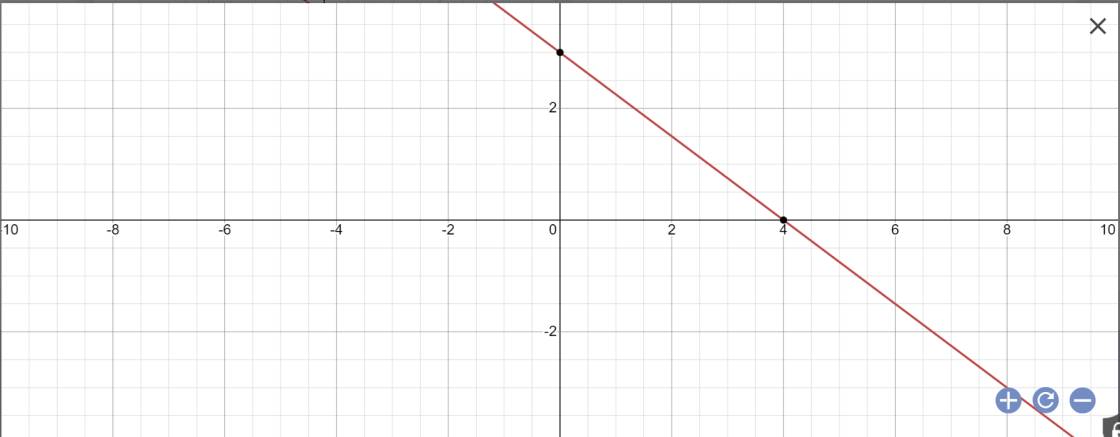
2: Tọa độ A là:
\(\left\{{}\begin{matrix}x=0\\y=-\dfrac{3}{4}x+3=-\dfrac{3}{4}\cdot0+3=3\end{matrix}\right.\)
Vậy: A(0;3)
Tọa độ B là:
\(\left\{{}\begin{matrix}y=0\\-\dfrac{3}{4}x+3=0\end{matrix}\right.\Leftrightarrow\left\{{}\begin{matrix}y=0\\-\dfrac{3}{4}x=-3\end{matrix}\right.\)
=>\(\left\{{}\begin{matrix}x=4\\y=0\end{matrix}\right.\)
Vậy: B(4;0)
O(0;0); A(0;3); B(4;0)
\(OA=\sqrt{\left(0-0\right)^2+\left(3-0\right)^2}=\sqrt{3^2+0^2}=3\)
\(OB=\sqrt{\left(4-0\right)^2+\left(0-0\right)^2}=\sqrt{4^2}=4\)
\(AB=\sqrt{\left(4-0\right)^2+\left(0-3\right)^2}=\sqrt{4^2+3^2}=5\)
Chu vi tam giác OAB là:
\(3+4+5=12\)
3: Vì (d1)//(d) nên \(\left\{{}\begin{matrix}a=-\dfrac{3}{4}\\b\ne3\end{matrix}\right.\)
Vậy: (d1): \(y=-\dfrac{3}{4}x+b\)
Thay x=-4 và y=1 vào (d1), ta được:
\(b-\dfrac{3}{4}\cdot\left(-4\right)=1\)
=>b+3=1
=>b=-2