
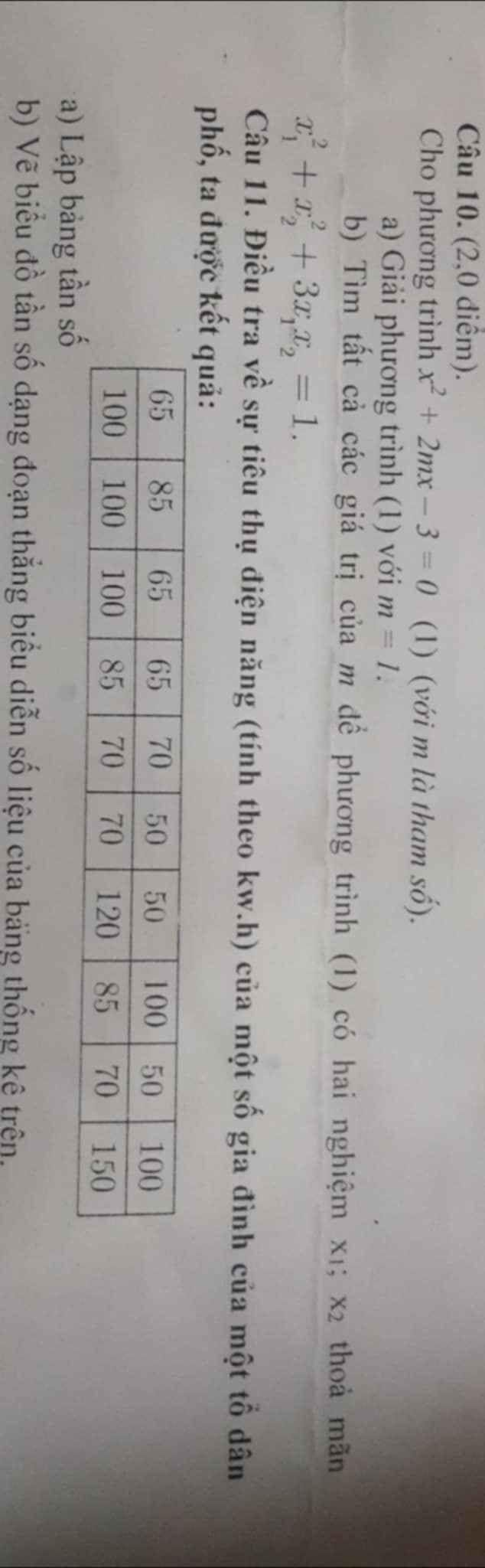



Câu 10:
a: Khi m=1 thì phương trình sẽ trở thành:
\(x^2+2\cdot1\cdot x-3=0\)
=>\(x^2+2x-3=0\)
=>(x+3)(x-1)=0
=>\(\left[{}\begin{matrix}x+3=0\\x-1=0\end{matrix}\right.\Leftrightarrow\left[{}\begin{matrix}x=-3\\x=1\end{matrix}\right.\)
b: \(x^2+2mx-3=0\)
a=1; b=2m; c=-3
Vì \(a\cdot c=1\cdot\left(-3\right)=-3< 0\)
nên phương trình luôn có hai nghiệm phân biệt
Theo Vi-et, ta có:
\(\left\{{}\begin{matrix}x_1+x_2=-\dfrac{b}{a}=-2m\\x_1x_2=\dfrac{c}{a}=-3\end{matrix}\right.\)
\(x_1^2+x_2^2+3x_1x_2=1\)
=>\(\left(x_1^2+2x_1x_2+x_2^2\right)+x_1x_2=1\)
=>\(\left(x_1+x_2\right)^2+x_1x_2=1\)
=>\(\left(-2m\right)^2+\left(-3\right)=1\)
=>\(4m^2=4\)
=>\(m^2=1\)
=>\(\left[{}\begin{matrix}m=1\\m=-1\end{matrix}\right.\)