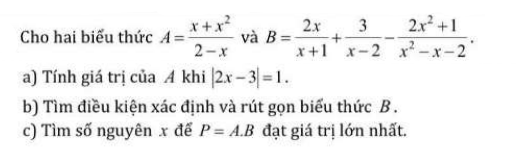



a: ĐKXĐ: x<>2
|2x-3|=1
=>\(\left[{}\begin{matrix}2x-3=1\\2x-3=-1\end{matrix}\right.\Leftrightarrow\left[{}\begin{matrix}2x=4\\2x=2\end{matrix}\right.\)
=>\(\left[{}\begin{matrix}x=2\left(loại\right)\\x=1\left(nhận\right)\end{matrix}\right.\)
Thay x=1 vào A, ta được:
\(A=\dfrac{1+1^2}{2-1}=\dfrac{2}{1}=2\)
b: ĐKXĐ: \(x\notin\left\{2;-1\right\}\)
\(B=\dfrac{2x}{x+1}+\dfrac{3}{x-2}-\dfrac{2x^2+1}{x^2-x-2}\)
\(=\dfrac{2x}{x+1}+\dfrac{3}{x-2}-\dfrac{2x^2+1}{\left(x-2\right)\left(x+1\right)}\)
\(=\dfrac{2x\left(x-2\right)+3\left(x+1\right)-2x^2-1}{\left(x-2\right)\left(x+1\right)}\)
\(=\dfrac{2x^2-4x+3x+3-2x^2-1}{\left(x-2\right)\left(x+1\right)}\)
\(=\dfrac{-x+2}{\left(x-2\right)\left(x+1\right)}=\dfrac{-1}{x+1}\)
c: P=A*B
\(=\dfrac{x+x^2}{2-x}\cdot\dfrac{-1}{x+1}\)
\(=\dfrac{x\left(x+1\right)}{\left(x+1\right)}\cdot\dfrac{1}{x-2}=\dfrac{x}{x-2}\)
\(=\dfrac{x-2+2}{x-2}=1+\dfrac{2}{x-2}\)
Để P max thì \(\dfrac{2}{x-2}\) max
=>x-2=1
=>x=3(nhận)