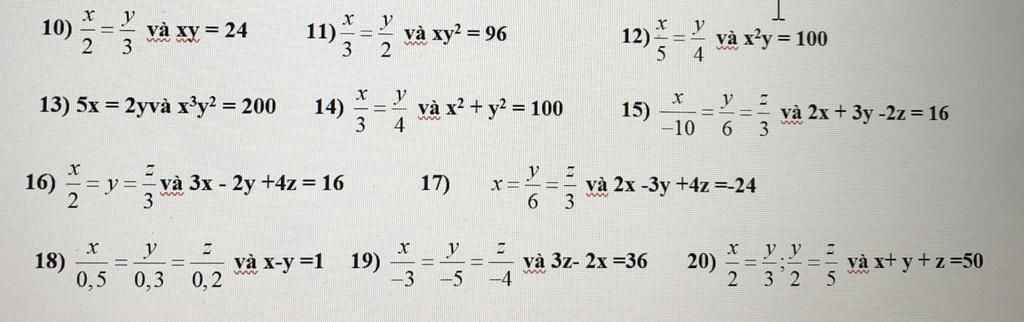


Bài 1:
a)\(\dfrac{x}{5}=\dfrac{y}{-3}\Rightarrow\dfrac{x^2}{25}=\dfrac{y^2}{9}\)
Áp dụng tính chất dãy tỉ số bằng nhau ta có:
\(\dfrac{x^2}{25}=\dfrac{y^2}{9}=\dfrac{x^2+y^2}{25+9}=\dfrac{34}{34}=1\)
\(\dfrac{x^2}{25}=1\Rightarrow x^2=25\Rightarrow\left[{}\begin{matrix}x=-5\\x=5\end{matrix}\right.\\ \dfrac{y^2}{9}=1\Rightarrow y^2=9\Rightarrow\left[{}\begin{matrix}y=-3\\y=3\end{matrix}\right.\)
Vậy \(\left(x,y\right)=\left\{\left(-5;-3\right);\left(5;3\right)\right\}\)
b) \(\dfrac{x}{4}=\dfrac{y}{7}\Rightarrow\dfrac{x^2}{16}=\dfrac{y^2}{49}\)
Áp dụng tính chất dãy tỉ số bằng nhau ta có:
\(\dfrac{x^2}{16}=\dfrac{y^2}{49}=\dfrac{x^2-y^2}{16-49}=\dfrac{-33}{-33}=1\)
\(\dfrac{x^2}{16}=1\Rightarrow x^2=16\Rightarrow\left[{}\begin{matrix}x=-4\\x=4\end{matrix}\right.\\ \dfrac{y^2}{49}=1\Rightarrow y^2=49\Rightarrow\left[{}\begin{matrix}x=-7\\x=7\end{matrix}\right.\)
Vậy \(\left(x,y\right)=\left\{\left(-4;-7\right);\left(4;7\right)\right\}\)


d: Ta có: 2x=5y
nên \(\dfrac{x}{5}=\dfrac{y}{2}=k\)
Suy ra: \(\left\{{}\begin{matrix}x=5k\\y=2k\end{matrix}\right.\)
Ta có: \(x^3+y^3=133\)
\(\Leftrightarrow k^3=1\)
hay k=1
Suy ra: x=5; y=2