Work in pairs. Discuss the following questions.
Which one do you prefer to live in: Ha Noi in the past or Ha Noi at present? Why?
Work in pairs. Discuss the following questions.
Which one do you prefer to live in: Ha Noi in the past or Ha Noi at present? Why?
Read the article again and complete the table using no more than THREE words and/or a number for each gap.

Thảo luận (1)Hướng dẫn giải1. 152
2. 8 / eight million
3. trams
4. metro / trains
5. low-rise buildings
Hướng dẫn dịch:
(Trả lời bởi Nguyễn Quốc Đạt)
Hà Nội
Thế kỷ 20
Bây giờ
Diện tích
khoảng 152 km2
hơn 3000 km2
Dân số
khoảng 530,000 người
hơn 8 triệu người
Phương tiện công cộng
xe điện và xe buýt
xe buýt hiện đại và xe điện
Kiến trúc
chủ yếu là nhà thấp tầng
nhiều tòa nhà cao tầng hơn
Read the article again. Put the main ideas in the order they appear in the article.
The correct order is:
1. _______________
2. _______________
3. _______________
4. _______________
A. Ha Noi's modern infrastructure and architecture
B. The challenges of urban growth
C. Ha Noi as a small city with old streets selling different products
D. 20th-century transport and architecture
Thảo luận (1)Hướng dẫn giảiThe correct order is:
(Thứ tự đúng là)
1 - C. Ha Noi as a small city with old streets selling different products
(Hà Nội như một thành phố nhỏ với những con phố cổ bán nhiều sản phẩm khác nhau)
2 - D. 20th-century transport and architecture
(Giao thông và kiến trúc thế kỷ 20)
3 - A. Ha Noi's modern infrastructure and architecture
(Cơ sở hạ tầng và kiến trúc hiện đại của Hà Nội)
4 - B. The challenges of urban growth
(Những thách thức của phát triển đô thị)
(Trả lời bởi Nguyễn Quốc Đạt)
Read the article. Choose the correct meanings of the highlighted words.
1. residents
A. people who live in a particular place
B. buildings in a particular place
2. colonial
A. connected with the native country
B. connected with a country that controls another country
3. gradually
A. slowly, over a period of time
B. quickly, over a short time
4. modernising
A. making something attractive
B. making use of the latest technology, design, etc.
5. concern
A. a feeling of satisfaction
B. a feeling of worry about something important
Thảo luận (1)Hướng dẫn giải
1. A
2. B
3. A
4. B
5. B
1. A
residents (cư dân)
A. people who live in a particular place (những người sống ở một nơi cụ thể)
B. buildings in a particular place (những tòa nhà ở một nơi cụ thể)
2. B
colonial (thuộc địa)
A. connected with the native country (gắn liền với quê hương)
B. connected with a country that controls another country (gắn liền với một quốc gia kiểm soát một quốc gia khác)
3. A
gradually (dần dần)
A. slowly, over a period of time (từ từ, trong một khoảng thời gian)
B. quickly, over a short time (nhanh chóng, trong một thời gian ngắn)
4. B
modernising (hiện đại hóa)
A. making something attractive (làm cái gì đó hấp dẫn)
B. making use of the latest technology, design, etc. (sử dụng công nghệ, thiết kế mới nhất, v.v.)
5. B
concern (mối quan tâm)
A. a feeling of satisfaction (cảm giác hài lòng)
B. a feeling of worry about something important (cảm giác lo lắng về điều gì đó quan trọng)
(Trả lời bởi Nguyễn Quốc Đạt)
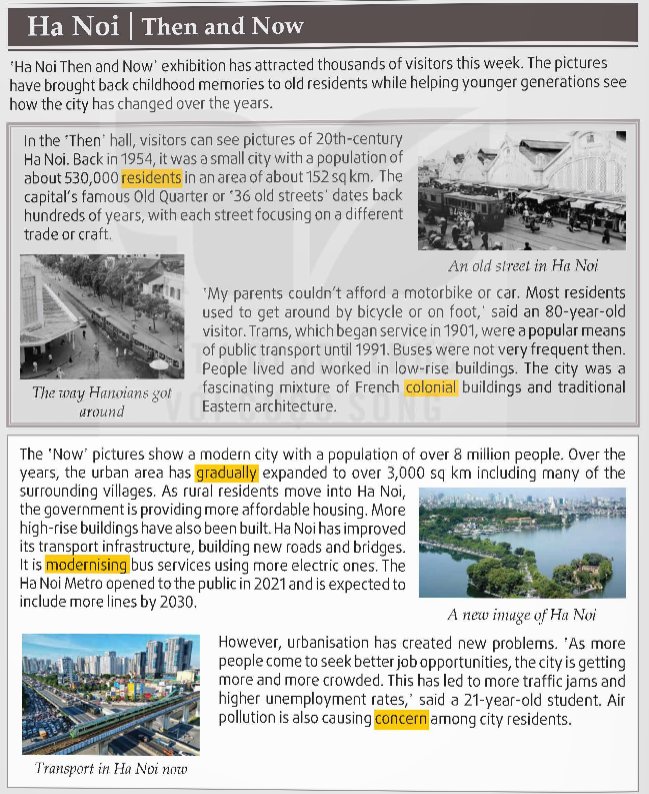
Work in pairs. Look at the pictures in the article in 2 below. Discuss the following questions.
1. What can you see in each picture?
2. What do the pictures tell you about Ha Noi and people's life in the city?
Thảo luận (1)Hướng dẫn giải1. In the first and second pictures, I can see old streets of Ha Noi. There were only low-rise buildings, and people mainly got around on foot, trishaw, bicycle or tram.
2. In the third and fourth pictures, I can see a present-day Hanoi with many high-rise buildings. There are more modern vehicles such as cars and trains. Streets are very busy, too.
Hướng dẫn dịch:
1. Trong bức ảnh thứ nhất và thứ hai, tôi có thể nhìn thấy những con phố cổ của Hà Nội. Chỉ có những tòa nhà thấp tầng và người dân chủ yếu di chuyển bằng cách đi bộ, xích lô, xe đạp hoặc xe điện.
2. Ở bức tranh thứ ba và thứ tư, tôi có thể thấy một Hà Nội ngày nay với nhiều tòa nhà cao tầng. Có nhiều phương tiện hiện đại hơn như ô tô và tàu hỏa. Đường phố cũng rất đông đúc.
(Trả lời bởi Nguyễn Quốc Đạt)