


Cập nhật ảnh bìa

Tải lên
Từ máy tính của bạn
Cập nhật ảnh đại diện

Tải lên
Từ máy tính của bạn
Học tại trường
Chưa có thông tin
Đến từ
Hà Nội , Chưa có thông tin
Số lượng câu hỏi
547
Số lượng câu trả lời
621
Điểm GP
211
Điểm SP
518
Người theo dõi (31)





Đang theo dõi (2)



Chủ đề:
Bài 6. Luyện tập: Cấu tạo vỏ nguyên tửCâu hỏi:
Cho 3,9 gam một kim loại kiềm tác dụng với H2O dư thu được 1,12 lit H2 (đktc).Xác định tên kim loại đó.
Hãy xác định ô nguyên tố, chu kì, nhóm; Công thức hợp chất khí với hiđro (nếu có), Công thức oxit, hiđroxit cao nhất, hiđroxit cao nhất có tính chất gì?






Chủ đề:
Unit 5: TECHNOLOGY AND YOUCâu hỏi:
Complete the second sentence so that it has a similar meaning to the first sentence, using the word gievn:
1. No-members cannot enter the sports center without a ticket ( allowed )
=> No-members ..............................................................................
2. My mother finished War and Peace in only 3 weeks ( took )
=> It only .................... .................... .............................................
3. George succeeded in putting up the tent on his own ( able )
=> George ......................................................................................
4. I didn’t go swimming with Sam because I was very busy ( too )
=> I was ............................................. ..............................................
5. Winning the football pools meant we could buy a new car ( enables )
=> Winning the football pools ..............................................
6. It took him a long time to paint this picture ( spent )
=> He ................................................................ .............................................
7. Calling Jim is pointless because his phone is out of order ( no )
=> It’s ...............................................................................................................
8. It might be a good idea to use honey instead of sugar ( using )
=>Why don’t you......................................................
Chủ đề:
VocabularyCâu hỏi:
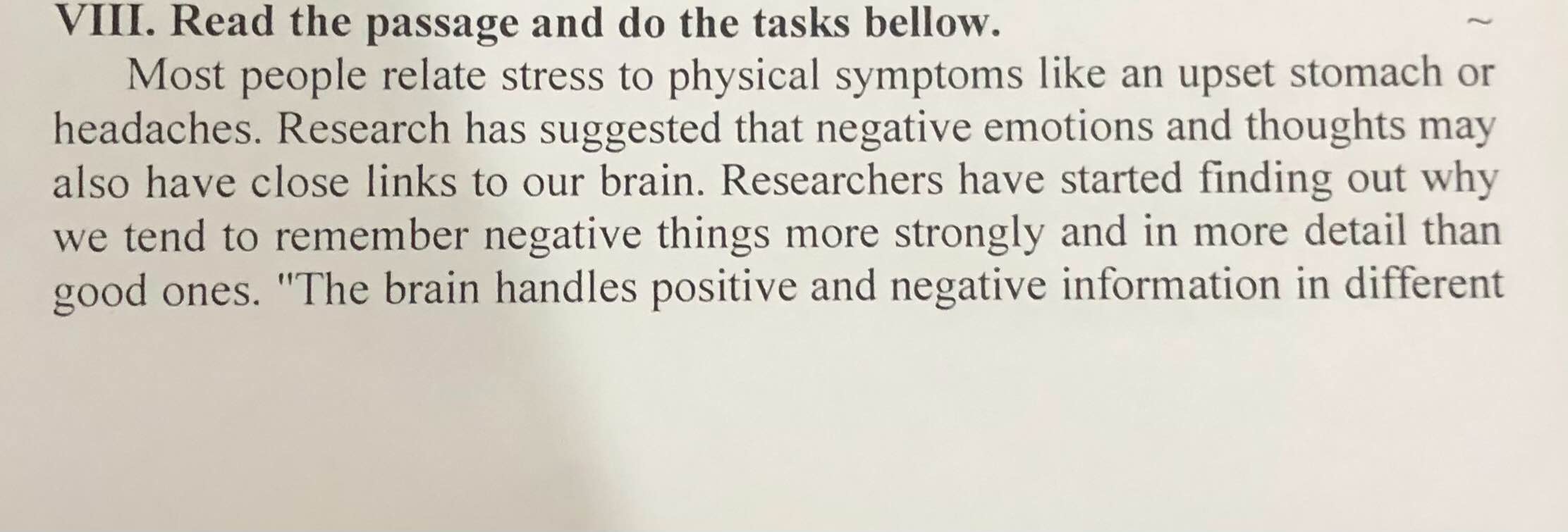
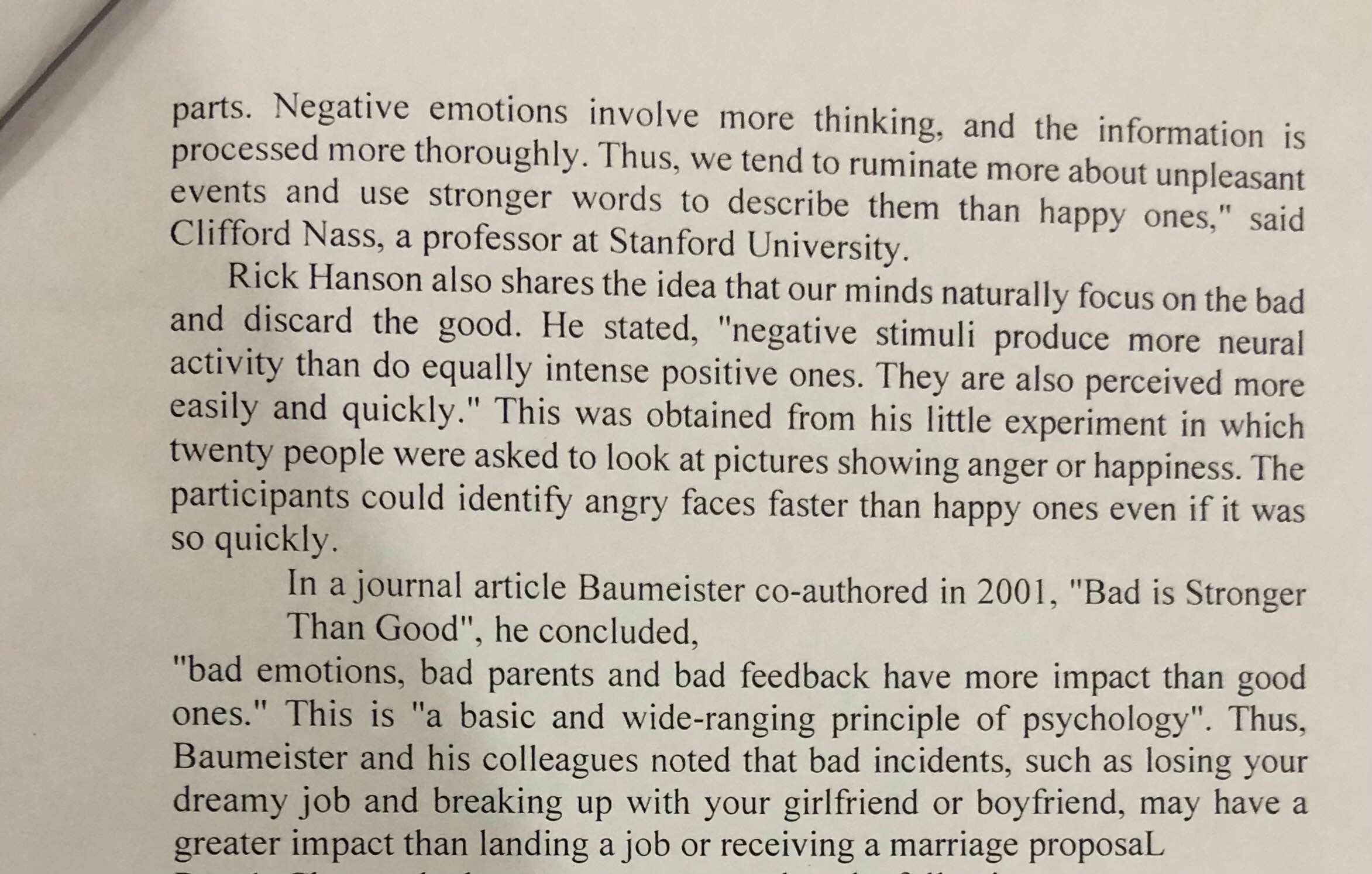
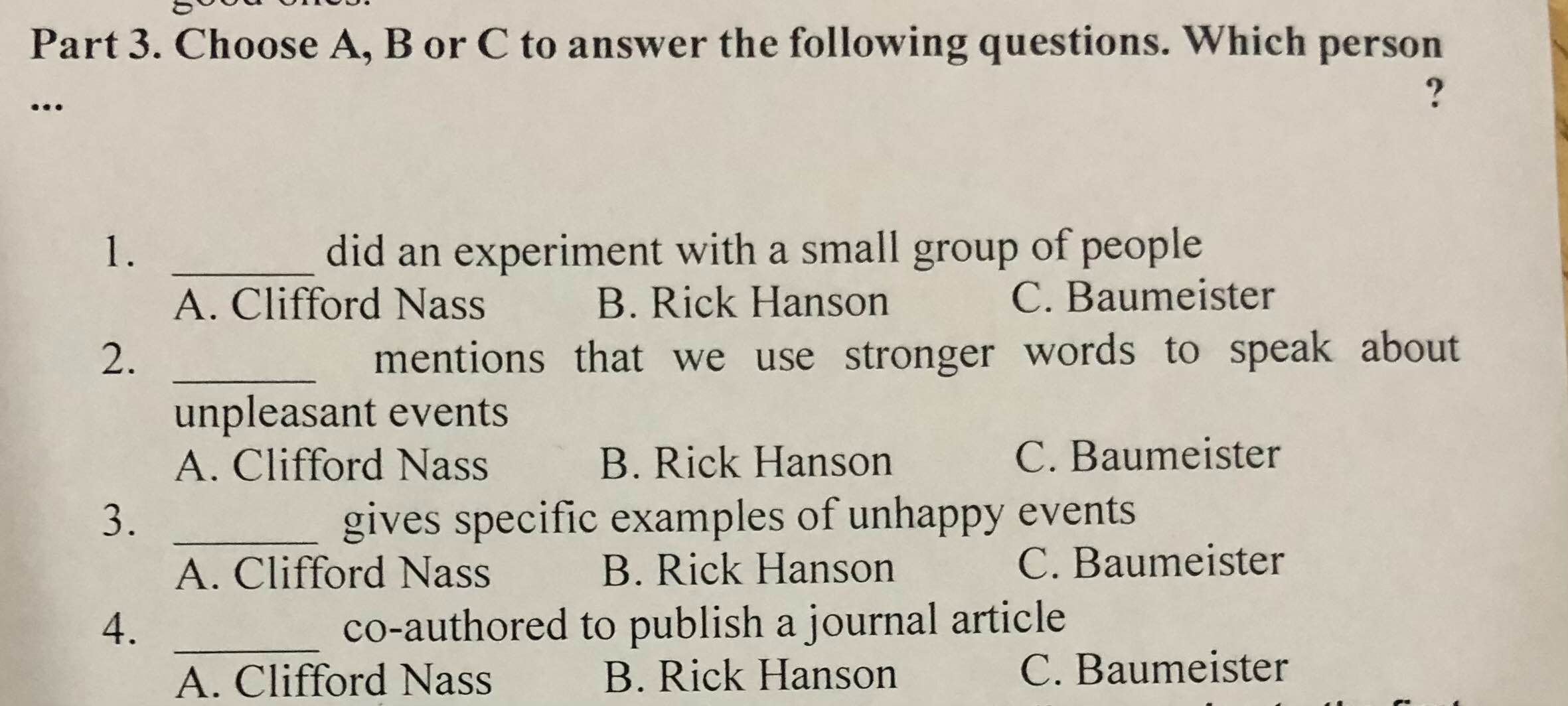
Most people relate stress to physical symptoms like an upset stomach or headaches. Research has suggested that negative emotions and thoughts may also have close links to our brain. Researchers have started finding out why we tend to remember negative things more strongly and in more detail than good ones. "The brain handles positive and negative information in different parts. Negative emotions involve more thinking, and the information is processed more thoroughly. Thus, we tend to ruminate more about unpleasant events and use stronger words to describe them than happy ones," said Clifford Nass, a professor at Stanford University.
Rick Hanson also shares the idea that our minds naturally focus on the bad and discard the good. He stated, "negative stimuli produce more neural activity than do equally intense positive ones. They are also perceived more easily and quickly." This was obtained from his little experiment in which twenty people were asked to look at pictures showing anger or happiness. The participants could identify angry faces faster than happy ones even if it was so quickly.
In a journal article Baumeister co-authored in 2001, "Bad is Stronger Than Good", he concluded,
"bad emotions, bad parents and bad feedback have more impact than good ones." This is "a basic and wide-ranging principle of psychology". Thus, Baumeister and his colleagues noted that bad incidents, such as losing your dreamy job and breaking up with your girlfriend or boyfriend, may have a greater impact than landing a job or receiving a marriage proposaL
Part 1. Choose the best answers to complete the following sentences.
1. People have generally related stress to ______.
A. physical symptoms
B. brain damage
C. ruined relationships with other people
2. Positive events take ______ to perceive than/as negative ones.
A. less time
B. more time
C. the same amount of time
3. Positive things ______.
A. do not produce neural activity
B. produce more neural activity than negative ones
C. produce less neural activity than negative ones
4. The best title for the above text is ______.
A. Stress makes us tired
B. People try to forget bad events.
C. Bad events have stronger impacts than good ones
Part 2. Decide whether the following statements are True (T), False (F) or Not Given (NG).
1. Positive emotions are easier to be forgotten than negative ones.
2. All information is processed in the same part of the brain.
3. The more we try to forget a bad event, the more we think about it.
4. Positive thoughts protect us from stress.
5. It's a wide-ranging rule that bad events have more influence on us than good ones.