Work in groups. Share stories of people you know who keep learning despite their old age.
VII. Communication and culture / CLIL
Culture 2 (SGK Global Success - Trang 137)
Thảo luận (1)
Culture 1 (SGK Global Success - Trang 137)
Read the text and complete the diagram with information from the text. One of the oldest university graduatesBertie Gladwin became one of Britains oldest graduates after receiving his Masters degree in intelligence history from the University of Buckingham at 91. He started his degree at the age of 89 together with his wife, who was then aged 77. I feel very satisfied to think that Ive done an MA at my age, he said at the time. When youre 90, you sit around and no...
Đọc tiếp
Read the text and complete the diagram with information from the text.
One of the oldest university graduates
Bertie Gladwin became one of Britain's oldest graduates after receiving his Master's degree in intelligence history from the University of Buckingham at 91. He started his degree at the age of 89 together with his wife, who was then aged 77. 'I feel very satisfied to think that I've done an MA at my age,' he said at the time. 'When you're 90, you sit around and not a lot happens, so it's important to carry on learning and to broaden your horizons.'
Gladwin left school at the age of 14 and never finished his secondary education or went to university. But he still found a satisfying job. When Gladwin retired, he became less active and thought getting back into learning would delay the negative symptoms of old age. He wanted to keep his brain active and learn more about something that had always interested him. Then at the age of 60, he earned a BA in Psychology. By the time he was 70, he had also completed a BSc in Molecular Biology. 'They're fascinating subjects,' he said. "I did them just because I was interested in them and wanted to know more about them.'

Everyday English 2 (SGK Global Success - Trang 137)
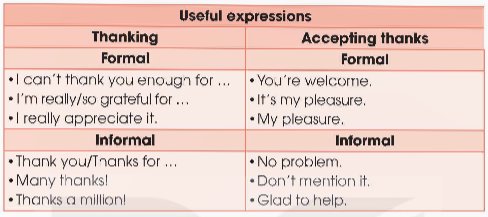
Work in pairs. Use the models in 1 to make similar conversations for these situations. One of you is A, the other is B. Use the expressions below to help you.1. A attends a cooking class taught by B. A thanks B for teaching her/him to cook a traditional dish. B replies by accepting thanks.2. A and B are friends. B thanks A for sharing information about an app for learning English. A replies by accepting thanks.
Đọc tiếp
Work in pairs. Use the models in 1 to make similar conversations for these situations. One of you is A, the other is B. Use the expressions below to help you.
1. A attends a cooking class taught by B. A thanks B for teaching her/him to cook a traditional dish. B replies by accepting thanks.
2. A and B are friends. B thanks A for sharing information about an app for learning English. A replies by accepting thanks.
Thảo luận (1)Hướng dẫn giải1.
A: I'm really grateful for teaching us how to cook a traditional food! It was a lot of fun, and I can't wait to try making it at home.
(Tôi thực sự biết ơn vì đã dạy chúng tôi cách nấu một món ăn truyền thống! Thật là thú vị và tôi rất nóng lòng được thử làm món này ở nhà.)
B: You're welcome! I'm glad you enjoyed the class. Don't hesitate to reach out if you have any questions while making it.
(Không có chi! Tôi rất vui vì bạn thích lớp học. Đừng ngần ngại liên hệ nếu bạn có bất kỳ câu hỏi nào trong khi thực hiện.)
2.
B: Thanks for telling me about that English learning app! It's been really helpful so far.
(Cảm ơn bạn đã cho tôi biết về ứng dụng học tiếng Anh đó! Nó thực sự hữu ích cho đến nay.)
A: No problem! I'm happy to hear it's working out for you.
(Không vấn đề gì! Tôi rất vui khi biết nó có hiệu quả với bạn.)
(Trả lời bởi Nguyễn Quốc Đạt)
Everyday English 1 (SGK Global Success - Trang 136)
Listen and complete the conversations with the expressions in the box. Then practise them in pairs. A. Dont mention it B. I really appreciate it C. Its my pleasure D. Thank you for inviting 1.Ms Lan: Mai, the information about the online courses is very useful. Thank you for presenting it. (1) ________.Mai: (2) ________, Ms Lan. Im glad you found it useful.2.Nam: Mark, I like the activities of the science club very much. (3) ________ me to join the c...
Đọc tiếp
Listen and complete the conversations with the expressions in the box. Then practise them in pairs.
A. Don't mention it B. I really appreciate it C. It's my pleasure D. Thank you for inviting |
1.
Ms Lan: Mai, the information about the online courses is very useful. Thank you for presenting it. (1) ________.
Mai: (2) ________, Ms Lan. I'm glad you found it useful.
2.
Nam: Mark, I like the activities of the science club very much. (3) ________ me to join the club.
Mark: (4) ________. Glad to help.
Thảo luận (1)Hướng dẫn giải
1. B 2. C 3. D 4. A 1.
Ms Lan: Mai, the information about the online courses is very useful. Thank you for presenting it. I really appreciate it.
(Mai, thông tin về các khóa học trực tuyến rất hữu ích. Cảm ơn em đã trình bày. Cô rất trân trọng điều này.)
Mai: It's my pleasure, Ms Lan. I'm glad you found it useful.
(Rất hân hạnh, cô Lan. Em rất vui vì cô thấy nó hữu ích.)
2.
Nam: Mark, I like the activities of the science club very much. Thank you for inviting me to join the club.
(Mark, mình rất thích hoạt động của câu lạc bộ khoa học. Cảm ơn cậu đã mời mình tham gia câu lạc bộ.)
Mark: Don't mention it. Glad to help.
(Đừng nhắc tới chuyện đó. Rất vui được giúp đỡ.)
(Trả lời bởi Nguyễn Quốc Đạt)