Read the conversation again and tick (✓) the green ideas mentioned in 1.


Read the conversation again and decide who has these skills. Put a tick ✔ in the correct column.
| Mai | Nam | Mark |
1. Managing money |
|
|
|
2. Cooking, cleaning and doing laundry |
|
|
|
3. Managing time |
|
|
|

| 1. Mark | 2. Mai | 3. Nam |
1. Mark
Managing money (Quản lý tiền bạc)
Thông tin: I use a money-management app. It’s the app that taught me how to be responsible with money.

Read the conversation again. Tick (✓) the true information about Mark and Mai.
| Mark | Mai |
1. has some arguments over small things with family members. |
|
|
2. lives with grandparents who have traditional views. |
|
|
3. lives in a nuclear family. |
|
|
4. has parents who don't force their children to follow in their footsteps. |
|
|
| Mark | Mai |
1. has some arguments over small things with family members. | V |
|
2. lives with grandparents who have traditional views. |
| V |
3. lives in a nuclear family. | V |
|
4. has parents who don't force their children to follow in their footsteps. |
| V |
Read the text again and decide whether the following statements are true (T) or false (F).
| T | F |
1. Three reasons for the generation gap between parents and children are mentioned in the text. |
|
|
2. Changes in society help parents and children get closer to each other. |
|
|
3. Despite their busy schedules, all parents and children spend a lot of time together. |
|
|
4. Parents don’t have enough time for their children because they work long hours. |
|
|
5. Many parents believe that comparing their children to others is good for them. |
|
|
You and your classmates want to make your classroom a 'green' place. Write down five rules for the class members to follow. You can read Unit 11 again for ideas.
Bạn và bạn cùng lớp của bạn muốn làm cho lớp học của bạn trở nên 'xanh'. Ghi năm quy tắc để các thành viên trong lớp tuân theo. Bạn có thể đọc Unit 11 một lần nữa để có ý tưởng.
Bạn và các bạn cùng lớp muốn lớp học trở thành một nơi 'xanh'. Viết 5 quy cho các thành viên trong lớp để tuân theo. Bạn có thể đọc lại Unit 11 để lấy ý tưởng.
Read and listen to the text again. Complete the sentences using the words in exercise 1.
1. Yellow and purple are _______ colours.
2. Blue and red are _______ colours.
3. A _______ colour is bright and strong.
4. Green and yellow are _______ colours.
5. Orange and purple are _______ colours.
6. A _______ colour is pale and soft.
The Colour Wheel
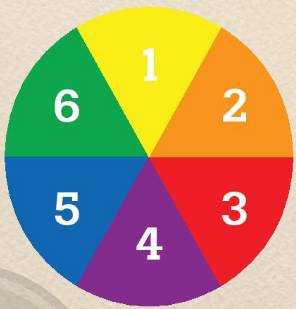
Have you ever thought about how colours are related? Why do some colour combinations look good and others don’t ?
According to Isaac Newton, white light consists of all the colours of the rainbow. Newton then arranged them in a circle of warm and cool categories.
Red, blue and yellow are the three primary colours on the colour wheel. By mixing two primary colours, we’ve got the secondary colours green, orange and purple.
Colours can also be harmonious or complementary. Complementary colours are directly opposite each other, like red and green. Harmonious colours sit next to each other on the wheel.
Famous artists and decorators have used the colour wheel to choose the right colours ever since then. Everyone agrees that colours can affect our feelings. A vibrant red, for example, is often associated with anger or danger, while yellow is a happy colour. Blue can make people feel calm; pastel pink, which is a gentle pink, sometimes makes them think of romance, and green is the colour of nature.
What’s your favourite colour? What do you associate it with?
1 Yellow and purple are complementary colours.
2 Blue and red are primary colours.
3 A vibrant colour is bright and strong.
4 Green and yellow are harmonious colours.
5 Orange and purple are secondary colours.
6 A pastel colour is pale and soft.
$HaNa$
1. complementary
2. primary
3. vibrant
4. harmonious
5. secondary
6. pastel
My favorite color is yellow, I associate it with the sun, a beautiful sunflower.
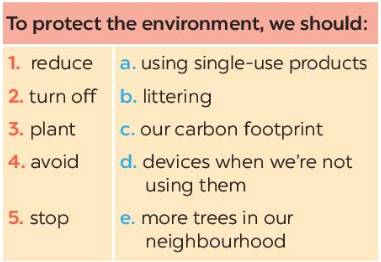
Read the conversation again and match the two halves in the two columns.
Club leader: Hello. Welcome back. Today we’re discussing environmental problems and environmental protection. What are our serious environmental problems now?
Nam: Pollution and habitat loss, I think.
Ann: I agree. The air and water quality are getting worse and worse.
Club leader: Any others?
Ann: Yes, I can think of some like global warming, endangered species loss, …
Nam: So what should we do to help protect our environment?
Club leader: We can reduce our carbon footprint even in our homes.
Ann: What do you mean by “carbon footprint”?
Club leader: It’s the amount of carbon dioxide we release into the environment.
Ann: I see. So we can do things like turning off devices when we’re not using them.
Club leader: Right … And there is much more we can do, like practising the 3Rs.
Nam: We can plant more trees in our neighbourhood too.
Ann: And try to avoid using single-use products, like plastic bags, and stop littering.
Club leader: Yeah. And we can volunteer at some local environment programmes to save endangered species.
1 - c: reduce our carbon footprint
(giảm thiểu lượng khí thải nhà kính)
2 - d: turn off devices when we're not using them
(tắt các thiết bị khi không sử dụng)
3 - e: plant more trees in our neighbourhood
(trồng thêm cây ở xung quanh nơi bạn sống)
4 - a: avoid using single - use products
(tránh các sản phẩm dùng một lần)
5 - b: stop littering
(ngừng xả rác)
Read the conversation again and answer the questions.
1. What’s Nam doing?
__________________________________________________________________________________
2. Does Minh like English?
__________________________________________________________________________________
3. Why does Minh learn English?
__________________________________________________________________________________
4. Is Michael Minh’s friend?
__________________________________________________________________________________
5. How does Minh practise listening?
__________________________________________________________________________________
6. Is Nam good at writing?
__________________________________________________________________________________
7. Who does Nam often write emails to?
__________________________________________________________________________________

Read the conversation again. Complete the following sentences. Use no more than three words in each blank.
1. Nick is going on ______ tomorrow.
2. The green shopping bag is better than the ______.
3. People can buy green bags at ______.
4. Mi wants to buy ______ bag for her mum.
5. Nick thinks that Mi is green because ______.
a picnic
plastic one
the check-out
a reusable
she is cycling
1. Nick is going on a picnic tomorrow.
(Nick sẽ đi dã ngoại vào ngày mai.)
2. The green shopping bag is better than the plastic one.
(Túi mua sắm tái sử dụng tốt hơn túi nhựa.)
3. People can buy green bags at the check-out.
(Mọi người có thể mua túi tái sử dụng khi trả phòng.)
4. Mi wants to buy a reusable bag for her mum.
(Mi muốn mua một chiếc túi có thể tái sử dụng cho mẹ.)
5. Nick thinks that Mi is green because she is cycling.
(Nick cho rằng Mi sống xanh vì cô ấy đang đi bằng xe đạp.)
Read the conversation again and complete the table.
| In Nam's country | In Tom's country |
- Students greet teachers by their title. - People eat breakfast (2) ____. - People buy and sell food on the roadside. | - People buy and sell food on the roadside. In Tom's country - Students refer to their teachers as Mr, Mrs, or Miss and their teachers' (1) ____. - People eat breakfast at home. - People often buy food in a (3) _____. |
Nam: Hello, Tom. How're things?
Tom: Oh good. I like it here. The lifestyle is interesting and different from that in my country.
Nam: Really?
Tom: Sure. Students here call their teachers by their title "teacher", not by their names.
Nam: Right. How do you greet your teachers?
Tom: We usually say "Hello" or "Good morning" then Mr, Mrs, or Miss and their surnames, for example "Good morning, Mr Smith."
Nam: Are there other differences?
Tom: People buy and sell a lot of street food here. In my country, people usually buy food in a store or a restaurant.
Nam: Yeah. Buying street food is a common practice in my city.
Tom: And l've noticed that many people have breakfast on the street too! In my country, we typically have a light breakfast at home.
Nam: I see. But here many adults are in the habit of having breakfast outside of their homes. If they're not in a hurry, they'll even have a leisurely coffee there.
Tom: That's fascinating!
Tham khảo
In Nam’s country (Ở đất nước của Nam) | In Tom’s country (Ở đất nước của Tom) |
- Students greet teachers by their title. (Học sinh chào giáo viên bằng chức danh) - People eat breakfast (2) on the street. (Mọi người ăn sáng trên đường.) - People buy and sell food on the roadside. (Mọi người mua và bán đồ ăn ở hai bên đường.) | - Students refer to their teachers as Mr, Mrs, or Miss and their teachers' (1) surnames. (Học sinh sẽ gọi giáo viên theo Mr, Mrs hoặc Mrs và họ của giáo viên.) - People eat breakfast at home. (Mọi người ăn sáng ở nhà.) - People often buy food in a (3) store or restaurant. (Mọi người thường mua đồ ăn trong cửa hàng và nhà hàng.) |
Read the conversation again and complete the sentences.
1. Trang is looking for a _________.
2. She likes doing DIY in her _________.
3. Tom loves spending his free time with _________.
4. Tom and his friends usually _________. together.
5. Tom, Mark, Trang, and Mai are going to see a comedy this _________.
Tom: Hi, Trang. Surprised to see you. What brings you here?
Trang: Oh, hello Tom. I'm looking for a knitting kit.
Tom: A knitting kit? I didn't know you like knitting.
Trang: Actually, I'm keen on many DIY activities. In my leisure time, I love knitting, building dollhouses, and making paper flowers.
Tom: I see. So, you like spending time on your own.
Trang: Yeah. What do you do in your free time?
Tom: I'm a bit different. I usually hang out with my friends. We go to the cinema, go cycling, or play sport in the park.
Trang: You love spending free time with other people, don't you?
Tom: That's right. By the way, would you like to go to the cinema with me and Mark this Sunday? There's a new comedy at New World Cinema.
Trang: Yes, I'd love to. Can I ask Mai to join us?
Tom: Sure. Let's meet outside the cinema at 9 a.m.
1. knitting kit | 2. leisure time | 3. other people | 4. hang out | 5. Sunday |
1. knitting kit (n): bộ dụng cụ đan len
Trang is looking for a knitting kit.
(Trang đang tìm kiếm một bộ dụng cụ đan len.)
Thông tin: Oh, hello Tom. I'm looking for a knitting kit.
(Ồ, chào Tom. Minh đang kiếm một bộ dụng cụ đan len.)
2. leisure time (n): thời gian rảnh
She likes doing DIY in her leisure time.
(Cô ấy thích tự làm đồ trong thời gian rảnh.)
Thông tin: Actually, I'm keen on many DIY activities. In my leisure time, I love knitting, building dollhouses, and making paper flowers.
(Thực ra thì, mình thích những đồ dùng tự làm. Vào thời gian rảnh, mình thích đan len, xây nhà cho búp bê và làm hoa giấy.)
3. other people (n): những người khác
Tom loves spending his free time with other people.
(Tom thường dành thời gian rảnh với những người khác.)
Thông tin: You love spending free time with other people, don't you? That's right.
(Cậu thích dành thời gian rảnh với mọi người đúng không? Đúng rồi đấy.)
4. hang out (phr.v): đi chơi
Tom and his friends usually hang out together.
(Tom và bạn của cậu ấy thường đi chơi cùng nhau.)
Thông tin: I usually hang out with my friends.
(Mình thường đi chơi với bạn bè.)
5. Sunday (n): Chủ nhật
Tom, Mark, Trang, and Mai are going to see a comedy this Sunday.
(Tom, Mark, Trang và Mai sẽ đi xem một vở kịch vào Chủ nhật này.)
Thông tin: By the way, would you like to go to the cinema with me and Mark this Sunday? There's a new comedy at New World Cinema. Yes, I'd love to.
(Nhân tiện thì, cậu có muốn đi xem phim với mình và Mark vào Chủ nhật không? Có một vở hài kịch mới ở rạp Thế giới Mới. Đồng ý.)
1. Knitting kit
2. Leisure time
3. Other people
4. Hang out
5. Sunday