Giải phương trình sau:
d) \(\dfrac{x^2}{\left(x+1\right)^2}+\dfrac{x}{x+1}-2=0\)
tính đạo hàm
a) \(y=\dfrac{\left(x-2\right)^2}{\left(2x-3\right)\left(x-1\right)}\)
b) \(y=x+3+\dfrac{4}{x+3}\) giải phương trình y'=0
c) \(y=\dfrac{\left(5x-1\right)\left(x+1\right)}{x+2}\) tính y'(-1)
d) \(y=x-2+\dfrac{9}{x-2}\) giải phương trình y'=0

a:
ĐKXĐ: \(x\notin\left\{\dfrac{3}{2};1\right\}\)
\(y=\dfrac{\left(x-2\right)^2}{\left(2x-3\right)\left(x-1\right)}=\dfrac{x^2-4x+4}{2x^2-2x-3x+3}\)
=>\(y=\dfrac{x^2-4x+4}{2x^2-5x+3}\)
=>\(y'=\dfrac{\left(x^2-4x+4\right)'\left(2x^2-5x+3\right)-\left(x^2-4x+4\right)\left(2x^2-5x+3\right)'}{\left(2x^2-5x+3\right)^2}\)
=>\(y'=\dfrac{\left(2x-4\right)\left(2x^2-5x+3\right)-\left(2x-5\right)\left(x^2-4x+4\right)}{\left(2x^2-5x+3\right)^2}\)
=>\(y'=\dfrac{4x^3-10x^2+6x-8x^2+20x-12-2x^3+8x^2-8x+5x^2-20x+20}{\left(2x^2-5x+3\right)^2}\)
=>\(y'=\dfrac{2x^3-5x^2-2x+8}{\left(2x^2-5x+3\right)^2}\)
b:
ĐKXĐ: x<>-3
\(y=\left(x+3\right)+\dfrac{4}{x+3}\)
=>\(y'=\left(x+3+\dfrac{4}{x+3}\right)'=1+\left(\dfrac{4}{x+3}\right)'\)
\(=1+\dfrac{4'\left(x+3\right)-4\left(x+3\right)'}{\left(x+3\right)^2}\)
=>\(y'=1+\dfrac{-4}{\left(x+3\right)^2}=\dfrac{\left(x+3\right)^2-4}{\left(x+3\right)^2}\)
y'=0
=>\(\left(x+3\right)^2-4=0\)
=>\(\left(x+3+2\right)\left(x+3-2\right)=0\)
=>(x+5)(x+1)=0
=>x=-5 hoặc x=-1
c:
ĐKXĐ: x<>-2
\(y=\dfrac{\left(5x-1\right)\left(x+1\right)}{x+2}\)
=>\(y=\dfrac{5x^2+5x-x-1}{x+2}=\dfrac{5x^2+4x-1}{x+2}\)
=>\(y'=\dfrac{\left(5x^2+4x-1\right)'\left(x+2\right)-\left(5x^2+4x-1\right)\left(x+2\right)'}{\left(x+2\right)^2}\)
=>\(y'=\dfrac{\left(5x+4\right)\left(x+2\right)-\left(5x^2+4x-1\right)}{\left(x+2\right)^2}\)
=>\(y'=\dfrac{5x^2+10x+4x+8-5x^2-4x+1}{\left(x+2\right)^2}\)
=>\(y'=\dfrac{10x+9}{\left(x+2\right)^2}\)
\(y'\left(-1\right)=\dfrac{10\cdot\left(-1\right)+9}{\left(-1+2\right)^2}=\dfrac{-1}{1}=-1\)
d:
ĐKXĐ: x<>2
\(y=x-2+\dfrac{9}{x-2}\)
=>\(y'=\left(x-2+\dfrac{9}{x-2}\right)'=1+\left(\dfrac{9}{x-2}\right)'\)
\(=1+\dfrac{9'\left(x-2\right)-9\left(x-2\right)'}{\left(x-2\right)^2}\)
=>\(y'=1+\dfrac{-9}{\left(x-2\right)^2}=\dfrac{\left(x-2\right)^2-9}{\left(x-2\right)^2}\)
y'=0
=>\(\dfrac{\left(x-2\right)^2-9}{\left(x-2\right)^2}=0\)
=>\(\left(x-2\right)^2-9=0\)
=>(x-2-3)(x-2+3)=0
=>(x-5)(x+1)=0
=>x=5 hoặc x=-1
Giải Phương trình
\(x-\dfrac{x+2}{3}< 3x+\dfrac{x}{2}+5
\)
\(\dfrac{x}{2}+\dfrac{1-x}{3}>0\)
\(\left(x-9\right)^2-x\left(x+9\right)< 0\)
a. \(x-\dfrac{x+2}{3}< 3x+\dfrac{x}{2}+5\)
\(\Leftrightarrow\dfrac{6x}{6}-\dfrac{2\left(x+2\right)}{6}< \dfrac{18x}{6}+\dfrac{3x}{6}+\dfrac{30}{6}\)
\(\Rightarrow6x-2x-4-18x-3x-30< 0\)
\(\Leftrightarrow-17x< 34\)
\(\Leftrightarrow x>-2\)
b. \(\dfrac{x}{2}+\dfrac{1-x}{3}>0\)
\(\Leftrightarrow3x+2-2x>0\)
\(\Leftrightarrow x>-2\)
c. \(\left(x-9\right)^2-x\left(x+9\right)< 0\)
\(\Leftrightarrow x^2-18x+81-x^2-9x< 0\)
\(\Leftrightarrow-27x< -81\)
\(\Leftrightarrow x>3\)

[Lớp 8]
Bài 1. Giải phương trình sau đây:
a) \(7x+1=21;\)
b) \(\left(4x-10\right)\left(24+5x\right)=0;\)
c) \(\left|x-2\right|=2x-3;\)
d) \(\dfrac{x+2}{x-2}-\dfrac{1}{x}=\dfrac{2}{x\left(x-2\right)}.\)
Bài 2. Giải bất phương trình sau đây và biểu diễn tập nghiệm trên trục số:
\(\dfrac{x-1}{3}-\dfrac{3x+5}{2}\ge1-\dfrac{4x+5}{6}.\)
Bài 3. Tìm giá trị lớn nhất của \(A=-x^2+2x+9.\)
Bài 4. Giải bài toán bằng cách lập phương trình:
Một người đi xe máy dự định đi từ A đến B với vận tốc 36km/h. Nhưng khi thực hiện người đó giảm vận tốc 6km/h nên đã đến B chậm hơn dự định là 24 phút.
Tính quãng đường AB.
Bài 5. Cho tam giác ABC vuông tại A có AH là đường cao. Vẽ HD⊥ AB (D ∈ AB), HE ⊥ AC (E∈ AC). AB=12cm, AC=16cm.
a) Chứng minh: ΔHAC đồng dạng với ΔABC;
b) Chứng minh AH2=AD.AB;
c) Chứng minh AD.AB=AE.AC;
d) Tính \(\dfrac{S_{ADE}}{S_{ABC}}.\)
Bài 4 :
24 phút = \(\dfrac{24}{60} = \dfrac{2}{5}\) giờ
Gọi thời gian dự định đi từ A đến B là x(giờ) ; x > 0
Suy ra quãng đường AB là 36x(km)
Khi vận tốc sau khi giảm là 36 -6 = 30(km/h)
Vì giảm vận tốc nên thời gian đi hết AB là x + \(\dfrac{2}{5}\)(giờ)
Ta có phương trình:
\(36x = 30(x + \dfrac{2}{5})\\ \Leftrightarrow x = 2\)
Vậy quãng đường AB dài 36.2 = 72(km)
Bài 3 :
\(A = -x^2 + 2x + 9 = -(x^2 -2x - 9) \\= -(x^2 - 2x + 1 + 10) = -(x^2 -2x + 1)+ 10\\=-(x-1)^2 + 10\)
Vì : \((x-1)^2 \geq 0\) ∀x \(\Leftrightarrow -(x-1)^2 \)≤ 0 ∀x \(\Leftrightarrow -(x-1)^2 + 10\) ≤ 10
Dấu "=" xảy ra khi và chỉ khi x - 1 = 0 ⇔ x = 1
Vậy giá trị nhỏ nhất của A là 10 khi x = 1

Giải bất phương trình
a) \(\left|x+1\right|-\left|x-2\right|\ge3\)
b) \(\dfrac{1}{\left|x\right|-3}-\dfrac{1}{2}< 0\)
a,Áp dụng BĐT `|A|-|B|<=|A-B|`
`=>|x+1|-|x-2|<=|x+1-x+2|=3`
Mà đề bài `|x+1|-|x-2|>=3`
`=>|x+1|-|x-2|=3`
`=>x=2\or\x=-1`
`b,1/(|x|-3)-1/2<0`
`<=>(5-|x|)/(2|x|-6)<0`
`<=>(|x|-5)/(|x|-3)>0`
`<=>` $\left[ \begin{array}{l}|x|>5\\|x|<3\end{array} \right.$
`<=>` $\left[ \begin{array}{l}\left[ \begin{array}{l}x>5\\x<-5\end{array} \right.\\-3<x<3\end{array} \right.$
\(\left(\dfrac{x+1}{x-1}\right)^2-6\left(\dfrac{x+1}{x-1}\right)+5=0\)
giải phương trình
ĐKXĐ: \(x\ne1\)
Đặt \(\dfrac{x+1}{x-1}=t\)
\(\Rightarrow t^2-6t+5=0\Leftrightarrow\left(t-1\right)\left(t-5\right)=0\)
\(\Leftrightarrow\left[{}\begin{matrix}t=1\\t=5\end{matrix}\right.\) \(\Leftrightarrow\left[{}\begin{matrix}\dfrac{x+1}{x-1}=1\\\dfrac{x+1}{x-1}=5\end{matrix}\right.\)
\(\Rightarrow\left[{}\begin{matrix}x+1=x-1\left(vô-nghiệm\right)\\x+1=5x-5\end{matrix}\right.\)
\(\Rightarrow x=\dfrac{3}{2}\)
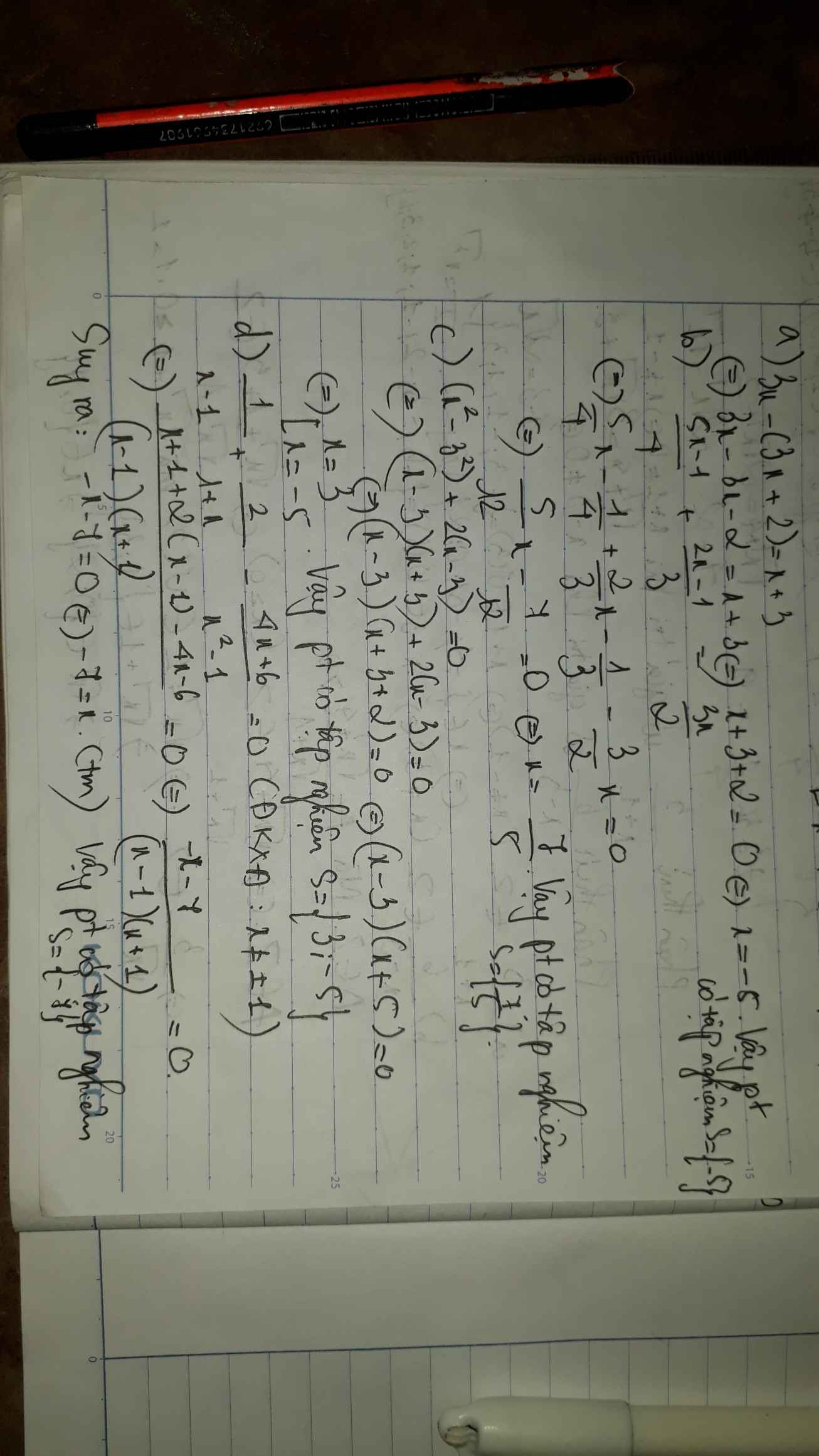
giải các phương trình sau
a, 3x -(3x+2) =x+3
b, \(\dfrac{5x-1}{4}+\dfrac{2x-1}{3}=\dfrac{3x}{2}\)
c, \(\left(x^2-3^2\right)+2\left(x-3\right)=0\)
d,\(\dfrac{1}{x-1}+\dfrac{2}{1+x}-\dfrac{4x+6}{x^2-1}=0\)
a: Ta có: \(3x-\left(3x+2\right)=x+3\)
\(\Leftrightarrow x+3=-2\)
hay x=-5
b: Ta có: \(\dfrac{5x-1}{4}+\dfrac{2x-1}{3}=\dfrac{3x}{2}\)
\(\Leftrightarrow15x-3+8x-4=18x\)
\(\Leftrightarrow5x=7\)
hay \(x=\dfrac{7}{5}\)
Bài 1. Giải các bất phương trình sau 1) \(\dfrac{2x-1}{x+1}-2< 0\) 2) \(\dfrac{x^2-2x+5}{x-2}-x+1\ge0\)
3) \(\dfrac{\left(1+2x\right)\left(x-3\right)}{\left(2x+3\right)\left(1-x\right)}\le0\) 4) \(\left|2x-3\right|>5\) 5)\(\left|1-2x\right|\le4\)
6) \(\left|3x+1\right|>x-2\)
\(\dfrac{2x-1}{x+1}-2< 0.\left(x\ne-1\right).\\ \Leftrightarrow\dfrac{2x-1-2x-2}{x+1}< 0.\Leftrightarrow\dfrac{-3}{x+1}< 0.\)
Mà \(-3< 0.\)
\(\Rightarrow x+1>0.\Leftrightarrow x>-1\left(TMĐK\right).\)
\(\dfrac{x^2-2x+5}{x-2}-x+1\ge0.\left(x\ne2\right).\\ \Leftrightarrow\dfrac{x^2-2x+5-x^2+2x+x-2}{x-2}\ge0.\\ \Leftrightarrow\dfrac{x+3}{x-2}\ge0.\)
\(\Leftrightarrow\left[{}\begin{matrix}\left\{{}\begin{matrix}x+3\ge0.\\x-2\ge0.\end{matrix}\right.\\\left\{{}\begin{matrix}x+3\le0.\\x-2\le0.\end{matrix}\right.\end{matrix}\right.\) \(\Leftrightarrow\left[{}\begin{matrix}\left\{{}\begin{matrix}x\ge-3.\\x\ge2.\end{matrix}\right.\\\left\{{}\begin{matrix}x\le-3.\\x\le2.\end{matrix}\right.\end{matrix}\right.\) \(\Leftrightarrow\left[{}\begin{matrix}x\ge2.\\x\le-3.\end{matrix}\right.\)
Kết hợp ĐKXĐ.
\(\Rightarrow\left[{}\begin{matrix}x>2.\\x\le-3.\end{matrix}\right.\)
\(\dfrac{\left(1+2x\right)\left(x-2\right)}{\left(2x+3\right)\left(1-x\right)}\le0.\left(x\ne1;x\ne\dfrac{-3}{2}\right).\)
Đặt \(\dfrac{\left(1+2x\right)\left(x-2\right)}{\left(2x+3\right)\left(1-x\right)}=f\left(x\right).\)
Ta có bảng sau:
| \(x\) | \(-\infty\) \(-\dfrac{3}{2}\) \(-\dfrac{1}{2}\) \(1\) \(2\) \(+\infty\) |
| \(1+2x\) | - | - 0 + | + | + |
| \(x-2\) | - | - | - | - 0 + |
| \(2x+3\) | - 0 + | + | + | + |
| \(1-x\) | + | + | + 0 - | - |
| \(f\left(x\right)\) | - || + 0 - || + 0 - |
Vậy \(f\left(x\right)\ge0.\Leftrightarrow x\in\left(\dfrac{-3}{2};\dfrac{-1}{2}\right)\cup\)(1;2].
Giải bất phương trình:
\(\dfrac{1}{x^2}+\dfrac{x^2}{1-x^2}+\dfrac{5}{2}\left(\dfrac{\sqrt{1-x^2}}{x}+\dfrac{x}{\sqrt{1-x^2}}\right)+2>0\)
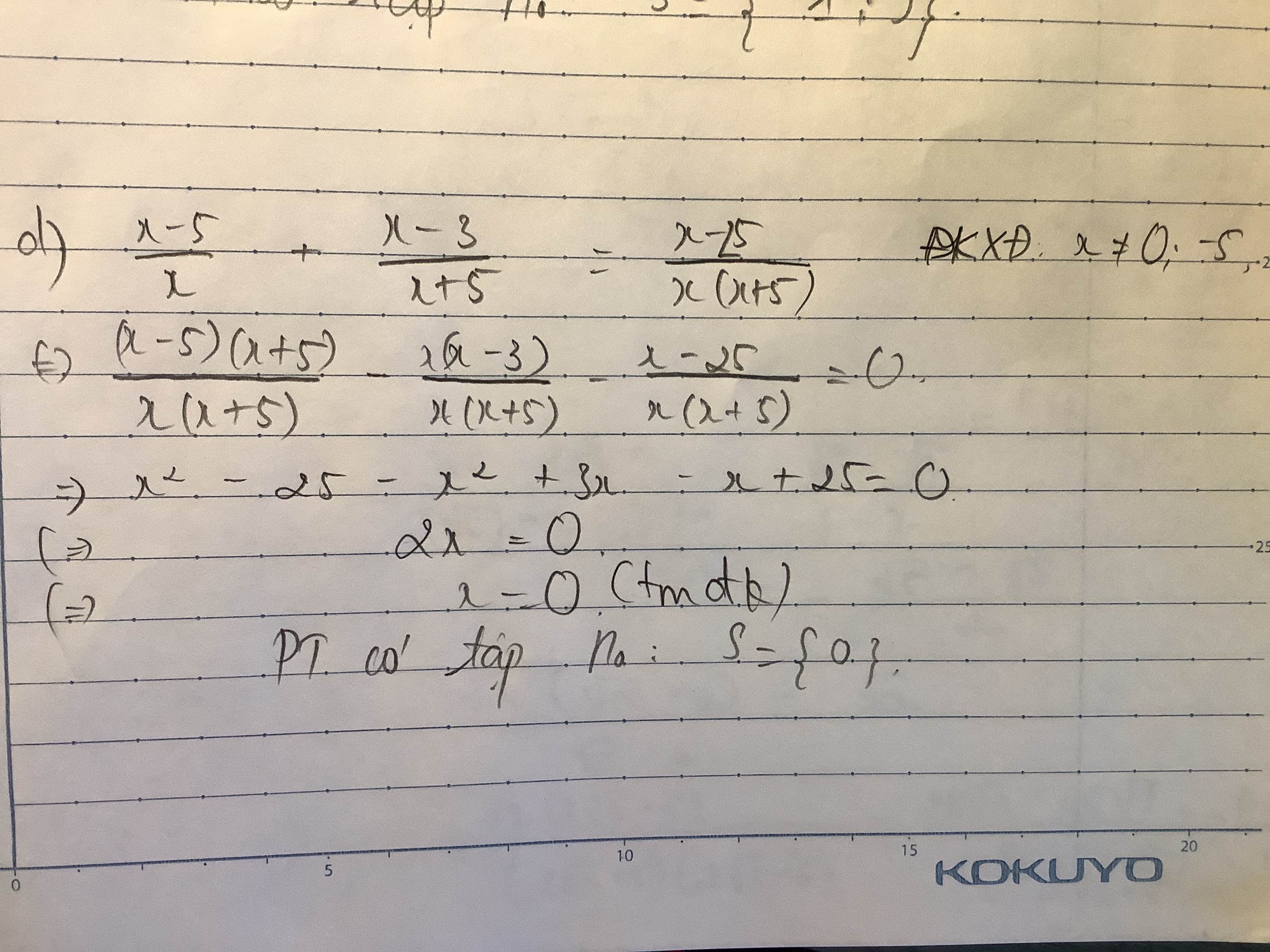
giải các phương trình sau
a, 4x- 2(1-x)= 5(x-4)
b, \(\dfrac{x}{6}+\dfrac{1-3x}{9}=\dfrac{-x+1}{12}\)
c, \(\left(x+2\right)^2-3\left(x+2\right)=0\)
d,\(\dfrac{x-5}{x}+\dfrac{x-3}{x+5}=\dfrac{x-25}{x\left(x+5\right)}\)
a: Ta có: \(4x-2\left(1-x\right)=5\left(x-4\right)\)
\(\Leftrightarrow4x-2+2x=5x-20\)
\(\Leftrightarrow x=-18\)
b: Ta có: \(\dfrac{x}{6}+\dfrac{1-3x}{9}=\dfrac{-x+1}{12}\)
\(\Leftrightarrow6x+4\left(1-3x\right)=3\left(-x+1\right)\)
\(\Leftrightarrow6x+4-12x=-3x+3\)
\(\Leftrightarrow-3x=-1\)
hay \(x=\dfrac{1}{3}\)
c: Ta có: \(\left(x+2\right)^2-3\left(x+2\right)=0\)
\(\Leftrightarrow\left(x+2\right)\left(x-1\right)=0\)
\(\Leftrightarrow\left[{}\begin{matrix}x=-2\\x=1\end{matrix}\right.\)
d: Ta có: \(\dfrac{x-5}{x}+\dfrac{x-3}{x+5}=\dfrac{x-25}{x\left(x+5\right)}\)
\(\Leftrightarrow x^2-25+x^2-3x=x-25\)
\(\Leftrightarrow2x^2-4x=0\)
\(\Leftrightarrow2x\left(x-2\right)=0\)
\(\Leftrightarrow\left[{}\begin{matrix}x=0\left(loại\right)\\x=2\left(nhận\right)\end{matrix}\right.\)