Answer the questions about Inventing the future.
Mark the letter A, B, C or D on your answer sheet to indicate the underlined part that needs correction in each of the following questions.

More eco-friendly products will be inventing in the future.
inventeing=>invented
Mark the letter A, B, C, or D on your answer sheet to indicate the correct answer to each of the following questions.
Someone who is _______is hopeful about the future or the success of something in particular.
A. pessimist
B. optimistic
C. optimist
D. pessimistic
Đáp án B
- Optimist (n): người lạc quan
- Pessimist (n): người bi quan
- Optimistic (adj): lạc quan
- Pessimistic (adj): bi quan
Sau động từ to be “is” thì ta dùng tính từ => ta loại A và C
Xét về nghĩa của câu thì ta loại D
ð Đáp án B (Một người lạc quan là người luôn hi vọng về tương lai hoặc sự thành công của việc nào đó.)

Work in pairs. Ask and answer questions about one of the features of future cities in 1. Use the model and the tips in 2 to help you.
TRANSPORT (GIAO THÔNG)
1. Do you think people will still own cars in the cities of the future?
(Bạn có nghĩ rằng mọi người sẽ vẫn sở hữu ô tô ở các thành phố trong tương lai không?)
I don't think so. Private vehicles will be replaced by more efficient and sustainable public transport systems.
(Tôi không nghĩ vậy. Các phương tiện cá nhân sẽ được thay thế bằng các hệ thống giao thông công cộng bền vững và hiệu quả hơn.)
2. How will public transport be different in the future cities?
(Giao thông công cộng sẽ khác ở các thành phố tương lai như thế nào?)
Public transport will be faster, more frequent, and more comfortable. It will also be controlled by computers and use eco-friendly technologies.
(Giao thông công cộng sẽ nhanh hơn, thường xuyên hơn và thoải mái hơn. Nó cũng sẽ được điều khiển bởi máy tính và sử dụng các công nghệ thân thiện với môi trường.)
3. What kind of eco-friendly technologies will be used in future transport systems?
(Loại công nghệ thân thiện với môi trường nào sẽ được sử dụng trong các hệ thống giao thông trong tương lai?)
There will be electric buses, trains, and trams that produce no or low emissions. There will also be more bike lanes and walkable streets to encourage active modes of transport.
(Sẽ có xe buýt điện, xe lửa và xe điện không tạo ra hoặc thải ít khí thải. Cũng sẽ có nhiều làn đường dành cho xe đạp và đường đi bộ hơn để khuyến khích các phương thức vận tải tích cực.)
4. How will people pay for public transport in the future?
(Mọi người sẽ trả tiền cho giao thông công cộng như thế nào trong tương lai?)
People will use smart cards or mobile apps to pay for their journeys. The fare system will be more integrated and offer discounts for regular users.
(Mọi người sẽ sử dụng thẻ thông minh hoặc ứng dụng dành cho thiết bị di động để thanh toán cho hành trình của họ. Hệ thống giá vé sẽ được tích hợp nhiều hơn và giảm giá cho người dùng thường xuyên.)
INFRASTRUCTURE (HẠ TẦNG)
1. How will the street infrastructure be different in the future cities?
(Cơ sở hạ tầng đường phố ở các thành phố tương lai sẽ khác như thế nào?)
The street infrastructure will be smarter with more sensors and data collection devices. This will enable faster and better decision-making for traffic management, waste collection, and other services.
(Cơ sở hạ tầng đường phố sẽ thông minh hơn với nhiều cảm biến và thiết bị thu thập dữ liệu hơn. Điều này sẽ cho phép ra quyết định nhanh hơn và tốt hơn cho quản lý giao thông, thu gom rác thải và các dịch vụ khác.)
2. Will there be more green spaces in the future cities?
(Sẽ có nhiều không gian xanh hơn ở các thành phố trong tương lai?)
Yes, there will be more green spaces and parks in the future cities to improve the quality of life and mitigate the effects of climate change. The green spaces will also provide habitats for wildlife and help reduce the urban heat island effect.
(Đúng vậy, sẽ có nhiều không gian xanh và công viên hơn ở các thành phố trong tương lai để cải thiện chất lượng cuộc sống và giảm thiểu tác động của biến đổi khí hậu. Các không gian xanh cũng sẽ cung cấp môi trường sống cho động vật hoang dã và giúp giảm hiệu ứng đảo nhiệt đô thị.)
3. How will the buildings be designed in the future cities?
(Các tòa nhà sẽ được thiết kế như thế nào trong các thành phố tương lai?)
The buildings will be designed to be more energy-efficient and eco-friendly. They will have green roofs, solar panels, and rainwater harvesting systems to reduce the energy consumption and carbon footprint. The buildings will also be equipped with smart technologies to optimize the use of resources and improve the indoor environment.
(Các tòa nhà sẽ được thiết kế để tiết kiệm năng lượng và thân thiện với môi trường hơn. Chúng sẽ có mái nhà xanh, tấm pin mặt trời và hệ thống thu gom nước mưa để giảm mức tiêu thụ năng lượng và lượng khí thải carbon. Các tòa nhà cũng sẽ được trang bị công nghệ thông minh để tối ưu hóa việc sử dụng tài nguyên và cải thiện môi trường trong nhà.)
LIVING CONDITIONS (ĐIỀU KIỆN SỐNG)
1. How will technology improve people's lives in the future cities?
(Công nghệ sẽ cải thiện cuộc sống của người dân ở các thành phố tương lai như thế nào?)
AI technologies will help people do many daily activities, such as cooking, cleaning, and shopping. For example, smart refrigerators will order groceries when they run low, and robots will clean the house while the residents are at work.
(Các công nghệ AI sẽ giúp mọi người thực hiện nhiều hoạt động hàng ngày, chẳng hạn như nấu ăn, dọn dẹp và mua sắm. Ví dụ, tủ lạnh thông minh sẽ đặt hàng tạp hóa khi chúng sắp hết và rô-bốt sẽ dọn dẹp nhà cửa khi người dân đi làm.)
2. Will there be more green spaces in the future cities?
(Sẽ có nhiều không gian xanh hơn ở các thành phố trong tương lai?)
Yes, there will be more green spaces and parks in the future cities to improve the quality of life and reduce pollution. The green spaces will also provide habitats for wildlife and help reduce the urban heat island effect.
(Vâng, sẽ có nhiều không gian xanh và công viên hơn ở các thành phố trong tương lai để cải thiện chất lượng cuộc sống và giảm thiểu ô nhiễm. Các không gian xanh cũng sẽ cung cấp môi trường sống cho động vật hoang dã và giúp giảm hiệu ứng đảo nhiệt đô thị.)
3. What will be the impact of green skyscrapers on the living conditions in the future cities?
(Tác động của các tòa nhà chọc trời xanh đến điều kiện sống ở các thành phố trong tương lai là gì?)
Green skyscrapers will replace old blocks of flats and offices in crowded urban centers. They will provide cleaner air, more natural light, and better insulation than traditional buildings, which will improve the quality of life for the residents.
(Những tòa nhà chọc trời xanh sẽ thay thế những khối căn hộ và văn phòng cũ ở các trung tâm đô thị đông đúc. Chúng sẽ cung cấp không khí sạch hơn, nhiều ánh sáng tự nhiên hơn và cách nhiệt tốt hơn so với các tòa nhà truyền thống, điều này sẽ cải thiện chất lượng cuộc sống cho cư dân.)
4. How will the public services be improved in the future cities?
(Các dịch vụ công cộng sẽ được cải thiện như thế nào ở các thành phố trong tương lai?)
Public services such as healthcare, education, and social services will be more accessible and efficient in the future cities. Smart technologies will help people schedule appointments, receive personalized care, and connect with social networks.
(Các dịch vụ công như y tế, giáo dục và dịch vụ xã hội sẽ dễ tiếp cận và hiệu quả hơn ở các thành phố trong tương lai. Các công nghệ thông minh sẽ giúp mọi người lên lịch hẹn, nhận dịch vụ chăm sóc cá nhân và kết nối với các mạng xã hội.)
5. Will people still need to commute to work in the future cities?
(Mọi người vẫn cần phải đi làm ở các thành phố trong tương lai chứ?)
Yes, people will still need to commute to work, but the commuting time will be shorter and more comfortable. Public transport will be faster and more reliable, and some people may also be able to work remotely from home or from shared workspaces.
(Có, mọi người sẽ vẫn phải đi làm, nhưng thời gian đi lại sẽ ngắn hơn và thoải mái hơn. Phương tiện giao thông công cộng sẽ nhanh hơn và đáng tin cậy hơn, đồng thời một số người cũng có thể làm việc từ xa tại nhà hoặc từ không gian làm việc chung.)

a. You’re interviewing an expert about homes in the future. Work in pair. Student A, interview the future home expert and make notes. Student B, you are an expert. Answer the questions. Swap roles and repeat.
(Bạn đang phỏng vấn một chuyên gia về nhà trong tương lai. Làm việc theo nhóm. Học sinh A, phỏng vấn chuyên gia và ghi chú lại. Học sinh B, bạn là chuyên gia. Hãy trả lời câu hỏi. Đổi vai và lặp lại.)
- Where do you think people will live in the future?
(Bạn nghĩ trong tương lai con người sẽ sống ở đâu?)
- I think...
(Tôi nghĩ...)
A: Where do you think people will live in the future?
(Bạn nghĩ mọi người sẽ sống ở đâu trong tương lai?)
B: I think people will live in smart homes.
(Tôi nghĩ mọi người sẽ sống trong những ngôi nhà thông minh.)
A: I don’t understand. Can you explain for me?
(Tôi không hiểu. Bạn có thể giải thích cho tôi được không?)
B: Oh, smart homes use technology to control and have technological equipment. It’s so convenient and intelligent.
(Ồ, nhà thông minh sử dụng công nghệ để điều khiển và có thiết bị công nghệ. Nó rất tiện lợi và thông minh.)
A: Yeahh, I see.
(Yeahh, tôi hiểu rồi.)
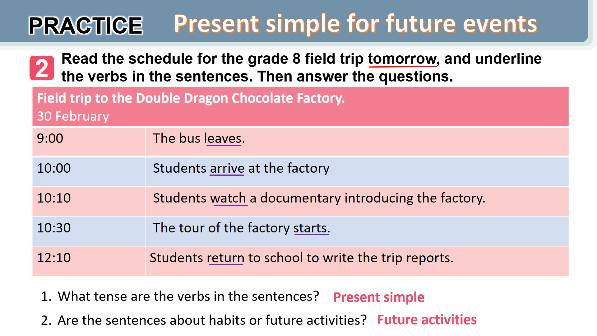
Read the schedule of the field trip for the grade 8 students tomorrow, and underline the verbs in the sentences. Then answer the questions.
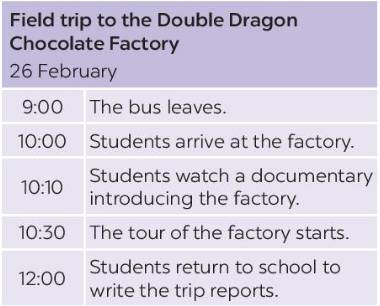
1. What tense are the verbs in the sentences?
2. Are the sentences about habits or future activities?
7. Read the passage about some future predictions and answer the questions. Circle A, B, or C.
Dr Pearson, a futurologist believes in 2045 buildings will be made from concrete plastics and shape-changing materials that can heal themselves and the builders will have super-strength skeletons creating half-man, half-machine workers. There will be a need for new kinds of elevators using magnetic systems.
By mid-century, buildings will be miles tall and some may be so large that their capacity enables them to function as small cities in their own right. As these buildings rise through the clouds, windows will be replaced by reality virtual screens so people can choose any view they like.
However, lack of exposure to pathogens will cause more allergies. Due to health concerns, scents, candles, incense are also likely to be more strongly regulated, added Dr Pearson.
1. When does Dr Pearson make these predictions? | ||
A. now | B. in 2045 | C. after 2045 |
2. What can future buildings do? | ||
A. change shapes | B. use machines | C. self-heal |
3. What is TRUE about future buildings? | ||
A. They will be very big. B. They will be very tall. C. They will be very modern. | ||
4. What will cause more allergies? | ||
A. incense | B. pathogens | C. candles |
5. A futurologist is someone who _____________ the future. | ||
A. believes in | B. predicts | C. adds to |

*Read the following passage and mark the letter A, B, C, or D on your answer sheet to indicate the correct answer to each of the questions from 26 to 30
After inventing dynamite, Swedish-born Alfred Nobel became a very rich man. However, he foresaw its universally destructive powers too late. Nobel preferred not to be remembered as the inventor of dynamite, so in 1895, just two weeks before his death, he created a fund to be used for awarding prizes to people who had made worldwide contributions to mankind. Originally there were five awards: literature, physics, chemistry, medicine and peace. Economics was added in 1968, just sixty-seven years after the first awarded ceremony.
Nobel’s original legacy of nine million dollars was invested, and the interest on this sum is used for the awards which vary from 30.000 dollars to 125.000 dollars.
Every year on December 10, the anniversary of Nobel’s death , the awards (gold medals, illuminated diploma and money) are present to the winners. Sometimes politics plays an important roles in the judges’ decision. American have won numerous science awards, but relatively few literature prizes.
No awards were presented from 1940 to 1942 at the beginning of World War II. Some people have won two prizes, but this is rare; other have shares their prizes.
Câu 26: When did the first award ceremony take place?
A. 1895
B. 1901
C. 1962
D. 1968
Câu 27: Why was the Nobel’s prize established?
A. to recognize worldwide contributions to humanity
B. to resolve political differences
C. to honor the inventor of dynamite
D. to spend money.
Câu 28: In which field have American received the most awards?
A. Literature
B. Peace
C. Economics
D. Science
Câu 29: In how many field are the prizes given?
A. 2
B. 5
C. 6
D. 10
Câu 30: Which of the following statements is NOT true.
A. Awards vary in moneytory value
B. Ceremonies are held on December 10 to commemorate Nobel’s invention
C. Politics can play an important role in selecting the winners
D. A few individuals have won two awards.
After inventing dynamite, Swedish-born Alfred Nobel became a very rich man. However, he foresaw its universally destructive powers too late. Nobel preferred not to be remembered as the inventor of dynamite, so in 1895, just two weeks before his death, he created a fund to be used for awarding prizes to people who had made worldwide contributions to mankind. Originally there were five awards: literature, physics, chemistry, medicine and peace. Economics was added in 1968, just sixty-seven years after the first awarded ceremony.
Nobel’s original legacy of nine million dollars was invested, and the interest on this sum is used for the awards which vary from 30.000 dollars to 125.000 dollars.
Every year on December 10, the anniversary of Nobel’s death , the awards (gold medals, illuminated diploma and money) are present to the winners. Sometimes politics plays an important roles in the judges’ decision. American have won numerous science awards, but relatively few literature prizes.
No awards were presented from 1940 to 1942 at the beginning of World War II. Some people have won two prizes, but this is rare; other have shares their prizes.
Câu 26: When did the first award ceremony take place?
A. 1895
B. 1901
C. 1962
D. 1968
Câu 27: Why was the Nobel’s prize established?
A. to recognize worldwide contributions to humanity
B. to resolve political differences
C. to honor the inventor of dynamite
D. to spend money.
Câu 28: In which field have American received the most awards?
A. Literature
B. Peace
C. Economics
D. Science
Câu 29: In how many field are the prizes given?
A. 2
B. 5
C. 6
D. 10
Câu 30: Which of the following statements is NOT true.
A. Awards vary in moneytory value
B. Ceremonies are held on December 10 to commemorate Nobel’s invention
C. Politics can play an important role in selecting the winners
D. A few individuals have won two awards.
D. Read about future trends and answer the questions. Then fill in the charts.
(Đọc về các xu hướng trong tương lai và trả lời các câu hỏi sau. Sau đó điền vào các biểu đồ.)

1. The population of the world will increase. The number of people in the countryside will decrease.
(Dân số thế giới sẽ tăng lên. Số người ở nông thôn sẽ giảm đi.)
Thông tin: The population of the world is over 7 billion now, and this will definitely increase to 9 billion by 2050.
(Dân số thế giới hiện nay là hơn 7 tỷ người, và con số này chắc chắn sẽ tăng đến 9 tỷ người vào năm 2050.)
In the future, this will probably go up to 70%, and the number of people in the countryside will decrease to 30%.
(Trong tương lai, con số này có thể sẽ tăng lên 70%, và số người ở nông thôn sẽ giảm xuống còn 30%.)
2. The writer uses “definitely” and “probably” in the sentences.
(Người viết sử dụng từ “chắc chắn” và “có lẽ” trong các câu.)
Thông tin: The population of the world is over 7 billion now, and this will definitely increase to 9 billion by 2050.
(Dân số thế giới hiện nay là hơn 7 tỷ người, và con số này chắc chắn sẽ tăng đến 9 tỷ người vào năm 2050.)
In the future, this will probably go up to 70%, and the number of people in the countryside will decrease to 30%.
(Trong tương lai, con số này có thể sẽ tăng lên 70%, và số người ở nông thôn sẽ giảm xuống còn 30%.)
Mark the letter A, B, C or D on your answer sheet to indicate the most suitable response to complete each of the following questions.
John and Tim are talking about future jobs.
John: “What kind of job would you like?”
Tim: “_______.”
A. Any of them are OK
B. Anything to do with computer
C. That will do
D. Any time after next week
Kiến thức: Ngôn ngữ giao tiếp
Giải thích:
John và Tim đang nói về công việc tương lai.
John: “Bạn muốn làm nghề gì?”
Tim: “ .”
A. Cái nào trong số chúng cũng được B. Bất cứ nghề gì có sử dụng máy tính
C. Nó sẽ thực hiện được D. Bất cứ lúc nào sau tuần tới
Các phương án A, C, D không phù hợp
Chọn B