fill in the blanks with "be going to" or "will"

Những câu hỏi liên quan

Fill in the blanks the correct form of WILL or BE GOING TO. *
Đọc tiếp




 Fill in the blanks the correct form of WILL or BE GOING TO. *



won't be
will come
Will - participate
won't build
will replace
Đúng 1
Bình luận (0)


17.won't be
15.will come
13.Will - participate
16.won't build
15.will replace
Đúng 1
Bình luận (0)


17.won't be
15.will come
13.Will - participate
16.won't build
14.will replace
Đúng 1
Bình luận (0)
Xem thêm câu trả lời

Fill in the blanks with the words into brackets using will or be going to.
1) My brother (be) ______45 in October.
2) There is a knock at the door, that(be) ______ the postman.
3) Boys(be) ______ boys!
4) I'm not feeling well, I(faint) _______.


1) My brother (be) ___will be___45 in October.
2) There is a knock at the door, that(be) ___will be___ the postman.
3) Boys(be) ____will be__ boys!
4) I'm not feeling well, I(faint) ___am going to faint____.

Provide the correct verbs in the form of will or be going to to fill in the blanks. 7. A: Aw. Im about to fall asleep. I had very little sleep last night.B: Oh, dear? I ___________________________ you a cup of coffee. That will wake you up. (get)8. They are going to deliver the sofas to my flat this afternoon. I just cant handle them on my own. __________you ____________________________ to give a hand? (come)9. As soon as the weathers fine again, we __________________________ down to the beach...
Đọc tiếp
Provide the correct verbs in the form of "will" or "be going to" to fill in the blanks.
7. A: Aw. I'm about to fall asleep. I had very little sleep last night.
B: Oh, dear? I ___________________________ you a cup of coffee. That will wake you up. (get)
8. They are going to deliver the sofas to my flat this afternoon. I just can't handle them on my own. __________
you ____________________________ to give a hand? (come)
9. As soon as the weather's fine again, we __________________________ down to the beach and you can take a lot of photos there. (walk)
10. A: What do you want to study after graduation?
B: I ________________________ Environmental Economics. I've always been interested since I read a
book about it. (study)
11. Her husband found a new job in Tottemham last month. They ________________________ to the city next week. (move)

1 will get
2 Will you come
3 will walk
4 am going to study
5 will move
Đúng 0
Bình luận (0)

EXERCISESI. Fill in the blanks with in, on, at, behind, in front of, from ... to Ex: I play games in the afternoon.1. They often go swimming Sunday.2. The meeting will last 7 a.m 5 p.m.3. She will be 13 her next birthday. 4. We are playing chess the moment.5. It’s often rainy July.6. My birthday is September 3rd.7. The party will start seven o’clock the evening.8. He was born ...
Đọc tiếp
EXERCISES
I. Fill in the blanks with in, on, at, behind, in front of, from ... to
Ex: I play games in the afternoon.
1. They often go swimming Sunday.
2. The meeting will last 7 a.m 5 p.m.
3. She will be 13 her next birthday.
4. We are playing chess the moment.
5. It’s often rainy July.
6. My birthday is September 3rd.
7. The party will start seven o’clock the evening.
8. He was born April 2002.
9. The dog is the shelf.
10. Our teacher is the blackboard.
II. Fill in the blanks with is, are, isn't, aren't, do, does, where.
1. We staying at my cousin’s house in Vung Tau.
2. they have the right things for the kitchen?
3. Where you live, Phong?
4. does your uncle live?
5. How many rooms there in the hotel?
6. There any chairs in the kitchen. We need five chairs.
7. Which house you want to live in? A town house or a country house?
8. There any furniture in my bedroom. I need many things.
9. In my house, there four bedrooms.
10. What Mrs. Brown need for the living room?
III. Add “is, are, a, an, some, any” to make a correct sentence.
Ex: There/ pencil/ in/ the/ box.
There is a pencil in the box.
There/ bananas/ in/ the fridge.
There are some bananas in the fridge.
1. There/ book/ on/ the table.
=>
2. There/ shoes/ under/ the chair.
=>
3. There/ not/ TV/ in/ his room.
=>
4. There/ not/ pens/ on/ my desk.
=>
5. There/ boy/ behind/ that tree.
=>
6. There/ girls/ in front of/ the house.
=>
7. There/ not/ telephone/ in her office.
=>
8. There/ not/ chairs/ downstairs.
=>
IV. Use the given words to make complete sentences.
1. house/ a/ Minh/ lake/ a/ lives/ in/ near.
=>
2. yard/ front/ school/There/ big/ of/ is/ our/ in/ a.
=>
3. many/ right/ the/ museum/ Are/ flowers/ the/ there/ to/ of/?
=>
4. next/ photocopy/ What/ store/ there/ the/ is/ to /?
=>
5. hospital/ father/ in/ the/ city/ 2yiy/ a/ works/ in.
=>
6. there/ family/ many/ in/ are/ How/ Linh’s/ people/ ?
=>
7. his/ friend/ in/ family/ My/ Hanoi/ doesn’t/ with/ live.
=>
8. brushes/ six/ gets/ her/ o’clock/ Hoa/ at/ up/ teeth/ and.
=>
9. on/ floor/ classroom/ the/ is/ Our/ first.
=>
10. Minh’s/ six/ There/ in/ rooms/ house/ are.
=>
V. Use the words in the box to complete the below sentences.
favorite washing machine dishwasher interesting
lovely modern kitchen
1. My mother is cooking in the .
2. Picture-books are very .
3. She puts her dirty clothes in the .
4. Apple is my fruit.
5. It’s the most car.
6. is a machine that washes dishes.
7. What a girl!


EXERCISES
I. Fill in the blanks with in, on, at, behind, in front of, from ... to
Ex: I play games in the afternoon.
1. They often go swimming on Sunday.
2. The meeting will last from 7 a.m to 5 p.m.
3. She will be 13 on her next birthday.
4. We are playing chess at the moment.
5. It’s often rainy in July.
6. My birthday is on September 3rd.
7. The party will start at seven o’clock in the evening.
8. He was born in April 2002.
9. The dog is on the shelf.
10. Our teacher is in front of the blackboard.
II. Fill in the blanks with is, are, isn't, aren't, do, does, where.
1. We are staying at my cousin’s house in Vung Tau.
2. Do they have the right things for the kitchen?
3. Where do you live, Phong?
4. Where does your uncle live?
5. How many rooms is there in the hotel?
6. There aren't any chairs in the kitchen. We need five chairs.
7. Which house do you want to live in? A town house or a country house?
8. There isn't any furniture in my bedroom. I need many things.
9. In my house, there are four bedrooms.
10. What does Mrs. Brown need for the living room?
Đúng 0
Bình luận (0)
III. Add “is, are, a, an, some, any” to make a correct sentence.
Ex: There/ pencil/ in/ the/ box.
There is a pencil in the box.
There/ bananas/ in/ the fridge.
There are some bananas in the fridge.
1. There/ book/ on/ the table.
=> There is a book on the table.
2. There/ shoes/ under/ the chair.
=> There are some shoes under the chair.
3. There/ not/ TV/ in/ his room.
=> There is not any TV in his room.
4. There/ not/ pens/ on/ my desk.
=> There are not any pens on my desk.
5. There/ boy/ behind/ that tree.
=> There is a boy behind that tree.
6. There/ girls/ in front of/ the house.
=> There are girls in front of the house.
7. There/ not/ telephone/ in her office.
=> There is not any telephone in her office.
8. There/ not/ chairs/ downstairs.
=> There are not any chairs downstairs.
Đúng 0
Bình luận (0)
IV. Use the given words to make complete sentences.
1. house/ a/ Minh/ lake/ a/ lives/ in/ near.
=> Minh lives in a house near a lake.
2. yard/ front/ school/There/ big/ of/ is/ our/ in/ a.
=> There is a big yard in front of our school.
3. many/ right/ the/ museum/ Are/ flowers/ the/ there/ to/ of/?
=> Are there many flowers to the right of the museum?
4. next/ photocopy/ What/ store/ there/ the/ is/ to /?
=> What is there next to the photocopy store?
5. hospital/ father/ in/ the/ city/ 2yiy ?/ a/ works/ in.
=> My father works in a hospital in the city.
6. there/ family/ many/ in/ are/ How/ Linh’s/ people/ ?
=> How many people are there in Linh's family?
7. his/ friend/ in/ family/ My/ Hanoi/ doesn’t/ with/ live.
=> His friend doesn't live with my family in Hanoi.
8. brushes/ six/ gets/ her/ o’clock/ Hoa/ at/ up/ teeth/ and.
=> Hoa gets up at six o'clock and brushes her teeth.
9. on/ floor/ classroom/ the/ is/ Our/ first.
=> Our classroom is on the first floor.
10. Minh’s/ six/ There/ in/ rooms/ house/ are.
=> There are six rooms in Minh's house.
Đúng 0
Bình luận (0)
Xem thêm câu trả lời

A. Fill in the gap with the correct names.1. ______________ is going to a street party in Scotland.2. ______________ is going to sing on New Year’s Eve.3. ______________ will be in a foreign country on New Year’s Eve.4. ______________ isn’t going to make any New Year’s resolutions.5. ______________ wants to learn to play a musical instrument.6. ______________ wants to have a healthier diet.B. Decide if the statements are true (T) or false (F).1. New Year’s resolutions often involve...
Đọc tiếp
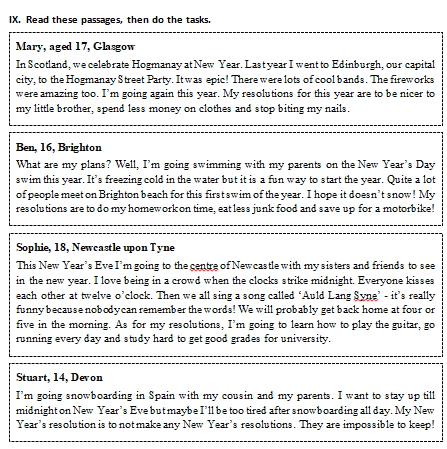
A. Fill in the gap with the correct names.
1. ______________ is going to a street party in Scotland.
2. ______________ is going to sing on New Year’s Eve.
3. ______________ will be in a foreign country on New Year’s Eve.
4. ______________ isn’t going to make any New Year’s resolutions.
5. ______________ wants to learn to play a musical instrument.
6. ______________ wants to have a healthier diet.
B. Decide if the statements are true (T) or false (F).
1. New Year’s resolutions often involve health and money.
2. People usually celebrate Hogmanay at New Year in England.
3. There are no fireworks for Hogmanay.
4. It’s traditional to go swimming in Brighton on New Year’s Eve.
5. People sing a song called ‘Auld Lang Syne’ at midnight on New Year’s Eve.
6. Most British people know all the words to ‘Auld Lang Syne’.
A. Fill in the gap with the correct names.1. ______________ is going to a street party in Scotland.2. ______________ is going to sing on New Year’s Eve.3. ______________ will be in a foreign country on New Year’s Eve.4. ______________ isn’t going to make any New Year’s resolutions.5. ______________ wants to learn to play a musical instrument.6. ______________ wants to have a healthier diet.B. Decide if the statements are true (T) or false (F).1. New Year’s resolutions often involve...
Đọc tiếp
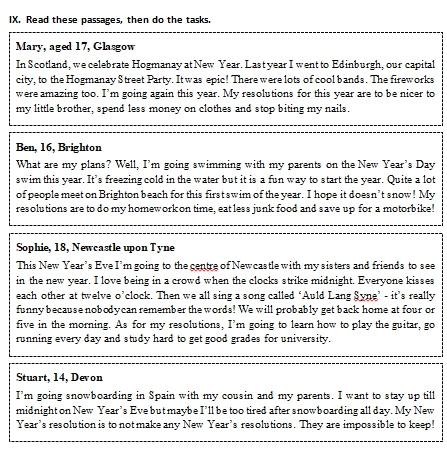
A. Fill in the gap with the correct names.
1. ______________ is going to a street party in Scotland.
2. ______________ is going to sing on New Year’s Eve.
3. ______________ will be in a foreign country on New Year’s Eve.
4. ______________ isn’t going to make any New Year’s resolutions.
5. ______________ wants to learn to play a musical instrument.
6. ______________ wants to have a healthier diet.
B. Decide if the statements are true (T) or false (F).
1. New Year’s resolutions often involve health and money.
2. People usually celebrate Hogmanay at New Year in England.
3. There are no fireworks for Hogmanay.
4. It’s traditional to go swimming in Brighton on New Year’s Eve.
5. People sing a song called ‘Auld Lang Syne’ at midnight on New Year’s Eve.
6. Most British people know all the words to ‘Auld Lang Syne’.
A. Fill in the gap with the correct names.1. ______________ is going to a street party in Scotland.2. ______________ is going to sing on New Year’s Eve.3. ______________ will be in a foreign country on New Year’s Eve.4. ______________ isn’t going to make any New Year’s resolutions.5. ______________ wants to learn to play a musical instrument.6. ______________ wants to have a healthier diet.B. Decide if the statements are true (T) or false (F).1. New Year’s resolutions often involve...
Đọc tiếp
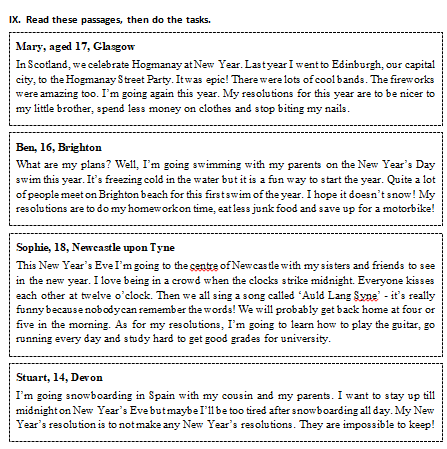
A. Fill in the gap with the correct names.
1. ______________ is going to a street party in Scotland.
2. ______________ is going to sing on New Year’s Eve.
3. ______________ will be in a foreign country on New Year’s Eve.
4. ______________ isn’t going to make any New Year’s resolutions.
5. ______________ wants to learn to play a musical instrument.
6. ______________ wants to have a healthier diet.
B. Decide if the statements are true (T) or false (F).
1. New Year’s resolutions often involve health and money.
2. People usually celebrate Hogmanay at New Year in England.
3. There are no fireworks for Hogmanay.
4. It’s traditional to go swimming in Brighton on New Year’s Eve.
5. People sing a song called ‘Auld Lang Syne’ at midnight on New Year’s Eve.
6. Most British people know all the words to ‘Auld Lang Syne’.
A. Fill in the gap with the correct names.1. ______________ is going to a street party in Scotland.2. ______________ is going to sing on New Year’s Eve.3. ______________ will be in a foreign country on New Year’s Eve.4. ______________ isn’t going to make any New Year’s resolutions.5. ______________ wants to learn to play a musical instrument.6. ______________ wants to have a healthier diet.B. Decide if the statements are true (T) or false (F).1. New Year’s resolutions often involve...
Đọc tiếp
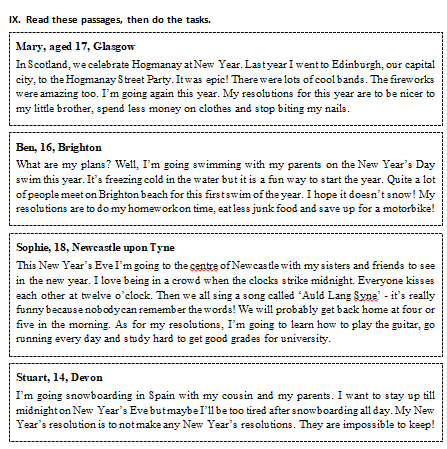
A. Fill in the gap with the correct names.
1. ______________ is going to a street party in Scotland.
2. ______________ is going to sing on New Year’s Eve.
3. ______________ will be in a foreign country on New Year’s Eve.
4. ______________ isn’t going to make any New Year’s resolutions.
5. ______________ wants to learn to play a musical instrument.
6. ______________ wants to have a healthier diet.
B. Decide if the statements are true (T) or false (F).
1. New Year’s resolutions often involve health and money.
2. People usually celebrate Hogmanay at New Year in England.
3. There are no fireworks for Hogmanay.
4. It’s traditional to go swimming in Brighton on New Year’s Eve.
5. People sing a song called ‘Auld Lang Syne’ at midnight on New Year’s Eve.
6. Most British people know all the words to ‘Auld Lang Syne’
A. Fill in the gap with the correct names.1. ______________ is going to a street party in Scotland.2. ______________ is going to sing on New Year’s Eve.3. ______________ will be in a foreign country on New Year’s Eve.4. ______________ isn’t going to make any New Year’s resolutions.5. ______________ wants to learn to play a musical instrument.6. ______________ wants to have a healthier diet.B. Decide if the statements are true (T) or false (F).1. New Year’s resolutions often involve...
Đọc tiếp
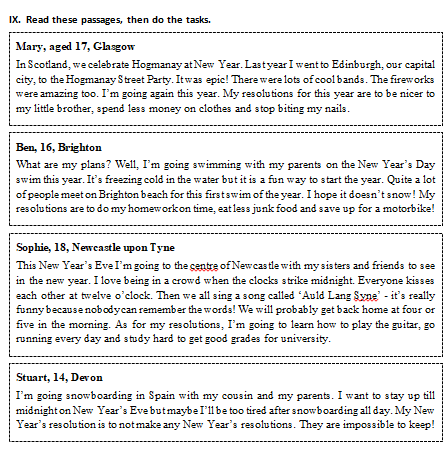
A. Fill in the gap with the correct names.
1. ______________ is going to a street party in Scotland.
2. ______________ is going to sing on New Year’s Eve.
3. ______________ will be in a foreign country on New Year’s Eve.
4. ______________ isn’t going to make any New Year’s resolutions.
5. ______________ wants to learn to play a musical instrument.
6. ______________ wants to have a healthier diet.
B. Decide if the statements are true (T) or false (F).
1. New Year’s resolutions often involve health and money.
2. People usually celebrate Hogmanay at New Year in England.
3. There are no fireworks for Hogmanay.
4. It’s traditional to go swimming in Brighton on New Year’s Eve.
5. People sing a song called ‘Auld Lang Syne’ at midnight on New Year’s Eve.
6. Most British people know all the words to ‘Auld Lang Syne’.