Work in pairs. Discuss what future cities should have so that city dwellers can live a long and healthy life. Fill in the diagram.
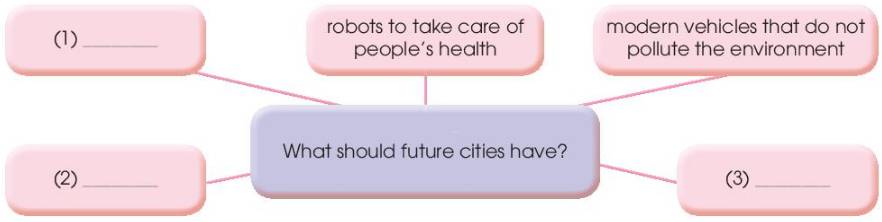

Work in pairs. Discuss what future cities should have so that city dwellers can live a long and healthy life. Fill in the diagram.

(1) - green spaces and parks
(2) - sustainable transportation
(3) - smart healthcare systems
Read the following passage and mark the letter A, B, C, or D on your answer sheet to indicate the correct answer to each of the questions
Unlike these fish, which are actually extinct, the coelacanth is a type of fish that was believed to be extinct. However, an unexpected twentieth- century rediscovery of living coelacanths has brought about a reassessment of the status of the prehistoric sea creature that was believed to have long since disappeared from the Earth. From fossil remains of the coelacanth, paleontologists have determined that the coelacanth was in existence around 350 million years ago, during the Paleozoic Era, more than 100 million years before the first dinosaurs arrived on the Earth. The most recent fossilized coelacanths date from around 70 million years ago, near the end of the age of dinosaurs. Because no fossilized remnants of coelacanth was believed to have died out around the same time as the dinosaurs.
The prehistoric coelacanth studied by paleontologists had distinctive characteristics that differentiated it from other fish. It was named for its hollow spine and was known to have been a powerful carnivore because of its many sharp teeth and a special joint in the skull that allowed the ferocious teeth to move in coordination with the lower jaw. It also had a pair of fins with unusual bony and muscular development that allowed the coelacanth to dart around the ocean floor. These fins also enable the coelacanth to search out prey trying to hide on the ocean bottom.
In 1938, a living specimen of the coelacanth was discovered in the catch of a fishing boat off the coast of South Africa, and since then numerous other examples of the coelacanth have been found in the waters of the Indian Ocean. This modern version of the coelacanth is not exactly the same as its prehistoric cousin. Today's coelacanth is larger than its prehistoric relative, measuring up to six feet in length and weighing up to 150 pounds. However, the modern version of the coelacanth still possesses the characteristic hollow spine and distinctive fins with their unusual bony and muscular structure.
What is stated in the passage about the prehistoric coelacanth?
A. It had few teeth.
B. It was a rather feeble fish.
C. It lived on plants.
D. It moved its teeth in an unusual way.
D
Kiến thức: Đọc hiểu
Giải thích:
Điều gì được nêu trong đoạn văn về cá vây tay thời tiền sử?
A. Có ít răng. B. Là một loài cá khá yếu.
C. Nó sống trên cây. D. Nó chuyển động răng của nó theo một cách khác thường.
Thông tin: It was named for its hollow spine and was known to have been a powerful carnivore because of its many sharp teeth and a special joint in the skull that allowed the ferocious teeth to move in coordination with the lower jaw.
Read the following passage and mark the letter A, B, C, or D on your answer sheet to indicate the correct answer to each of the questions
Unlike these fish, which are actually extinct, the coelacanth is a type of fish that was believed to be extinct. However, an unexpected twentieth- century rediscovery of living coelacanths has brought about a reassessment of the status of the prehistoric sea creature that was believed to have long since disappeared from the Earth. From fossil remains of the coelacanth, paleontologists have determined that the coelacanth was in existence around 350 million years ago, during the Paleozoic Era, more than 100 million years before the first dinosaurs arrived on the Earth. The most recent fossilized coelacanths date from around 70 million years ago, near the end of the age of dinosaurs. Because no fossilized remnants of coelacanth was believed to have died out around the same time as the dinosaurs.
The prehistoric coelacanth studied by paleontologists had distinctive characteristics that differentiated it from other fish. It was named for its hollow spine and was known to have been a powerful carnivore because of its many sharp teeth and a special joint in the skull that allowed the ferocious teeth to move in coordination with the lower jaw. It also had a pair of fins with unusual bony and muscular development that allowed the coelacanth to dart around the ocean floor. These fins also enable the coelacanth to search out prey trying to hide on the ocean bottom.
In 1938, a living specimen of the coelacanth was discovered in the catch of a fishing boat off the coast of South Africa, and since then numerous other examples of the coelacanth have been found in the waters of the Indian Ocean. This modern version of the coelacanth is not exactly the same as its prehistoric cousin. Today's coelacanth is larger than its prehistoric relative, measuring up to six feet in length and weighing up to 150 pounds. However, the modern version of the coelacanth still possesses the characteristic hollow spine and distinctive fins with their unusual bony and muscular structure.
The pronoun “It” in the third paragraph refers to
A. coordination
B. coelacanth
C. joint
D. jaw
B
Kiến thức: Đọc hiểu
Giải thích:
Đại từ "Nó" ở đoạn thứ ba đề cập đến
A. phối hợp B. cá vây tay
C. khớp D. hàm
“It” đề cập đến cá vây tay: The prehistoric coelacanth studied by paleontologists had distinctive characteristics that differentiated it from other fish. […] It also had a pair of fins with unusual bony and muscular development that allowed the coelacanth to dart around the ocean floor.
Cá vây tay tiền sử được các nhà cổ sinh vật học nghiên cứu có đặc điểm phân biệt với các loài cá khác. […] Nó cũng có một đôi vây với sự phát triển xương và cơ bắp bất thường cho phép cá vây tay lặn xuống đáy đại dương.
Read the following passage and mark the letter A, B, C, or D on your answer sheet to indicate the correct answer to each of the questions
Unlike these fish, which are actually extinct, the coelacanth is a type of fish that was believed to be extinct. However, an unexpected twentieth- century rediscovery of living coelacanths has brought about a reassessment of the status of the prehistoric sea creature that was believed to have long since disappeared from the Earth. From fossil remains of the coelacanth, paleontologists have determined that the coelacanth was in existence around 350 million years ago, during the Paleozoic Era, more than 100 million years before the first dinosaurs arrived on the Earth. The most recent fossilized coelacanths date from around 70 million years ago, near the end of the age of dinosaurs. Because no fossilized remnants of coelacanth was believed to have died out around the same time as the dinosaurs.
The prehistoric coelacanth studied by paleontologists had distinctive characteristics that differentiated it from other fish. It was named for its hollow spine and was known to have been a powerful carnivore because of its many sharp teeth and a special joint in the skull that allowed the ferocious teeth to move in coordination with the lower jaw. It also had a pair of fins with unusual bony and muscular development that allowed the coelacanth to dart around the ocean floor. These fins also enable the coelacanth to search out prey trying to hide on the ocean bottom.
In 1938, a living specimen of the coelacanth was discovered in the catch of a fishing boat off the coast of South Africa, and since then numerous other examples of the coelacanth have been found in the waters of the Indian Ocean. This modern version of the coelacanth is not exactly the same as its prehistoric cousin. Today's coelacanth is larger than its prehistoric relative, measuring up to six feet in length and weighing up to 150 pounds. However, the modern version of the coelacanth still possesses the characteristic hollow spine and distinctive fins with their unusual bony and muscular structure.
According to the passage, why are scientists sure that the prehistoric coelacanth was a flesh-eater?
A. Because of its hollow spine
B. Because of its unusual bony and muscular development
C. Because of the shape and movement of the teeth
D. Because of the size of the skull
C
Kiến thức: Đọc hiểu
Giải thích:
Theo đoạn văn, tại sao các nhà khoa học chắc chắn rằng cá vây tay tiền sử là một loài ăn thịt?
A. Do cột sống rỗng của nó
B. Do sự phát triển xương và cơ bất thường của nó
C. Do hình dạng và chuyển động của răng
D. Do kích thước của hộp sọ
Thông tin: It was named for its hollow spine and was known to have been a powerful carnivore because of its many sharp teeth and a special joint in the skull that allowed the ferocious teeth to move in coordination with the lower jaw.
Read the following passage and mark the letter A, B, C, or D on your answer sheet to indicate the correct answer to each of the questions
Unlike these fish, which are actually extinct, the coelacanth is a type of fish that was believed to be extinct. However, an unexpected twentieth- century rediscovery of living coelacanths has brought about a reassessment of the status of the prehistoric sea creature that was believed to have long since disappeared from the Earth. From fossil remains of the coelacanth, paleontologists have determined that the coelacanth was in existence around 350 million years ago, during the Paleozoic Era, more than 100 million years before the first dinosaurs arrived on the Earth. The most recent fossilized coelacanths date from around 70 million years ago, near the end of the age of dinosaurs. Because no fossilized remnants of coelacanth was believed to have died out around the same time as the dinosaurs.
The prehistoric coelacanth studied by paleontologists had distinctive characteristics that differentiated it from other fish. It was named for its hollow spine and was known to have been a powerful carnivore because of its many sharp teeth and a special joint in the skull that allowed the ferocious teeth to move in coordination with the lower jaw. It also had a pair of fins with unusual bony and muscular development that allowed the coelacanth to dart around the ocean floor. These fins also enable the coelacanth to search out prey trying to hide on the ocean bottom.
In 1938, a living specimen of the coelacanth was discovered in the catch of a fishing boat off the coast of South Africa, and since then numerous other examples of the coelacanth have been found in the waters of the Indian Ocean. This modern version of the coelacanth is not exactly the same as its prehistoric cousin. Today's coelacanth is larger than its prehistoric relative, measuring up to six feet in length and weighing up to 150 pounds. However, the modern version of the coelacanth still possesses the characteristic hollow spine and distinctive fins with their unusual bony and muscular structure.
This passage is about a fish
A. that is extinct
B. that once was extinct
C. that is becoming extinct
D. that is not extinct
D
Kiến thức: Đọc hiểu
Giải thích:
Đoạn này nói về một con cá
A. hiện đã tuyệt chủng B. đã từng bị tuyệt chủng
C. đang trở nên bị tuyệt chủng D. không bị tuyệt chủng
Thông tin: Unlike these fish, which are actually extinct, the coelacanth is a type of fish that was believed to be extinct. However, an unexpected twentieth- century rediscovery of living coelacanths has brought about a reassessment of the status of the prehistoric sea creature that was believed to have long since disappeared from the Earth.
Read the following passage and mark the letter A, B, C, or D on your answer sheet to indicate the correct answer to each of the questions
Unlike these fish, which are actually extinct, the coelacanth is a type of fish that was believed to be extinct. However, an unexpected twentieth- century rediscovery of living coelacanths has brought about a reassessment of the status of the prehistoric sea creature that was believed to have long since disappeared from the Earth. From fossil remains of the coelacanth, paleontologists have determined that the coelacanth was in existence around 350 million years ago, during the Paleozoic Era, more than 100 million years before the first dinosaurs arrived on the Earth. The most recent fossilized coelacanths date from around 70 million years ago, near the end of the age of dinosaurs. Because no fossilized remnants of coelacanth was believed to have died out around the same time as the dinosaurs.
The prehistoric coelacanth studied by paleontologists had distinctive characteristics that differentiated it from other fish. It was named for its hollow spine and was known to have been a powerful carnivore because of its many sharp teeth and a special joint in the skull that allowed the ferocious teeth to move in coordination with the lower jaw. It also had a pair of fins with unusual bony and muscular development that allowed the coelacanth to dart around the ocean floor. These fins also enable the coelacanth to search out prey trying to hide on the ocean bottom.
In 1938, a living specimen of the coelacanth was discovered in the catch of a fishing boat off the coast of South Africa, and since then numerous other examples of the coelacanth have been found in the waters of the Indian Ocean. This modern version of the coelacanth is not exactly the same as its prehistoric cousin. Today's coelacanth is larger than its prehistoric relative, measuring up to six feet in length and weighing up to 150 pounds. However, the modern version of the coelacanth still possesses the characteristic hollow spine and distinctive fins with their unusual bony and muscular structure.
It can be inferred from the passage that the word “coelacanth” comes from the Greek
A. sharp teeth
B. extinct fish
C. hollow spine
D. bony fingers
C
Kiến thức: Đọc hiểu
Giải thích:
Có thể suy luận từ đoạn văn rằng từ "coelacanth" xuất phát từ tiếng Hy Lạp
A. răng sắc bén B. cá đã tuyệt chủng
C. cột sống rỗng D. ngón tay xương xẩu
Thông tin: The prehistoric coelacanth studied by paleontologists had distinctive characteristics that differentiated it from other fish. It was named for its hollow spine
Read the following passage and mark the letter A, B, C, or D on your answer sheet to indicate the correct answer to each of the questions
Unlike these fish, which are actually extinct, the coelacanth is a type of fish that was believed to be extinct. However, an unexpected twentieth- century rediscovery of living coelacanths has brought about a reassessment of the status of the prehistoric sea creature that was believed to have long since disappeared from the Earth. From fossil remains of the coelacanth, paleontologists have determined that the coelacanth was in existence around 350 million years ago, during the Paleozoic Era, more than 100 million years before the first dinosaurs arrived on the Earth. The most recent fossilized coelacanths date from around 70 million years ago, near the end of the age of dinosaurs. Because no fossilized remnants of coelacanth was believed to have died out around the same time as the dinosaurs.
The prehistoric coelacanth studied by paleontologists had distinctive characteristics that differentiated it from other fish. It was named for its hollow spine and was known to have been a powerful carnivore because of its many sharp teeth and a special joint in the skull that allowed the ferocious teeth to move in coordination with the lower jaw. It also had a pair of fins with unusual bony and muscular development that allowed the coelacanth to dart around the ocean floor. These fins also enable the coelacanth to search out prey trying to hide on the ocean bottom.
In 1938, a living specimen of the coelacanth was discovered in the catch of a fishing boat off the coast of South Africa, and since then numerous other examples of the coelacanth have been found in the waters of the Indian Ocean. This modern version of the coelacanth is not exactly the same as its prehistoric cousin. Today's coelacanth is larger than its prehistoric relative, measuring up to six feet in length and weighing up to 150 pounds. However, the modern version of the coelacanth still possesses the characteristic hollow spine and distinctive fins with their unusual bony and muscular structure.
It can be inferred from the passage that the first dinosaurs most likely appeared on Earth around
A. 450 million years ago
B. 350 million years ago
C. 150 million years ago
D. 250 million years ago
D
Kiến thức: Đọc hiểu
Giải thích:
Có thể suy luận từ đoạn văn rằng những con khủng long đầu tiên có thể xuất hiện trên trái đất khoảng
A. 450 triệu năm trước B. 350 triệu năm trước
C. 150 triệu năm trước D. 250 triệu năm trước
Thông tin: From fossil remains of the coelacanth, paleontologists have determined that the coelacanth was in existence around 350 million years ago, during the Paleozoic Era, more than 100 million years before the first dinosaurs arrived on the Earth.
Read the following passage and mark the letter A, B, C, or D on your answer sheet to indicate the correct answer to each of the questions
Unlike these fish, which are actually extinct, the coelacanth is a type of fish that was believed to be extinct. However, an unexpected twentieth- century rediscovery of living coelacanths has brought about a reassessment of the status of the prehistoric sea creature that was believed to have long since disappeared from the Earth. From fossil remains of the coelacanth, paleontologists have determined that the coelacanth was in existence around 350 million years ago, during the Paleozoic Era, more than 100 million years before the first dinosaurs arrived on the Earth. The most recent fossilized coelacanths date from around 70 million years ago, near the end of the age of dinosaurs. Because no fossilized remnants of coelacanth was believed to have died out around the same time as the dinosaurs.
The prehistoric coelacanth studied by paleontologists had distinctive characteristics that differentiated it from other fish. It was named for its hollow spine and was known to have been a powerful carnivore because of its many sharp teeth and a special joint in the skull that allowed the ferocious teeth to move in coordination with the lower jaw. It also had a pair of fins with unusual bony and muscular development that allowed the coelacanth to dart around the ocean floor. These fins also enable the coelacanth to search out prey trying to hide on the ocean bottom.
In 1938, a living specimen of the coelacanth was discovered in the catch of a fishing boat off the coast of South Africa, and since then numerous other examples of the coelacanth have been found in the waters of the Indian Ocean. This modern version of the coelacanth is not exactly the same as its prehistoric cousin. Today's coelacanth is larger than its prehistoric relative, measuring up to six feet in length and weighing up to 150 pounds. However, the modern version of the coelacanth still possesses the characteristic hollow spine and distinctive fins with their unusual bony and muscular structure.
What is NOT true about the prehistoric coelacanth, according to the passage ?
A. It was smaller than the modern coelacanth.
B. It had a hollow pine and distinctive fins.
C. It weighed less than 150 pounds.
D. It measured as much as six feet in length.
D
Kiến thức: Đọc hiểu
Giải thích:
Điều gì là không đúng sự thật về cá vây tay tiền sử, theo đoạn văn?
A. Nó nhỏ hơn so với cá vây tay hiện đại. B. Nó có cột sống rỗng và vây khác thường.
C. Nó nặng chưa đầy 150 pound. D. Nó dài khoảng 6 feet.
Thông tin:
- Today's coelacanth is larger than its prehistoric relative, measuring up to six feet in length and weighing up to 150 pounds.
- However, the modern version of the coelacanth still possesses the characteristic hollow spine and distinctive fins with their unusual bony and muscular structure.
Read the following passage and mark the letter A, B, C, or D on your answer sheet to indicate the correct answer to each of the questions
Unlike these fish, which are actually extinct, the coelacanth is a type of fish that was believed to be extinct. However, an unexpected twentieth- century rediscovery of living coelacanths has brought about a reassessment of the status of the prehistoric sea creature that was believed to have long since disappeared from the Earth. From fossil remains of the coelacanth, paleontologists have determined that the coelacanth was in existence around 350 million years ago, during the Paleozoic Era, more than 100 million years before the first dinosaurs arrived on the Earth. The most recent fossilized coelacanths date from around 70 million years ago, near the end of the age of dinosaurs. Because no fossilized remnants of coelacanth was believed to have died out around the same time as the dinosaurs.
The prehistoric coelacanth studied by paleontologists had distinctive characteristics that differentiated it from other fish. It was named for its hollow spine and was known to have been a powerful carnivore because of its many sharp teeth and a special joint in the skull that allowed the ferocious teeth to move in coordination with the lower jaw. It also had a pair of fins with unusual bony and muscular development that allowed the coelacanth to dart around the ocean floor. These fins also enable the coelacanth to search out prey trying to hide on the ocean bottom.
In 1938, a living specimen of the coelacanth was discovered in the catch of a fishing boat off the coast of South Africa, and since then numerous other examples of the coelacanth have been found in the waters of the Indian Ocean. This modern version of the coelacanth is not exactly the same as its prehistoric cousin. Today's coelacanth is larger than its prehistoric relative, measuring up to six feet in length and weighing up to 150 pounds. However, the modern version of the coelacanth still possesses the characteristic hollow spine and distinctive fins with their unusual bony and muscular structure.
The topic of the preceding paragraph is most likely
A. the discovery of the coelacanth
B. a reassessment of the status of a number of kinds of fish
C. a particular prehistoric sea creature
D. various extinct fish
D
Kiến thức: Đọc hiểu
Giải thích:
Chủ đề của đoạn trước rất có thể là
A. sự khám phá cá vây tay B. đánh giá lại tình trạng của một số loại cá
C. một sinh vật biển thời tiền sử đặc biệt D. các loài cá tuyệt chủng khác nhau
Bởi ở đầu bài viết này có nhắc đến “these fish, which are actually extinct” nên đoạn trước có thể nói về các loài cá đã tuyệt chủng
Dịch bài đọc:
Không giống như những loài cá này thực sự đã tuyệt chủng, cá vây tay là một loại cá được cho là đã tuyệt chủng. Tuy nhiên, một khám phá lạ lùng trong thế kỷ hai mươi về cá vây tay sống đã mang đến một đánh giá về trạng thái của sinh vật biển tiền sử được cho là từ lâu đã biến mất khỏi Trái Đất.
Từ các hóa thạch còn lại của cá vây tay, các nhà cổ sinh vật học đã xác định rằng cá vây tay đã tồn tại khoảng 350 triệu năm trước, trong kỷ nguyên Paleozoi, hơn 100 triệu năm trước khi những con khủng long đầu tiên xuất hiện trên trái đất. Các loài cá vây tay hoá thạch gần đây nhất được cho là từ khoảng 70 triệu năm trước, gần cuối thời kỳ khủng long. Bởi vì không có hóa thạch còn sót lại của cá vây tay được cho là đã chết trong khoảng thời gian giống như khủng long.
Cá vây tay tiền sử được các nhà cổ sinh vật học nghiên cứu có đặc điểm phân biệt với các loài cá khác. Nó được đặt tên bởi cột sống rỗng của nó và được biết đến là một động vật ăn thịt mạnh bởi nhiều răng sắc và một khớp đặc biệt trong hộp sọ cho phép răng khoẻ mạnh chuyển động cùng với hàm dưới. Nó cũng có một đôi vây với sự phát triển xương và cơ bắp bất thường cho phép cá vây tay lặn xuống đáy đại dương. Những vây này cũng cho phép cá vây tay tìm ra con mồi cố gắng trốn trên đáy đại dương.
Năm 1938, một mẫu vật sống của cá vây tay đã được tìm thấy trong một chiếc thuyền đánh bắt ngoài khơi Nam Phi, và kể từ đó nhiều ví dụ khác của cá vây tay đã được tìm thấy ở vùng biển Ấn Độ Dương. Phiên bản hiện đại của cá vây tay không hoàn toàn giống với thời tiền sử của nó. Cá vây tay ngày nay lớn hơn so với tiền sử của nó, có chiều dài lên đến 6 feet và nặng đến 150 pound. Tuy nhiên, phiên bản hiện đại của cá vây tay vẫn có cột sống rỗng đặc trưng và các vây đặc biệt với cấu trúc xương và cơ bất thường của chúng.
Fill each gap in the passage with a suitable word. Write your answers in the spaces that follow. (10 pts)
Cities have a long history. There were cities in Asia and Africa seven thousand years __(1)__, and some cities in Europe __(2)__ histories of two thousand years. However, only a __(3)__ cities in America are more than two hundred years old. Most ancient cities began __(4)__ centers of trade. People have always __(5)__ cities on rivers, lakes, or oceans. At that time most transportation __(6)__ to be by boat and ship, so more trade was possible in cities near good __(7)__ transportation. Newer cities are near __(8)__ or highways for the same reason. Some inland cities are not near waterways, and they have grown mostly since airplanes made them __(9)__ to reach. In modern times cities have grown very __(10)__ in places where there are large industries.
1 ago
2 had
3 few
4 with
5 located
6 used
7 public
8 harbour
9 easier
10 quickly
1. ago
2. had
3. few
4. with
5. located
6. used
7. public
8. harbour
9. easier
10. quickly